Category Archives: People

Mitcham Council gained more control over milk from 1922

From the Mitcham Urban District Council minutes, volume VIII, 1922-23, pages 195-6, meeting of the Public Health and Burials Committee, on 12 September 1922:

11. MILK AND DAIRIES (AMENDMENT) Act, 1922

The Clerk submitted the following report re the Milk and Dairies (Amendment) Act, 1922:

To the Chairman and Members of the Public Health Committee, Mrs. Hallowes and Gentlemen:

MILK AND DAIRIES (AMENDMENT) ACT, 1922.

The provisions of the above Act came into operation on the 1st September 1922, the Act being passed in order to strengthen the hands of Local Authorities in their efforts to protect the milk supply from contamination. Some of the sections of the Act refer to the adulteration of milk and the regulations as to imported milk, the administration of which are in the hands of the inspectors appointed by the County Council and with which the District Council are not primarily concerned.

The District Council are, however, directly concerned with the
administration of the Dairies, Cowsheds and Milkshops Order of 1885, which Order is amended by Section 2 of the new Act.

The Order in question requires the Council to keep a register of persons carrying on in the trade of cowkeepers, dairymen or purveyors of milk, and the Order gives gives the Council no power to refuse to register any person or remove him from the register. The Act of 1922 empowers the Local Authority to refuse to enter any person on the register or remove him from the register if satisfied that the public health is likely to be endangered by any act or default in relation in quality, storage or distribution of milk, provision being made
to remove the name of any person from the register and for appeal against the proposed removal.

I suggest that applications for registration should in future be presented to the Public Health Committee, accompanied by a recommendation from the Sanitary Inspector as to the advisability or otherwise of acceding to the application.

Yours obediently,
STEPHEN CHART,
Clerk to the Council.

It was Resolved, That the Report be received and the recommendation therein adopted.

Links
Registration of Dairies and Milk Shops in 1917
1934 Milk Licences


Minutes of meetings held by the Mitcham Urban District Council are available on request from the Merton Heritage and Local Studies Centre at Morden Library.
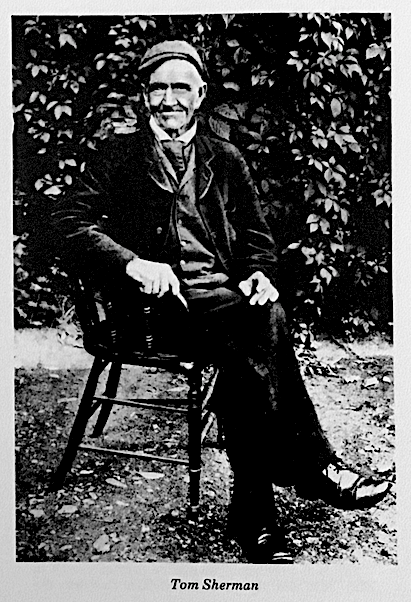
Tom Sherman, the fastest bowler of his time

Cricketer who made 82 appearances in first class matches in the 19th century.

Born in Mitcham on 1st December 1825, his father James Sherman was also a cricketer. He died 10th October 1911.

A letter dated 30th November was published in the The Sportsman of Thursday 1st December 1904:

TOM SHEARMAN.

Sir.,

I thought it would be of interest for you and others interested in cricket to know that Mr Tom Sherman attains his seventy-ninth birthday to-morrow. He is the oldest Surrey cricketer, and has the unique distinction of having played continuously for fifty years. His health haring quite failed him, and circumstances for this reason being anything but comfortable, I would be glad if something might be done to make his position a little more comfortable during the winter months. I feel quite sure that some of the older generation who knew him in his famous bowling days would willingly help him if they knew his position.

— Yours, etc.,
Arthur B. Wilkinson.
Studio,
Carlton-gardens,
Lower Green,
Mitcham, November 30.

Source: The British Newspaper Archive

His obituary was reported in the Croydon Guardian and Surrey County Gazette of Saturday 14th October 1911.

TOM SHERMAN DIES AT CROYDON.

A Famous Surrey Cricketer.

The Inquest.

The death of Tom Sherman, of Mitcham, who succumbed at Croydon Hospital, Tuesday, after breaking his leg at Mitcham, leaves William Caffyn the only survivor of a great band of professional cricketers who were in their prime nearly sixty years ago.

In “Scores and Biographies,” Sherman, who was born 1827, is described the as the fastest bowler of his time, and himself recalled the fact that in one of Surrey matches against Yorkshire at Sheffield he broke stump into five pieces. For this feat an admirer gave him a case of razors.

For the greater part of his long life, says “Unknown” in the “Morning Leader,” he lived at Mitcham, one of the famous nurseries of the game, and it was on the village common nine years ago that I last saw Sherman, on the occasion of his annual benefit. It may the vanity of old age to compare the present with the past to the disadvantage of the former, but I remember the wrinkled veteran as very emphatic in expressing an opinion that the bowling in his time was a great deal faster than that of modern days. In the matter of physical power, he believed that Alfred Mynn and himself were considerably ahead of latter-day bowlers when it came to question of pace. “This right knee,” he said, ” was put out as result of a scorching ball from Mynn. and it has never been right since.”

Sherman played for Surrey during eleven or twelve seasons with Julius Caesar, Caffyn, Lockyer, Martingell, and Mortlock. Sherman never bowled against Dr. W. G. Grace, but the man for whom he had the greatest respect as a bat was Fuller Pilch. Sherman dropped out of county cricket when his county were at their best, taking scarcely any part in the great things achieved by the Surrey team under Mr. F. P. Miller, who led the side to victory against All England in 1861. Appearing at Lords in 1846, Sherman met with most success in season the of 1850 and 1851, taking 99 wickets in the course of ten matches during two years. This was before bowling analyses were taken. Described as one of the fastest round-arm bowlers, he earned fame as a contemporary of Alfred Mynn, Fuller Pilch, George Parr, William Caffyn, Felix, and Martingeil. Two months older than Caffyn, Sherman was the oldest professional cricketer living.