Western Road County Secondary School consisted of two schools, one for boys on the upper floor, and girls on the ground floor. It became a high school in the late 1960s, and today it is a primary school, renamed Liberty, after the print works at Abbey Mills.
Timetables were organised such that the boys and girls never met each other. They also had separate playgrounds and the staff for the boys school were all men, for the girls school, all women.
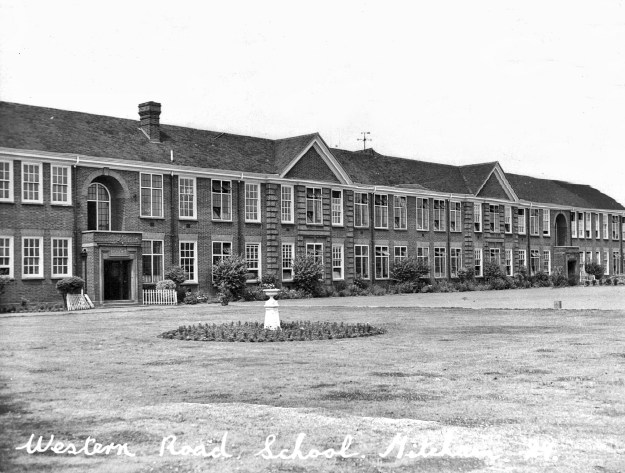
Date possibly 1954. The BOYS entrance can be seen on the left. From a private collection.
Originally one main building built by Surrey County Council in the 1930s, it may have been extended in the 1960s, as shown on these two OS maps. Refer also to the 1959 newspaper article below.

1934 OS map

Layout of sports ground and gardens from 1952 OS map
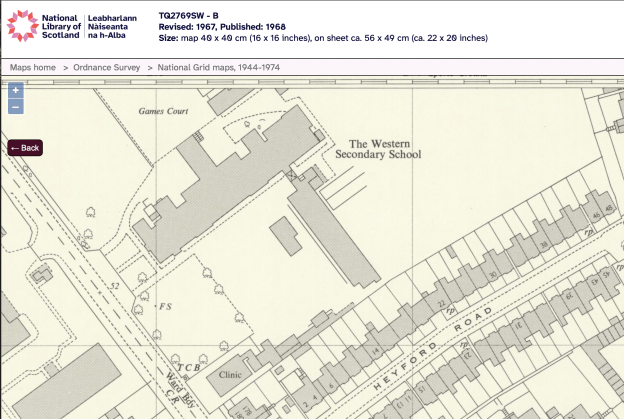
1967 OS map
School Keeper William Albert PILE lived at the School House from its opening to his death on 28th April 1939.
Newspaper articles
Streatham News – Friday 22 December 1961
Teenagers go climbing
Forty boys from Western Road School, Mitcham, travelled to Kent recently for a day’s rock climbing at Groombridge, near Tunbridge Wells. This was the second time the school had sent a group of boys climbing. On the first occasion they were instructed by Olympic steeplechase champion John Disley, deputy physical education officer for Surrey. The boys taking part in the latest climb were in the 14 to 15 age group. One of the teachers instructing them was Mr. K. Knapp, an American visiting England by an exchange scheme. Some of the boys hope to compete in the Duke of Edinburgh’s award scheme next year.
Norwood News – Friday 03 April 1959
New classrooms
Four transportable classrooms may be erected at Western Road County Secondary School, Mitcham, Ito help relieve the overcrowding problem.
Norwood News – Friday 07 November 1958
MITCHAM Boxing Club have solved their accommodation problem.
Recently they have been unsettled at their Western Road School, Mitcham, headquarters. because they were unable to use the punchbag and other equipment as the noise upset other people using the building. So president Jimmy Tring his arranged for the club to move into the old Parish Rooms at the Cricket Green. Mitcham’s young boxers begin training there on Tuesday night.
Sutton & Epsom Advertiser – Thursday 09 November 1950
QUESTIONS BY CHILDREN
Problem for parents and teachers Speaking at Western Road School Mitcham last week in the series “ Yourself Your Home and Your Family” arranged by the Mitcham Marriage Guidance Council Mr Alan Ingleby education secretary of the National Marriage Guidance Council dealt with a difficult problem how best to answer children’s questions.
Questions about sex should be answered truthfully and without any sense of furtiveness he said There need for co-operation between teachers and parents but parents must not evade their share of the problem and put the whole burden on the teachers Dealing with the troubles of the child of divorced parents Mr Ingleby said that he did not that there was any real way of helping except to find for the child a home in which there was a happy atmosphere and a feeling of security lively discussion in which Dr Mrs Evans and Coun Mrs Martin took part followed the lecture.
Streatham News 20th March 1936

PAYING THEIR TAXES!—But it is only a play. A scene from “Daylight Robbery,” as produced by boys of the Western-road School, Mitcham. (Streatham News 20th March 1936. Copyright holder unknown.)
Memories from pupils
I asked on the Mitcham History Facebook group for memories of the school, and here are the replies.
George was at the boys school between 1947 and 1949 and has kindly shared his school report for the term ended 31st March 1947. A scab is shown below, which is followed by the subjects and marks in text.

Note that the subjects on the report form was for both boys and girls, as the latter did needlework, handicraft and gardening. The school used a rubber stamp to show ‘Boys County Secondary School’ in this case.
Western Road Boys School 1947 Pupil Report
| Subject |
Exam Mark |
Term’s Work |
Remarks |
| Scripture |
|
|
|
| English |
26 |
39 |
Keen & works well. |
|
|
|
|
| History |
29 |
38 |
Fairly good |
| Geography |
24 |
32 |
Fair |
| Mathematics |
21 |
61 |
Disappointing in exam |
|
|
|
|
|
|
|
|
| French |
25 |
35 |
Has made steady progress |
| Science |
67% |
|
Good |
| Domestic Subjects |
|
|
|
| Needlework |
|
|
|
| Handicraft |
|
|
|
| Gardening |
|
|
|
| Drawing (Geometry) |
20 |
36 |
|
| Drawing |
|
|
|
| Physical Training |
|
|
Good. Tries hard. |
| Book-Keeping |
|
|
|
| Shorthand |
|
|
|
| Homework |
|
|
|
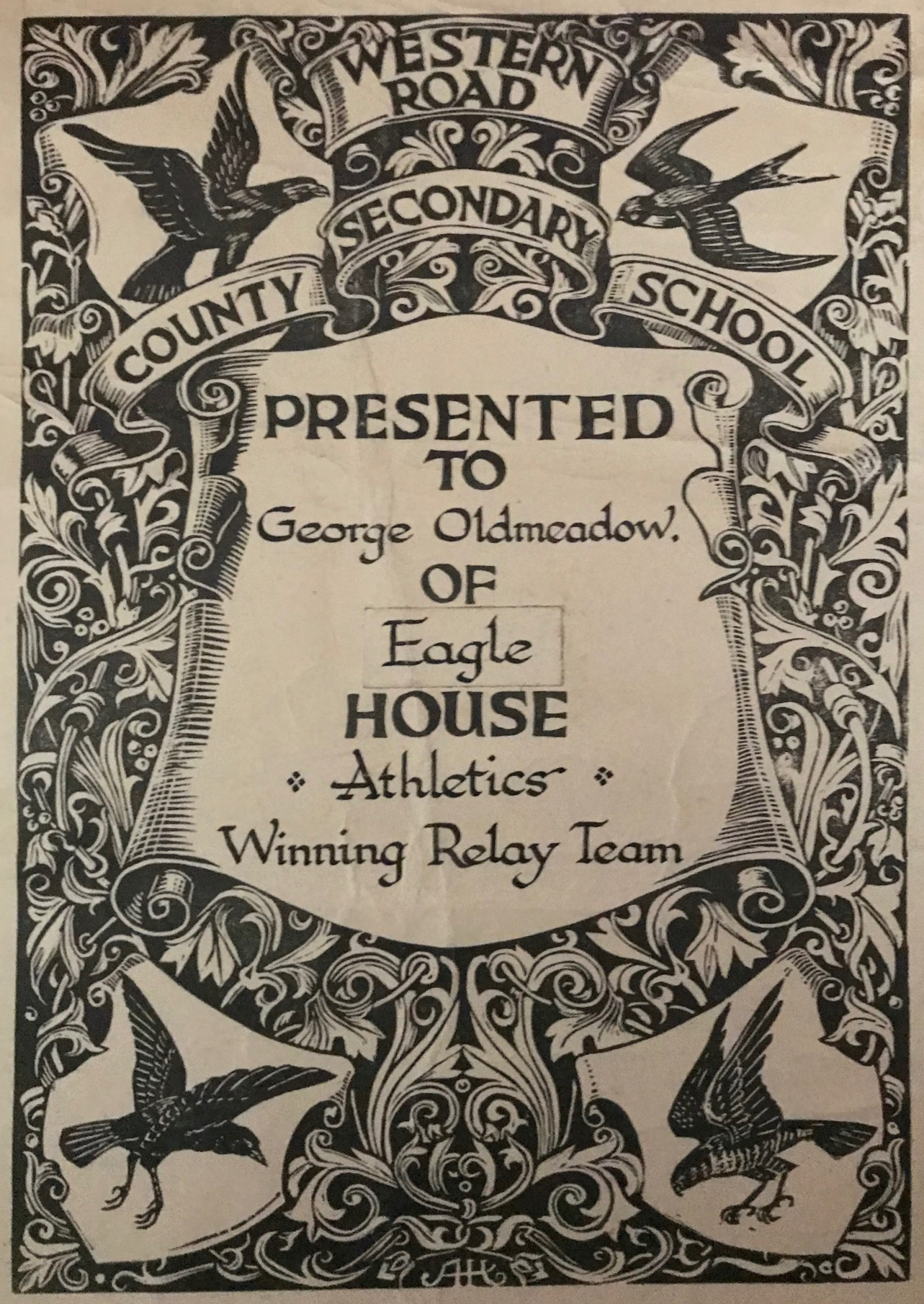
George has also provided his athletics certificate, which shows he was in ‘Eagle’ house. The boys school was divided into 4 houses. During the 1940s these were named Eagle, Hawk, Raven and Swift. In the 1950s these were changed to Graveney, Ravensbury and two others.

He remembers getting the cane from the headmaster Mr Deubert:
My memory of the boys playground from when I was there between 1947-49 was in the black area. I have vague memory of watching the girls playing on the other side of the building. If you got caught the punishment was having to spend a lesson with them on something like needlework or cooking.
However this was about 78 years ago but the memory seems reasonably clear. As does the memory of getting caught and suffering our headmaster’s idea of punishment.
His name was Mr. Deubert and once when he gave me the cane in error, his apology was to say “It won’t do you any harm”.
Dave remembers his time at the school:
I started in 1957 and left in 1961. Both entrances was used by the boys, you came out opposite the art room and room 6 was on the left and 7 was on the right at the top of the stairs when you used the door on the right. We had a garden, but it went when the extension was being built.
Chris recalls:
I started at Western Road in 1960 and were the garden was, is where the new technology wing was almost finished being built. The girls entered the school at the front near the road. We had a garden but it was at the very front of the school by 1960 it didn’t look like there was much gardening going on, certainly my class didn’t do any. Both my brother and sister were at the school in the fifties.
Toni remembered a haunted toilet!:
I was there in 1970, when it was the stupid 3-school system that Merton instigated. I was only there for a few years from Bond then off to Rowan. Miss Narge was the French teacher, I think Miss Ward was science, Mr Coward Maths. In the new block there was metalwork, woodwork, Art (with a very attractive art teacher, the boys loved her), sewing room and home economics. The P.E. teacher looked like Gorge Best.
And the haunted toilet no 5 behind the tennis courts.
Jackie remembered the art teacher was a Miss Duey, but wasn’t sure of the spelling of her surname. Derek Moore was the P.E. teacher, and her dad played cricket with him.
Peter said did he a bit of boxing there at night in the early sixties
Pat recalled that the health centre included a dentist:
I lived at the northern end of Mitcham so attended Gorringe Park infants and juniors 1945 to 1952 and then went to Links Road Senior girls. I loved it but the only connection that I had with Western Road school was the dreaded clinic there attending the dentist!
Lillian recalled that she:
went there left in 1955. Miss Norris was the head mistress. She caught me and my friends playing round the toilets she made us get buckets and cloths, marched us across the playground and made us wipe the seats where we stood on them. Happy days.
I recorded Sheila in 2022 when I asked her about her time at the school. She was there from 1960 to 1965 and remembers Miss Norris as the head mistress. Listen to her on this audio recording here.
Maps are reproduced with the permission of the National Library of Scotland.