Currently a restaurant.
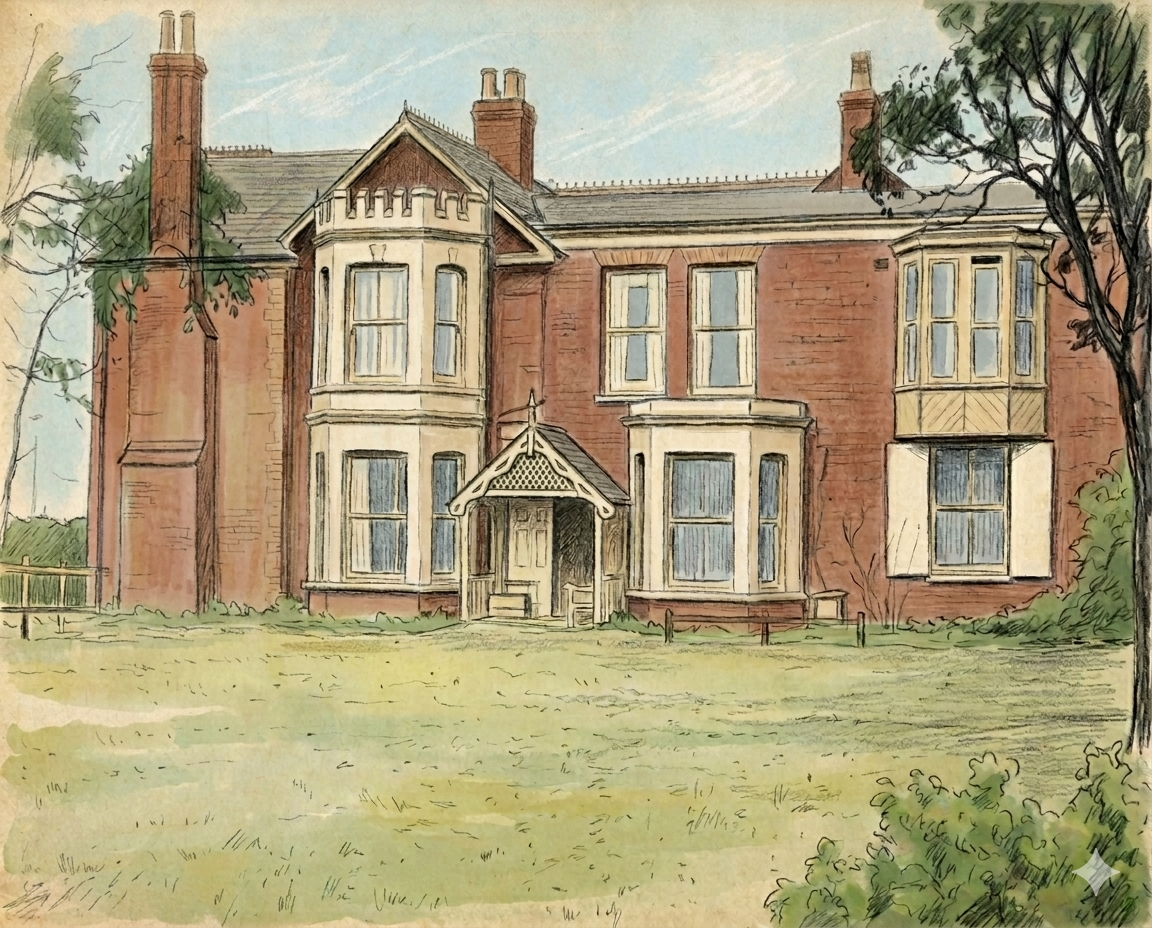
1950 sketch of Mill House by Gemini
Mitcham Advertiser – Thursday 12 January 1950
1950 sketch of Mill House by Gemini
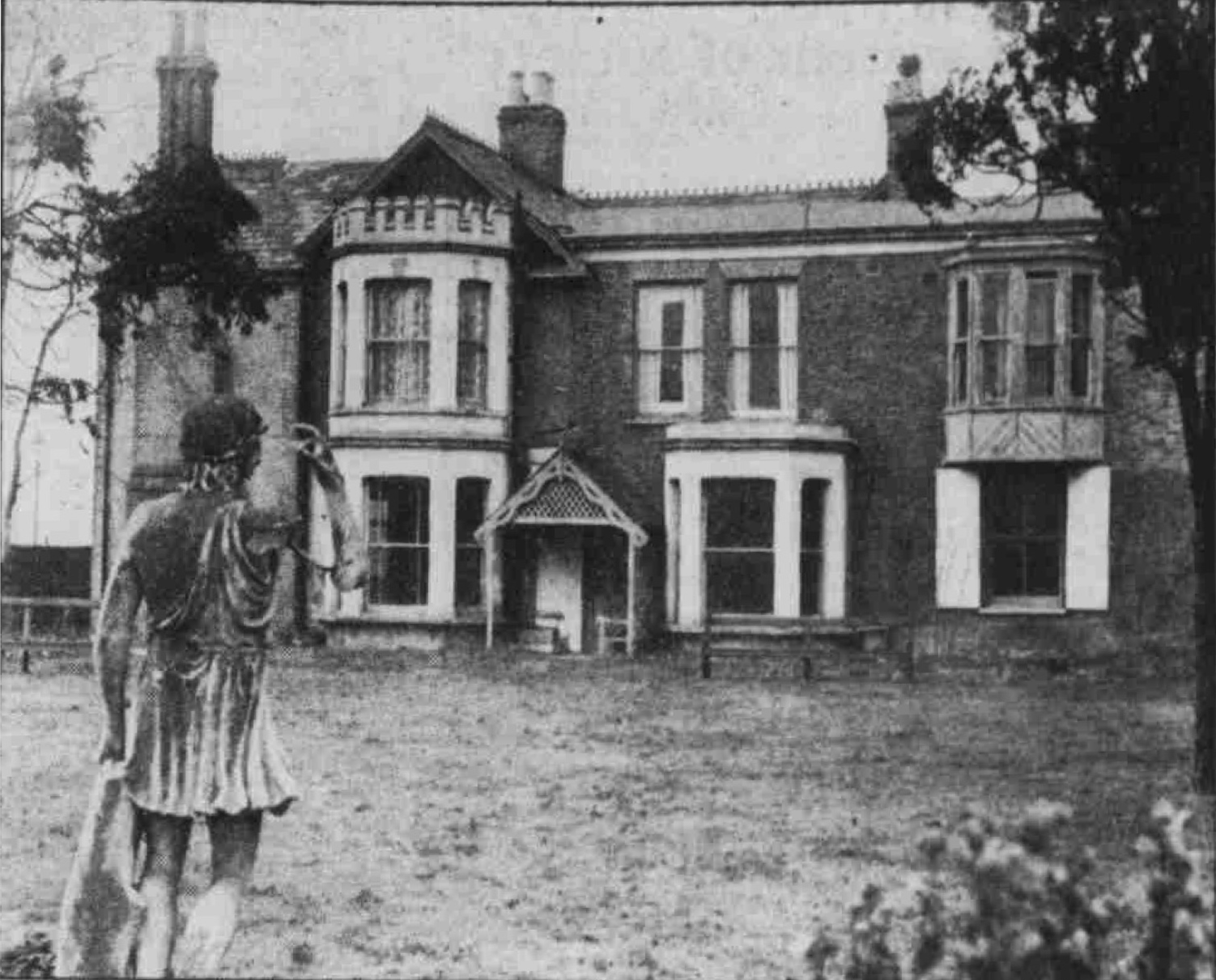
Mill House may be bought by Council
MILL HOUSE, which may be utilised by Mitcham Council to ‘accommodate local youth organisations, was an early Victorian mansion situated on a particularly bleak part of Mitcham Common near the Croydon boundary. It is of no particular historical interest, but stands on the site of the famous old wooden post windmill, which was demolished at the beginning of the ceatury. The round, red brick base of the mill still stands in the – garden of the house. Mitcham Council is, at present, negotiating with the Ministry of Health for permission to buy the property, which covers an area of slightly iess than an acre. During the period between the two wars, the house was used as a remand home for dllrla. and a laundry outbuilding was added. It is thought that this will provide a large hall, suitable for all club activities. The first floor of the house has been converted into three self-contained flats, Mr. Tom Francis, an authority on local history, told an “ Advertiser ” reporter that for centuries the windmill had been a picturesque landmark on the common, Permission to erect it was given by the Lords of the Manors, Biggin and Tamworth. Under the terms of the grant the miller had to grind the villagers’ corn on three dayvs a week for “ever and ever.” During a violent thunderstorm about 1862 the mill was struck by “a ball of fire ” that travelled across the common, and two of its four sails were destroyed. The mill was finally dismantled in 1906. Mr. Francis has a watercolour of the mill, painted in 1870 by Mr. George Haite, a Mitcham artist, who afterwards became a president of the Society of English Decorators. The present house, which was built for a wealthy family named Watson about 1860, is much larger than the original miller’s house. Its garden, although somewhat overgrown, is still attractive, and the Victorian stone statues and grotto that are a feature of it, if not to modern taste, have been agreeably softened in outline by wind and rain.
In the 1970 edition of the History of Mitcham Common, by Eric Montague:
In January 1936 Mill House was bought by the London Female Preventive and Reformatory Institution for the Holt-Yates Memorial Home for Girls’ and was occupied by them until evacuation was thought desirable at the outbreak of war in 1939.
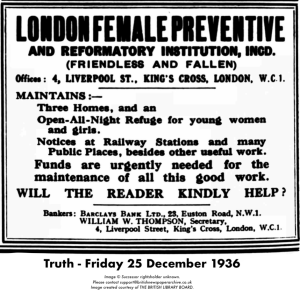
Female Preventive ad from 25th December 1936 in the Truth
Lloyd’s Weekly Newspaper – Sunday 15 April 1877
THE HOLT YATES MEMORIAL HOME.
The London Female Preventive end Reformatory institution was founded upon small beginnings 20 years ago. It now possesses seven establishments, which, in the various forms of night refuges, asylums, and reformatories, are busy in the prevention and cure of immorality in women and girls. The night refuges are open to all; but the asylums are devoted to females of good character who are-thrown friendless upon their own resources, end there is of course a wide distinction resources, end there is of course a wide distinction between them and the reformatories, which are avowedly for the recovery of the fallen. The inmates of the last are received at their own wish but have to submit to a mild restrictive treatment, and to fit them- selves by work for domestic service or otherwise, .accord- ing to their capacity. In return they find they have no difficulty in procuring respectable employment as soon as they have proved themselves reliable; and it speaks well for the usefulness of the institution that, so far as can be ascertained 75 per cent of the persons who have taken advantage of it have turned out satisfactorily. By the kindness of the late Dr. Holt Yates the houses and grounds occupied by the society at Parsons-green were, during his lifetime, let to it at a merely nominal rent, and, his widow sharing his sympathy, the whole property has now been handed over to the trustees at a price which makes it almost a gift, hence the new reformatory opened yesterday is called the “Holt Yates Memorial.” It is a substantial building, capable of accommodating 30 persons, who will not be much more contlned than in an ordinary dwelling-house; rangemente in this department, which embrace a wonder- the plurality of neat little beds in the upper rooms As the business of a laundry will be carried on, the ar an acre of ground. The ensemble was offered full drying chamber, are on a large scale, the washhouse extending far back ioto the gardens, which cover about an acre of ground. The ensemble was offered for the inspection of visitors yesterday; and a number of at half-pest three, when Sir Wm. Rose, K.C.B. (the chair- penitents themselves gave the rooms almost the appear- ance of a fancy fair. The business of the day commenced at half-pest three, when Sir Wm. Rose, K.C.B. (the chair- head of the meeting-room. After a prayer and a hymn Rev. Mr. Barnes, Messrs. G. Startin, A. O. Charles, H. G. Weakley, A. Madison, &c. took their seats at the head of the meeting-room. After a prayer and a hymn in which the large number of ladles and gentlemen present joined, the chairman introduces Mrs. Yates, who declared tion since its foundation, 7,OOv were domestic servants- a circumstance which elicited a strong appeal from Sir W. that of the 8,505 fallen women admitted to the institution since its foundation, 7,000 were domestic servants- the dismissels were only 815;and the rather smaill Rose for consideration and forbearance by employers. The re-admissions reached the large number of 1,880, but the dismissals were only 315; and the rather small number of 54 marriages had been recorded. The present ginning of the present year, so thlat the promlpt and cluding whet was earned by the women thermselves, ‘a £5,000; but there was only a balance of £441 at the be- ginning of the present year, so that the prompt and active support of the public is, in spite of the good re- sults already attained still needed. It is bardly neces- sary to point out that these good results should stimulate the well disposed.

