Frderick Rexstrew, was born 19 May 1914.
He married, aged 26, on 13th June 1940 to Gladys Ayling, 24, of 7 Ravensbury Cottages, Morden Road, Mitcham, at the parish church of Beddington. He was a soldier living at 47 Bute Gardens West in Beddington. His father, Henry Marshall Rexstrew, was deceased. Gladys Ayling’s father, Albert William Ayling, was a cowman. Source: Ancestry.com. Sutton, Surrey, England, Church of England Marriages and Banns, 1754-1940, London Borough of Sutton; Sutton, London, England; Reference Number: 2813/1/5.
The 1939 register shows Frederick Rexstrew as a Motor Driver, Baker’s Roundsman, and he lived with his mother Alice, housewife, and brother George R., born 29 Sept 1918, foreman stock keeper, munitions. Source: The National Archives; Kew, London, England; 1939 Register; Reference: RG 101/1318E
The 1939 register shows Gladys Ayling as working as a newsagent assistant, her mother Katie was listed as a housewife. Source: The National Archives; Kew, London, England; 1939 Register; Reference: RG 101/1374B
The Ravensbury Cottages were on a part of the road called Ravensbury Grove, which later was renamed Hatfeild Close, as shown in this 1953 OS map.
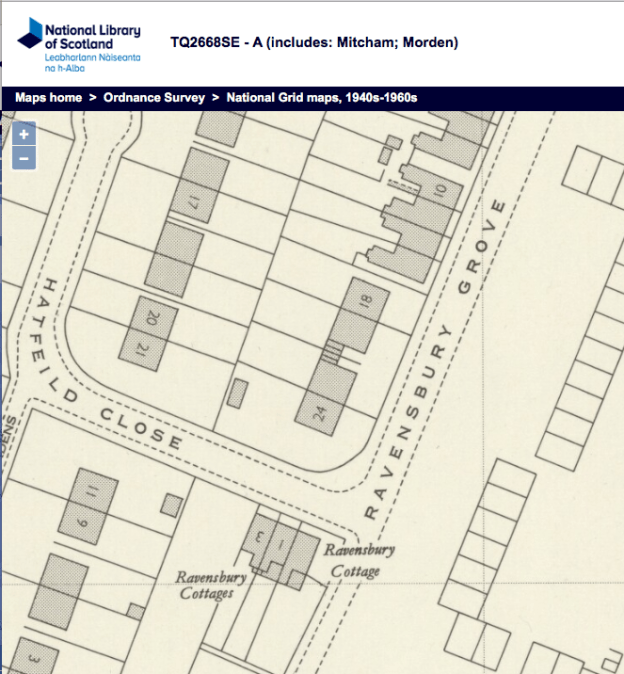
1953 OS map
Hatfeild Close was named after Gilliat Hatfeild, the owner of the nearby Morden Hall (house and gardens now owned by the National Trust).
Frederick Rexstrew was a Lance Corporal, service number 179420 with the 253 (Airborne) Composite Company Royal Army Service Corps.
He died on 20th September, 1944, and was re-interred at Arnhem Oosterbeek Cemetery, grave 29. C. 8. Source: Commonwealth War Grave Commission.
He was an air dispatcher on a Stirling IV LJ829 aircraft with RAF Squadron 190. All crewmembers were killed when the aircraft crashed in Doorwerth. Source : Harrington Museum – Aircraft lost on Allied Force’s Special Duty Operations & Associated Roll of Honour, page 382. Note that this pdf is 3 megabytes and has 583 pages.
A memorial to all the RAF crew and air despatchers like Frederick Rexstrew is in a side street in Doorwerth:
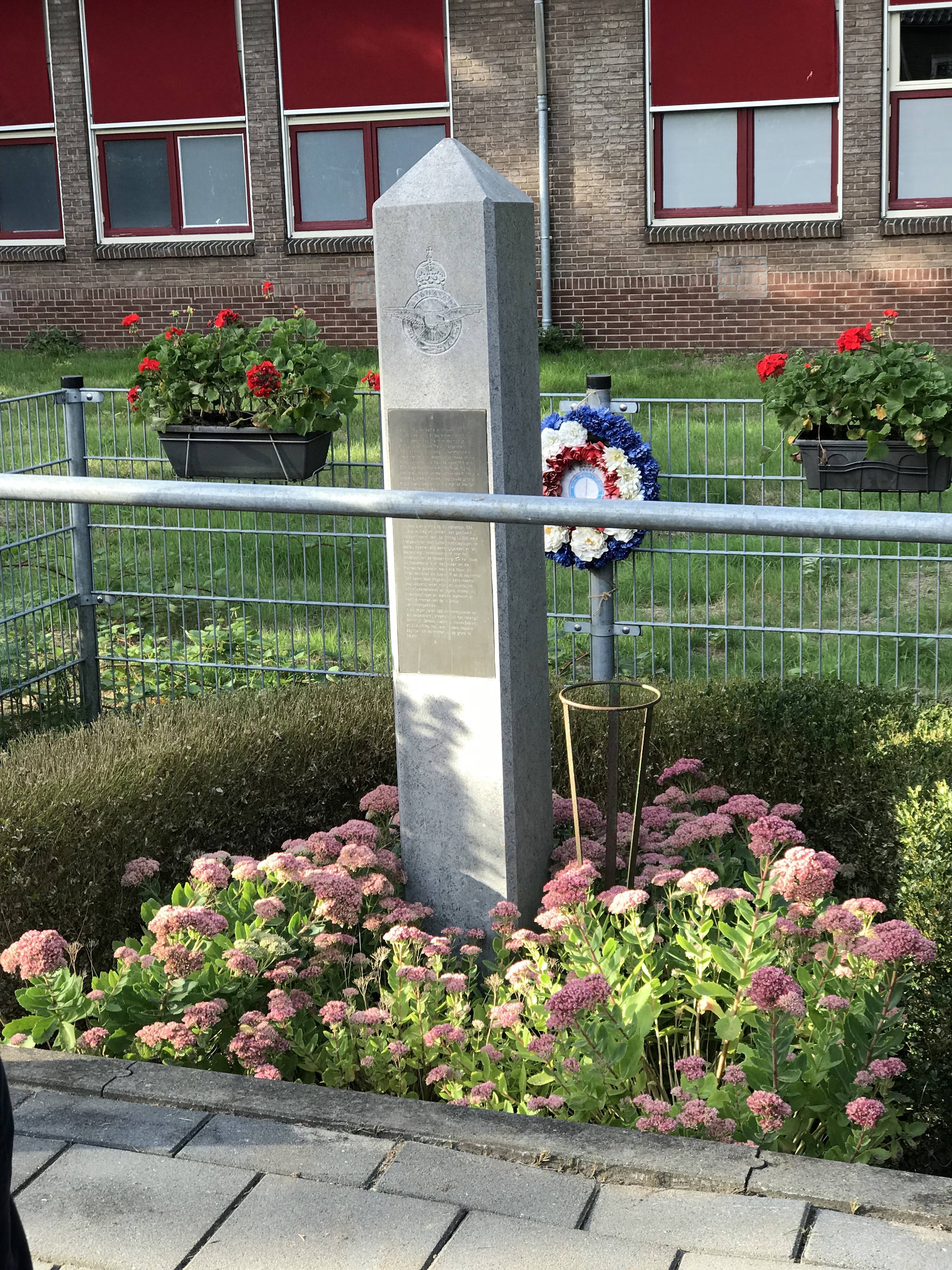
“Here, during the Battle of Arnhem, Stirling LJ928 crashed on 21 september 1944, after having been hit by fire from enemy fighters, killing the crew and the air despatchers. This memorial is not only to commemorate these men, but to remember all those of the Royal Air Force who flew between 17th and 25th September 1944 over this area. Flying on low level through German anti aircraft fire and attacking enemy fighters, they towed gliders and dropped supplies for the men of the 1st British Airborne Division.
During those days 229 crew members and air despatchers from the United Kingdom, Canada, Australia, New Zealand and South Africa lost their lives in a brave attempt to help the men on the ground.”
In his will, his address was 7 Ravensbury Cottages, Mitcham, Surrey and he left £215 5s. to his widow Gladys. Source: Ancestry.com. England & Wales, National Probate Calendar (Index of Wills and Administrations), 1858-1995
See also the ParaData website.
Maps are reproduced with the permission of the National Library of Scotland.


