Pye Records Ltd. was on the James Estate, Western Road, part of which can be seen in this photo. The site is occupied today by Asda, Hoo Hing etc.
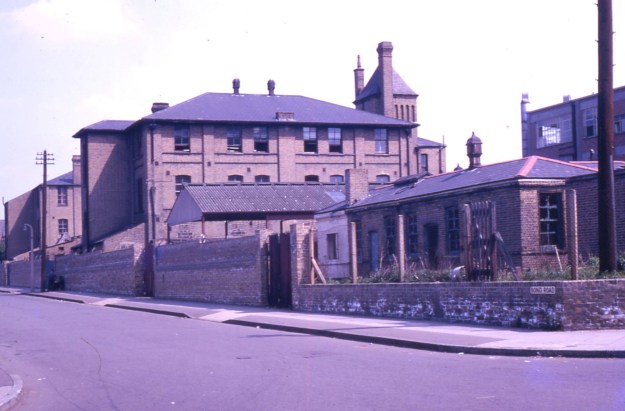
Clip of photo taken by Eric Montague in 1966. Reproduced by kind permission of the Merton Historical Society. Image reference mhs-em-um-40
From the Mitcham News & Mercury, 23rd October, 1959, page 3.
Behind-the-scenes for your favourite “pops”
IT IS A RECORD-MAKING BUSINESS By Wendy Scott
The green light flickers in a cafe jukebox, an automatic grab arm selects a record and the music plays out of the loudspeaker.
The foot-tapping crowd who listen to their favourite “pops” are not really concerned with how that spinning disc began it’s life or with the marvel of music that is translated from the minute grooves.
Yet the manufacture of gramophone records is an important industry today, with the various companies striving to woo the public with their current releases and gimmick productions.
Since the war, sales have far surpassed the wildest dreams of production managers. Today the factory workshops hum with constant activity in order to keep retailers supplied with large stocks of classical, jazz and other popular music discs.
Pye Records Ltd., whose factory is at Western Road, Mitcham, follow production methods that are typical of the disc industry.
Here thousands of records daily are pressed, packaged in colourful glossy covers, checked and sent out to waiting delivery vans.
The story of how records are made – with the combined skill of the factory’s several hundred employees – is complicated, yet interesting.
The heart of the factory is away from the main office block. It is here, in a secluded room that the taped music is initially transferred on to a lacquer coated aluminium disc. Surrounding the operator are various dials and control knobs which modulate tone and quality.
INTO TUBE
The recording room has all the atmosphere of a science fiction setting. As the sapphire needle on the master cutting lathe gouges into the soft lacquer it is converting the electrical impulses from the tape back into vibrations and inscribing them into the surface of the acetate disc.
The gouged out surplus material is fed into a tube and collects at the back of the machine in a large bottle.
The master acetate, as it is termed, then undergoes some beauty treatment – a little harsh, perhaps as it is mainly bathed in a chemical solution.
For the technically minded, it is coated with a silver solution and placed in an electro-plating bath. It is then treated by workers wearing rubber gloves to prevent injury from the acids, and lowered into a bath where copper anodes are suspended. The reverse side of the metal disc is made in the same way, forming the two halves of the record.
The record, still in a metal state, but polished and trimmed, is then transferred to the pressing department. Here numerous operators sit at the pressing machines. At their side is a sack of plastic composition crystals looking rather like grains of rice.
This is weighed according to size of the record and then gently warmed on an electric hot plate which is reminiscent of the household gadget.
The operator sandwiches the plastic ball between two record labels, clamps the nickel prototypes together and the record emerges.
Near the pressing department are a few operators who hole the records and make incisions so that they may be played on American and other record players that differ from English makes.
CHECKED
Nearby, in soundproof boxes lined with acoustic tiling, a selection of finish records are played through to check for irregularities in sound.
Fifteen girls – most of them live in the Mitcham and Tooting area, – then receive the discs for final checking and wrapping. The discs are dusted and sleeved with paper or polythene protective covers.
They are then neatly slipped into the glossy covers and sent to the packaging and dispatch department.
So next time you walk into your local record store to select a disc, remember the work and processing necessary before your favourite song or classical suite is brought to the living room.