The Norbury building firm of Wates Ltd built the mooring pontoons that carried the bridges of the Mulberry Harbour used after the Normandy landings on D-Day in June 1944. Workshops in Balham and Mitcham were involved, as told in this front page article from the Mitcham News & Mercury published on 16th February 1945.

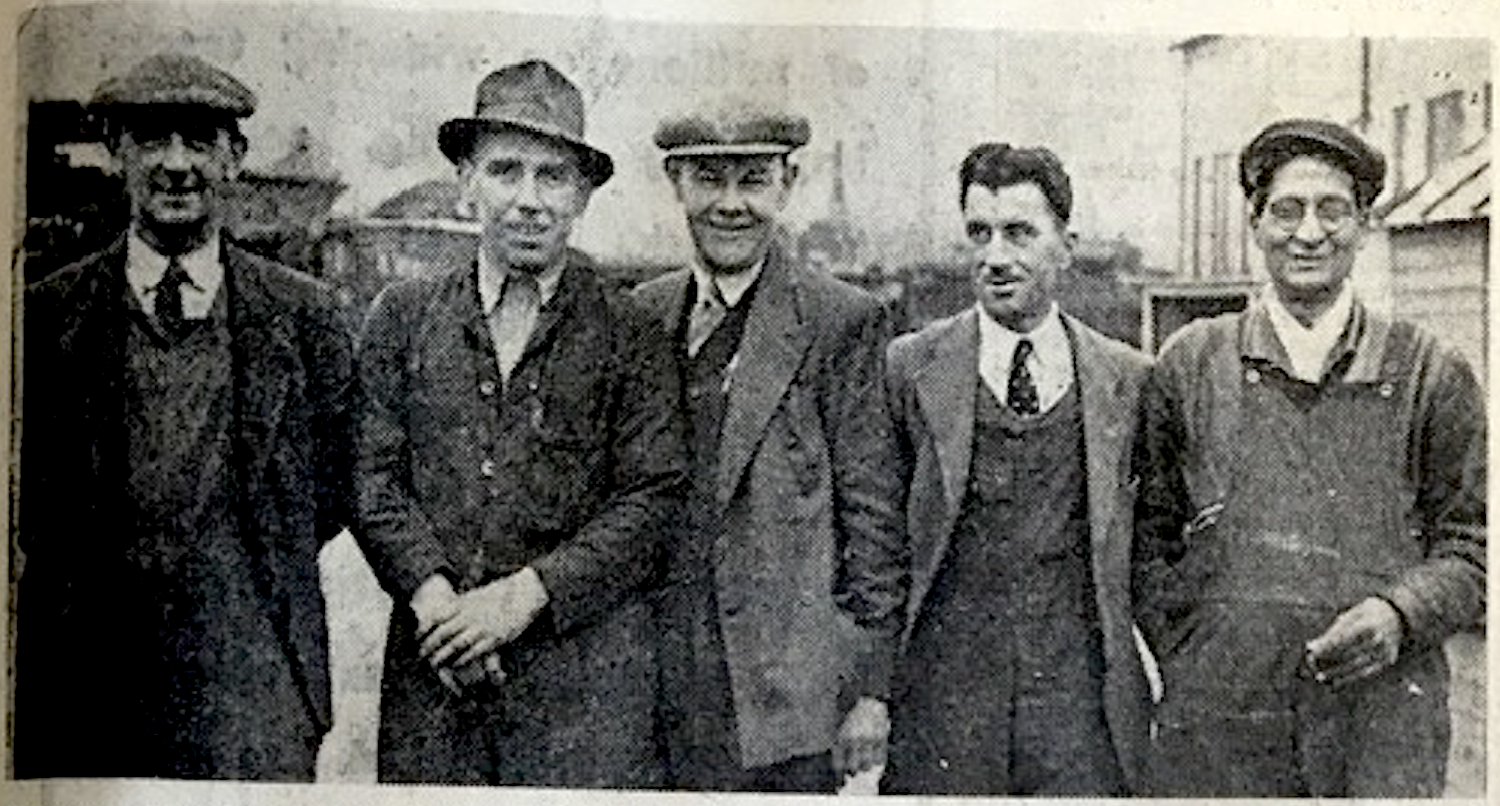
These men brought a speedier victory. They are among the key men in the construction of important parts of the historic Mulberry Ports which enabled D-Day to be such a phenomenal success.
Left to right, they are Arthur Cole, Frank Ford King, Frank Bull, Arthur Hyland, Arthur Orieux.
They Planned Mulberry Ports
Shuttles made at workshops in Mitcham.
D-Day Landing Prepared by Messrs. Wates.
Historic experiments hastened peace.
The achievement of the famous Mulberry Ports which enabled D-Day to hasten the day of Victory and Peace, was a local job.
Months of experimenting and planning in the Norbury office Messrs. Wates, Ltd., were followed by more months of construction at special workshops at Mitcham and Balham. Later, men from Streatham – one of them bombed-out from his home – went to Southampton and other dock areas for further construction.
At Mitcham and Balham hundreds of local men worked at high pressure making the mooring buoys for the docks, or “shuttles,” as they were termed.
A considerable portion of the floating port, Mulberry Harbour, was built by South Londoners.
To the men whose hands forged the dock in Mitcham, Balham and South India Docks, and to those whose energies were engaged for months on the gigantic task of planning the work at a Norbury office, the towing of the harbour across the Channel to the Normandy coast was tangible proof of a job well done.
Behind this feat of British engineering, which enabled Allied soldiers to force a way into the European Fortress, lies a story of hard work and of energy of hundreds co-ordinated to the mastery of a formidable task.
The story of the part South London played in the building of the harbour began in 1942, when Messrs. Wates, Ltd., builders and contractors of Norbury, were asked to experiment on ways of landing vehicles and equipment on the long flat sloping beaches inaccessible to ships.
Experimental work started, and when the Prime Minister met President Roosevelt in Ottawa in 1943 he carried with him a film showing the detail of a pier made of flexible steel spans supported on reinforced concrete pontoons. At Ottawa it was agreed that the floating pier should be the basis of the invasion port.
Then came instructions from Mr Churchill for the building of ten miles of pier and five miles of breakwater. “Don’t argue the matter,” he said, “The difficulties will argue for themselves.”
Wates were asked to construct 450 concrete pontoons to carry the flexible steel spans on which a road to carry transport from the ships was later laid. They were also asked for 500 shuttles, or mooring buoys, to steady the pontoons and for 12 bridgehead pontoons.
PROBLEMS OVERCOME
The construction of the pontoons presented many problems. They had to be light, but strong enough if aground to support the steel spans plus the weight of tanks and heavy traffic, and that they could be towed broadside as well as bows on.
For the employees of Wates there came months of unremitting hard work. Mr J. Heath, who has been bombed out from Moyser-road, Streatham, was at Southampton for about a year supervising the construction of 12 pier head pontoons. With him went Foreman B.A. Prescott of Norwood, Mr A. Bird of Tooting, George Payne, of Mitcham and Arthur Watts of Brixton, whose final job before the port was towed out to sea was to instruct Army officers and N.C.O.s on how to repair the pontoons. Mr Heath saw the port assembled, and on D-Day he saw it towed out to sea and disappear over the horizon.
“It was a fine sight and a daring enterprise,” he said. “Tests had been carried out on sections of the harbour, but it had not been possible to have a full dress rehearsal, the job was too big.”
To Mr C.D. Mitchell of New Malden, public works manager, fell the onerous task of supervising and planning all the jobs with which the firm was entrusted. He, perhaps, carried the greatest responsibility of all those working in South London.
Then there was Mr L.R. Seaton, Lamberhurst-road, streatham who for 18 months was in charge at the West India Docks, and Mr Morgan, who supervised the construction of the beetles or pontoons.
BALHAM WORKSHOP
At Balham a workshop was hastily setup to make the wooden shuttles, or mooring buoys, and hundreds of local men were taken on for three months’ intensive work.
Those at the Mitcham workshops also worked at high pressure on the shuttles. Mr J. Jacobs of Ewell toured England to buy the right kind of timber needed for the shuttles, Mr C.A. Webb, of New Malden, organised the transport of the completed shuttles to the coast and Mr Bob Whittaker was in charge of the constructional work.
In the workshops men worked 12 hours every day of the week.
The first shuttle was made by Mr Arthur Hyland, Park-road, South Norwood. From his model all the other shuttles were constructed, and then men got to work, slowly at first, but as practice increased their skill the shuttles came off the jigs ever more rapidly until the time taken for making one shuttle reduced from two weeks to two days.
In the winter of 1944 the night workers, among them Frank Bull of Brixton, carried on during the raids while shrapnel from our own guns pierced the roof of the workshop and fell around them.
The only ship’s carpenter among the men was Arthur Orieux of Mauritius, who served in the Navy in the last war.
“By the end of the time we were six weeks ahead of schedule, and were sending shuttles down to the coast so fast that the men there could not assemble them all. So we started assembling them ourselves, and were still ahead of time,” he said.
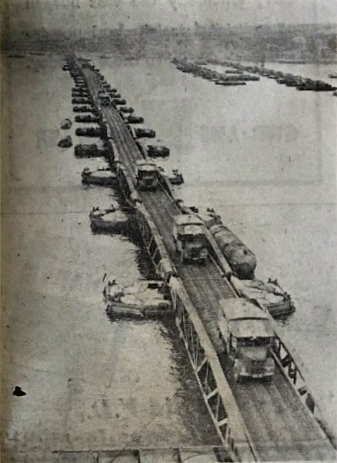
This remarkable photograph shows the shuttles or mooring buoys which formed a vital part of the famous Mulberry Ports which enable the British Forces successfully to land on the Continent on D-Day and so seal the doom of Hitler and his Nazi Germany.
Arthur had a Sea Job again

On the left Arthur Cole, and next to him, Frank Ford King.
Boats, the feel of the good hard wood that makes them and the curve of the prow are things that stir the blood of Arthur Cole, of Abbott-road, Wimbledon. Once Arthur was a sailor. He joined the Navy in 1904 and for 23 years sailed the seas calling at the great ports of the world, dodging U-boats in the last war and taking part in the Battle of Jutland.
But even though the sea has become a part of them there comes a time when a sailor must leave the sea. Arthur’s first job ashore was making artificial limbs, a job that lasted ten years. It was not that the sea had lost its power over him. He built boats in his spare time, not show pieces, but models to please the heart of a sailor, that would sail before and against the wind. He wanted to build boats for a livelihood, and called on every boat builder on the Thames from Putney to the sea. But Arthur was not a boat builder, they would not start him.
Then he did bomb repair work until at last he went to the Labour Exchange.
“They’ll take you at Wates,” they told him.
“What do they do there?” he asked.
“Coracle building,” was the reply, and Arthur went to work, and was happy. When the order for shuttles came along he and Frank Ford-King were chosen to learn every job required in the building of them, and in a week the two of them taught 45 men their jobs.
Arthur and Frank were key men. If any man was ill they were there to take over any task. Arthur was satisfied and could not work hard enough.
On one occasion determined to complete a shuttle before he went home, he did an operation for which 11 hours was allowed in half an hour.
Biographies
Arthur Cole
Arthur Cole was born in 1895, and during the war he was living in 58 Abbot Avenue, Wimbledon, with his wife Emily. He had joined the Navy when he was 12. He passed away in 1969, aged 78.
Arthur Orieux

Arthur Peter Orieux was born in Mauritius in 1887. While working at Wates he was living at 9 Moreton House, Garratt Lane, with his wife Alice. He was awarded Campaign Medals for World War I Merchant Seamen. He passed away 11th March 1951, aged 63.

The ‘Beetle’ pontoon made by Wates Ltd.


 Mitcham History Notes