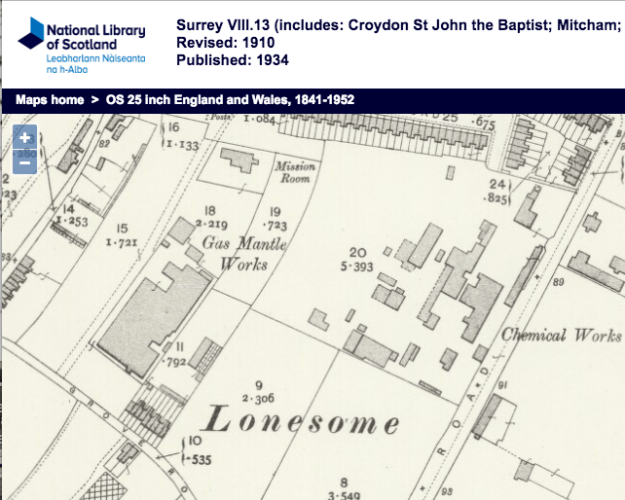
Factory that was at 9 Western Road, which made cardboard boxes. The building was originally the Zion Congregational Chapel.
It was listed in the 1963 Borough of Mitcham List of Factories.
In the 1954 telephone directory, listed as 7 Western Road : MIT 4681 and 131 Love Lane : MIT 2016.
The company was started by Max Leyens probably in 1939, as there isn’t an entry of it in the 1938 directory.
He was born in 1906 in Schwanenberg, Germany. At the start of World War 2 he was living at 21 Mitcham Park, and he was interned in the Isle of Man. He was released from internment on 4th December 1940 as category 12. His Home Office release card showed his previous and present occupation as cardboard manufacturer.
He was naturalised in 1947 as recorded in the London Gazette:
Leyens, Max; Germany; Cardboard Box Manufacturer;
21, Mitcham Park, Mitcham, Surrey.
22 September, 1947.
In 1953, Max Leyens patented an improvement for cardboard boxes, registered as GB28753A.
The company went into voluntary liquidation in 1981 as recorded in the London Gazette:
LEYENS CARDBOARD BOX CO. (1971) LIMITED
At an Extraordinary General Meeting of the above-named Company, duly convened, and held at 7-13 Western Road, Mitcham, Surrey, on 24th April 1981, the following Resolution was duly passed:
“That the Company be wound up voluntarily, and that S. Guthrie-Brown, of 1 West Smithfield, London EC1A 9LA. be and he is hereby appointed Liquidator for the purposes of such winding-up.”
R. V. Machin, Chairman.
Max Leyens died in December, 1984, as reported in the journal of the Association of Jewish Refugees (pdf). He had been living in Bournemouth, and left £78,750 in his will, according to Ancestry.
News Articles
Mitcham News & Mercury, 7th June, 1957
Factory blazed – but workers did not know
HOUSEWIVES raised the alarm when fire broke out at the Leyens Cardboard Box factory in Western Road, Mitcham, on Thursday last week.
They saw smoke billowing from the factory window. Minutes
later there was a loud crash as part of the factory roof caved in.But the staff, who were having lunch in the canteen, did not
realise the building was on fire.“The canteen is at the front of the factory. We were listening to the radio and didn’t hear the noise,”- said an employee.
Over 200 tons of raw materials — reels of paper and cardboard
sheets — were severely burnt. Damage to the budding and loss
of materials is estimated at between £3.000 and £5.000.SALVAGE ATTEMPT
Two fire engines went to the factory. Using hoses the firemen
managed to confine the blare to the laminating room. They
stayed two hours with one of the machines.“The fire brigade took control very quickly. If they had not acted so promptly it could have easily spread to the rest of the building,” commented Mr M. Leyens, the managing director.
Before the fire brigade arrived, some of the men tried to salvage boasrding and paper, but the heat became too intense.
Expensive machinery and other equipment were only slightly damaged. Production was held up only until fresh supplies of raw materials arrived.
Note: Almost a year ago – on June 7, 1956, fire broke at the factory and materials worth £300 were destroyed.
 Mitcham History Notes