Category Archives: WW1

Hancock, Corfield and Waller

Imperial Works
Morden Road

Litho Printing on Steel and Metal Sheet Processing

Source:
Borough of Mitcham List of Factories,
Town Clerk’s Department,
July 1963.
Available at Merton Heritage and Local Studies Centre at Morden Library.
Reference L2 (670) MIT
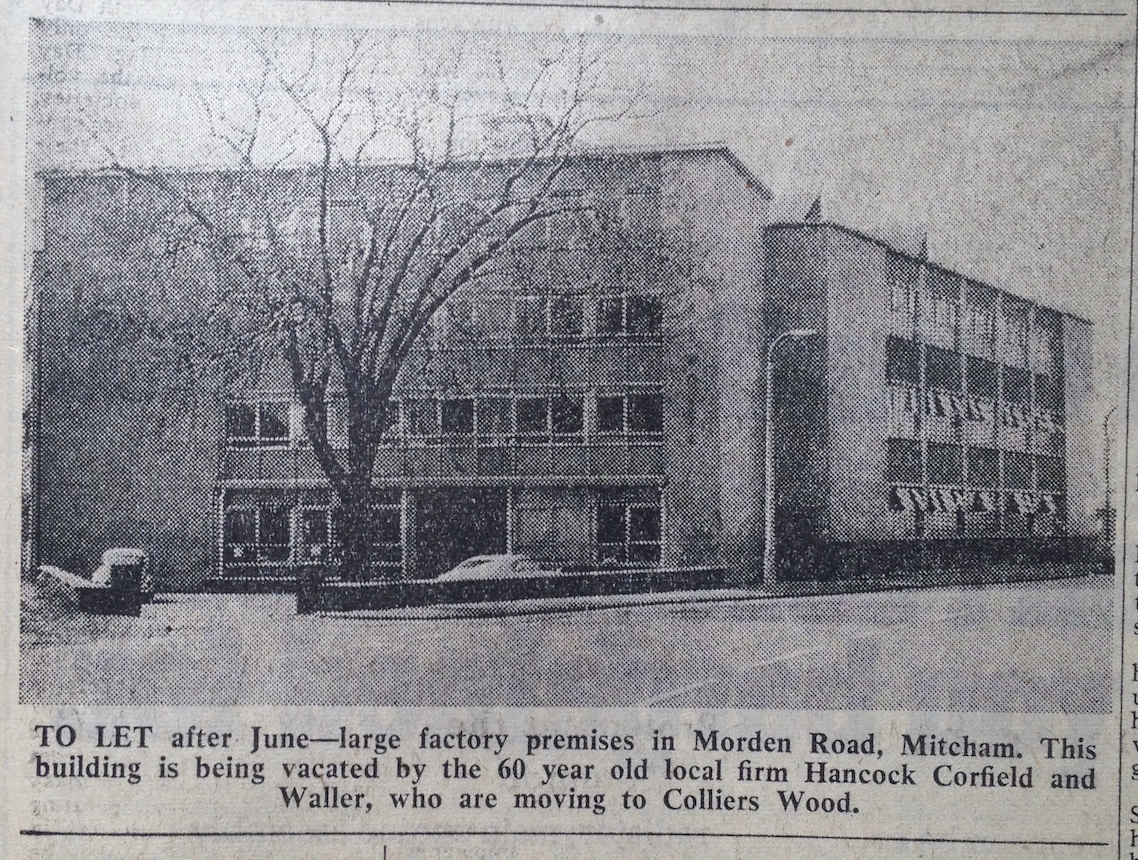

From the Mitcham News & Mercury, 30th April 1971

From the ‘brewery trays’ website (link not working 27/12/2018):

WWI ‘The Great War Years’ 1914 – 1918

In 1914 business was interrupted by the outbreak of World War I. Much of HCW Ltd’s continued success during this period was not due to tray manufacturing. Metal printing was put on hold and for the next four years the Imperial Works produced millions of items for the British Forces. One of the biggest successes, and HCW Ltd’s speciality, was water-bottles which were pressed on the machines which had previously produced showcards and waiter trays. These same bottles were then covered in khaki by the factory’s considerable female labour force who became disrespectfully known as “the sewing party”.

Current company contact
21 High Street
Ewell Village
Surrey. KT17 1SB

Tel: 0208 394 2785


From Grace’s Guide to British Industrial History – 1914 Who’s Who in Business

HANCOCK & CORFIELD, Ltd., ColourPrinters (Posters, Showcards, &c.). Imperial Works, Mitcham, near London.
Hours of Business: 8 a.m. to 6.30 p.m.
Established twenty-three years ago to take over the patent rights from the Embossed Metal Tablet Co., Gray’s Inn Road, E.C., for Printing and Embossing Metal for advertising purposes, and in 1904 acquired the business of Messrs. Waller, Willis & Co., Colour Printers.
Incorporated as a Private Limited Company.
Directors: John Corfield (Managing Director), Reginald Corfield, William Henry Waller.
Premises: Large Factory with floorage covering about three acres at the Imperial Works, Morden Road, Mitcham.
Staff: 300.
Branches: Glasgow, Birmingham, Belfast, Manchester, Den Haag, Holland, and Australia.
Specialities: Artistic Colour Printing on Metal, Aluminium and Paper, Steel, Iron, Tin, Zinc, &c. Are Manufacturers of Embossed Iron Advertisement Tablets, General Printing and Lithography. Are well known for the excellence of their work, and for the introduction of novelties in designs. Specialize in all Advertising Novelties.
Connection: World-wide. Contractors to H.M. Government (Admiralty, War Office, Post Office).
Telephones: Nos. 1202 and 1203 Wimbledon.
Telegraphic Address: ” Corfield, Mitcham.”


From the Imperial war Museum online collection:

Dunlop Cycle Tyres Dunlop Cycle Tyres © IWM (Art.IWM PST 13686)

Watney's Watney’s © IWM (Art.IWM PST 4651)

Holborn Military Hospital

The Holborn Union Workhouse was taken over as a Military Hospital in 1916:

From the Mitcham Advertiser, 4th August, 1916:

WOUNDED SOLDIERS FOR MITCHAM.

We understand that the War Office has taken over the Holborn Institution, Western Road, for the purpose of using it as a hospital for wounded soldiers. It is suggested that the present inmates will be transferred to the Workhouse at Belmont.

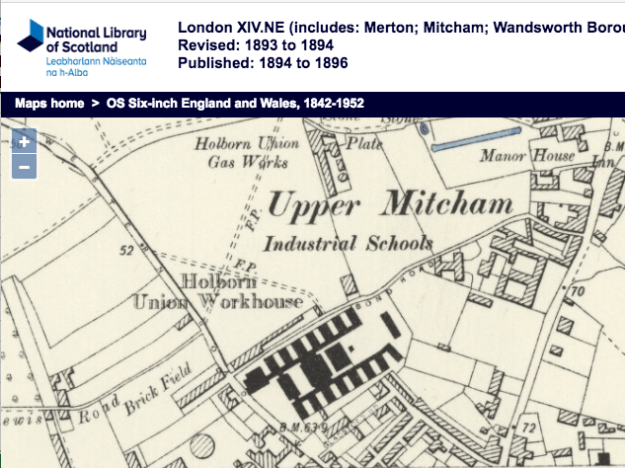
1893 OS map

From “Mitcham Histories No. 14 ‘Upper Mitcham and Western Road'” by E.N. Montague of the Merton Historical Society, page  94:

In 1919, after the last of the soldiers had left, a memorial tablet was set in the wall to the right of the main gate, and unveiled by Lady Worsfold of Hall Place. The inscription read “Holborn Military Hospital, Mitcham 1916-1919. To the glory of God and Sacred to the memory of those who gave Their lives in the Great War”, and listed the names of 22 men and one nursing sister who had died there. When what remained of the former workhouse reception building was being removed by demolition contractors in the late 1960s the memorial was salvaged by the writer, and taken into safekeeping by Merton Historical Society.

This memorial tablet is now in storage in the custody of Merton Local Studies Centre. The names that can be worked out from the photo on Merton Memories (see below) are:

Merton Memories Photos

Memorial stone
Entrance in Western Road

News Articles

From the Belfast Telegraph – Monday 09 September 1918, via the British Newspaper Archives, which requires a subscription.

NO SIGN OF THE TRACTOR.

At Marlborough Street Police Court, London, Sydney Moore (32), automobile engineer, giving an address at Manchester, was charged on remand with obtaining £150 from George Godfrey by false pretences. Godfrey, a private in a Reserve Garrison Battalion of the Rifle Brigade, at present an inmate of the Mitcham Military Hospital. It was stated that, seeing an advertisement in a daily paper headed “Urgent Work of National Importance,” he replied to it, and received an answer that if he ordered a tractor plough for land work this would be considered work of national importance, and his release from the Army could be obtained through the Ministry of National Service. He sent a cheque for £150 for a tractor, but had not received it or the return of his money, nor had he heard anything as to his being released.

The advertisement was issued by a firm in Regent Street. Evidence was given that the Ministry of National Service knew nothing of the firm and that the company’s paid-up capital was £2, its nominal capital being £5,000.
The accused was remanded.


Maps are reproduced with the permission of the National Library of Scotland.