Raising the ale garland was an old custom that was revived by Youngs Brewery when they reopened rebuilt, or repaired, pubs after the Second World War. This was done when the Cricketers pub was reopened officially on 8th January 1956 for example.
A letter to the Illustrated Sporting and Dramatic News, published on Wednesday 2nd January 1963, explained the custom:-
SIR,
— When a new inn was opened in Bristol earlier this year, the ancient custom of hoisting the ale-garland was observed. The accompanying photograph shows the garland hanging over the door of the house.
The custom has links with the Romans, who used a bush as their sign to advertise a tavern. Other references to the garland or bush are found over a long period of literature. For instance in 1603 a traveller records that he “spied a bush at the end of
a pole (the ancient badge of a country ale house ) “.It is from this custom that the saying arose, “good wine needs no bush” —i.e., is advertisement enough for itself. The “bush” was often composed of ivy leaves, not only because of ivy’s lasting quality, but also because of Bacchus’ connection with ivy.”
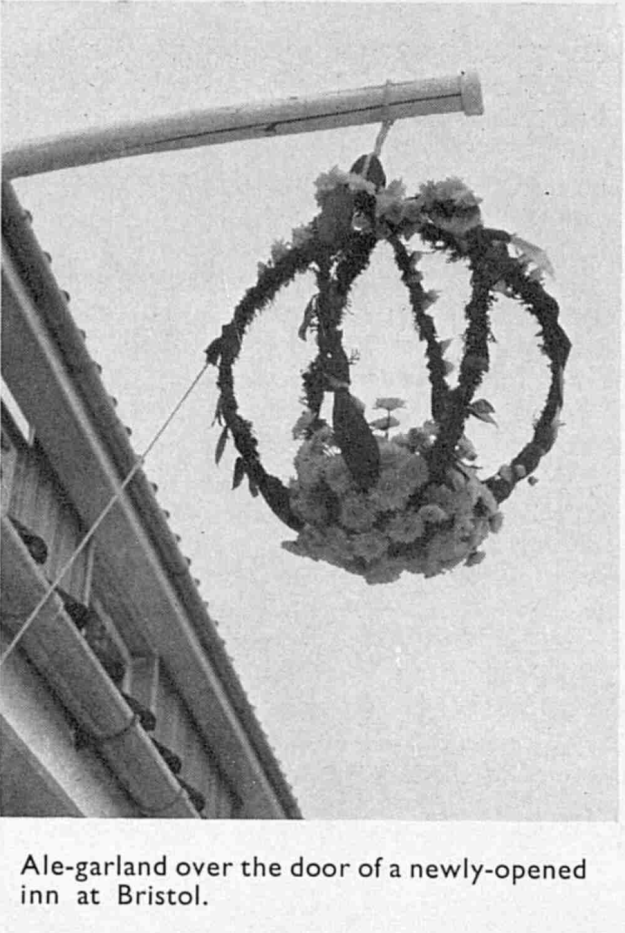
Image © Illustrated London News Group. Image created courtesy of THE BRITISH LIBRARY BOARD!
A longer explanation can be found in this article from the Lewisham Borough News, Tuesday 16th January 1951:
STORY OF THE ALE GARLAND
‘Conning The Brew’ In Ancient TimesBy Stephen E. Hutchins
The hoisting of the ale garland in City and suburban taverns which is much observed about the New Year together with what is known as “ale conning” is regarded as the revival of a custom of the time of William the Conqueror and involves an expression of goodwill to all, and a kind of public protest against all sorts of vexatious regulations.
In olden days all garlands were to be seen outside all the inns at the festive season as a sign that fellowship and hospitality reigned within.
To “con the brew” is to sip at the mulled ale, the wassail bowl, and the ale posset, and the lambs wool — (meaning pulped roasted apples, sugar, nutmeg and ginger in warmed ale) — and pronounce it to be an excellent concoction.
The ale garland is usually displayed from a pole known as the “ale-stake” — in former days such ale-stakes had to be exhibited by inn-keepers to tell the travelling ale-conners that the new beers were ready to be tested.
The punishment for brewing poor beer was to be ducked in a pond in the ducking stool.
Under an Act of 1604 ale houses had to be inspected by constables to see if they were properly conducted and the object of the law was “to restrain inordinate tippling in inns and alehouses” and to confirm that the true use of the English inn was to relieve wayfarers and supply victuals, and not to entertain idle people and encourage them to spend their money.
Penny a Quart
Fines were levied by the constables and church wardens on people who indulged in drink for “an unreasonable time” and the money was given to the poor.
There was a fine of 5s. for being drunk and the alternative if the offender was unable to pay was to be awarded a spell in the stocks.
The price of the best ale was fixed at one penny a quart and “small” ale was one half penny a quart.
In 1614 the City had a thousand breweries with 40,000 barrels in their cellars. Beer was made at the back and sold for consumption in the front.
The old English ale was made from malt, yeast and water, and eventually beer flavoured with hops, called “hopping beer,” was brought in from Germany. This beverage became very popular.
Inns were often owned by the Church and we still have reminders of this in titles like the Seven Stars, the King and Keys, the Mitre and the Angel and “The Case is Altered” — the later signifying the period after the Reformation when the inns passed to other ownership.
Many inns were in the nature of hostels for pilgrims to the religious shrines. The poorest often received free hospitality and they were usually situated in a town near to the abbey or cathedral.
Among notable examples of this type of establishment may be listed the Falstaff of Canterbury, the “Star” at Alfriston, and the Pilgrims Rest beside Battle Abbey. The “Star” was a house of call for pilgrims travelling eastward to the noted Abbey at Battle and it was owned by the Monks of Battle.

 Mitcham History Notes