Pinnock’s Pond was 0.13 acre (5380 sq ft) pond near the corner of Cedars Avenue and Commonside East.
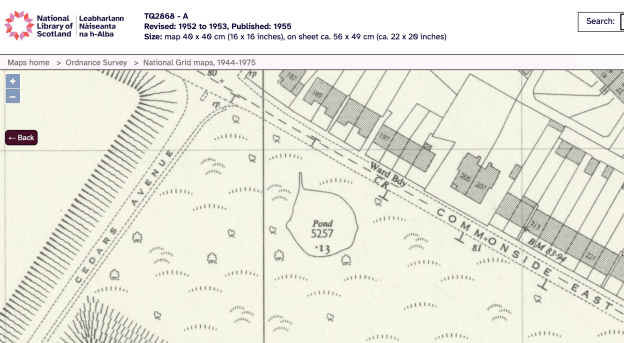
1955 OS Map Pinnocks Pond
According to H.G. Winbow writing in 1962, the pond was named after Market Gardener Mr Pinnock.
Janet Morris, in her booklet Mitcham Common A short history, said:
Drainage water from the tip alongside Cedars Avenue polluted Pinnock’s Pond and a
nearby roadside ditch along Commonside East. The pond was emptied in an effort to
stop the terrible smell and the tip was closed. For years afterwards the pond bred plagues of mosquitoes that made summer evenings a misery for people over a wide area, stretching as far as Mitcham Park. The pond was eventually filled in.
Searches of minutes from Conservator meetings revealed:
Historical records for the pond at the corner of Cedars Avenue and Commonside East (OS Pond 5257) detail its naming, water source, maintenance history, and eventual infilling:
1. Naming and Identification
The “Pinnock’s” Name: The name “Pinnock’s Pond” appears only once across all Conservators’ minutes, dated 8 July 1959, regarding a request to spray for midges.
Official Terminology: The Conservators otherwise strictly referred to it by its geographic location, such as “Pond at Cedars Avenue,” “pond at the corner of Cedars Avenue and Commonside East,” or “Pond, Commonside East”.2. Water Source and Hydrology
Surface/Ditch Runoff: A key minute from 13 January 1927 details that the pond was fed by an inlet from the Commonside East ditch with a return pipe to the ditch on Cedars Road.
Rain Dependence: Both the inlet and outlet pipe were noted as choked, requiring heavy rain for any fresh water to enter.
No Spring or Borehole Feed: There is no record of the pond ever being supplied by a spring, well, borehole, or piped water system.3. Maintenance and Public Complaints (1926–1964)
Cleanings & Rubbish: The pond suffered from recurring silt, stagnant water, and dumped rubbish (tins, bottles, paper), prompting multiple cleared-out operations in 1927, 1937, 1938, 1940, and 1962.
Requests to Fill In: Local residents requested the pond be filled in as early as October 1926 and July 1939 due to mud and safety concerns for children. The Conservators initially rejected these requests, noting in 1939 that it was not intended as a paddling pond.4. Infilling and Site Conversion (1964–1965)
Decision to Fill: On 9 September 1964, following reports of offensive smells and unperformed drainage works, the Board officially agreed to fill in the pond via a contractor free of charge.
Site Reclamation: By November 1964, infilling was nearly complete. In 1965, the site was grass-seeded and temporarily fenced to prevent illegal flytipping and car parking.5. Related Distinctions in the Records
Cedars Avenue Borehole (1996–1997): A Thames Water observation borehole was installed nearby in 1996 for London Underground to monitor rising groundwater in the deep chalk aquifer; it had no connection to the former pond’s water supply.