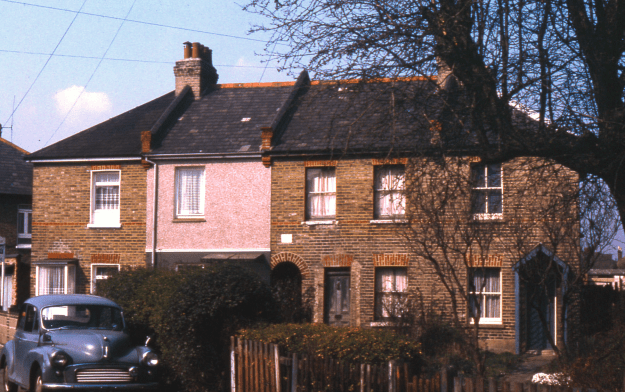
Benjamin Slater wrote of his memories of Mitcham in 1911. The following was published in the October 1932 edition of the East Mitcham Ratepayers Association Magazine.
Some notes:
1. Major Moor refers to Moore as in Potter & Moore;
2. 10 acres is about half the size of the present day Figges Marsh;
3. Mr Aspery assumed to mean Mr Asprey;
4. The Tram line was the Surrey Iron Railway
———–
MEMORIES OF MITCHAM
By the Late BENJAMIN SLATER.
(Written in 1911. The Author’s vivid italics have been retained).
In the year 1848 the land now covered by the coal wharf and Harvey & Knight’s Floor Cloth factory in Morden Road, Mitcham, was a field of Liquorice which is grown for Its Root – which penetrates the earth to the depth of from 3 to 4 feet, and has to be trenched out of the ground by men to that depth. In the work of getting this crop out the men came across a large quantity of human bones – some of the skeletons were found in stone coffins – with them a long sword was found; a number of spears were also found, also silver and bronze coins; most of these the men kept – also some of the spears. There used to be a man come down each week and buy these of the men employed in the work – all the swords – and most of the spears were taken to Major Moor’s house at Fig’s Marsh, where he lived at Manor House by the Swan Hotel. The bones were taken to a barn which stood where John’s Place now stands called Angel’s Farm, and there taken care of until the work of trenching was over – and then carted back to the field and buried in a deep trench. There was also found several cups shaped like a beer glass with a foot to it, the lip was curved very much, it looked to be made of black mud with a greyish look about it; some of them got broken, but the men took them home. The teeth in the skulls were as perfect and bright as in life, there were several sets taken away by the men. I found a spear and a set of teeth myself some time after the work had been finished, but don’t know what became of them; the silver coins were about as large as a two shilling piece, but thin as wafer, but in good preservation; the bronze coins were similar in size to the silver ones.
At this time nearly all the land in Mitcham was cultivated in herbs; there were about fifty acres of liquorice grown in Mitcham by Major Moor and Mr James Arthur and one of two other growers; there were also about 100 acres of peppermint grown annually; this crop was distilled for its oil. The oil of peppermint is a very valuable oil, a certain cure for cholera gripes and pains in the stomach. It is very cleansing. I have many times when cutting the crop cut my finger badly, but took no notice of it; it would bleed freely at first but would soon stop, and in twenty-four hours it would be healed up. The mint after being stilled would be carted to a convenient place and put into a lump and mixed with stable manure and used for manuring the land, so you see everything was turned to account. There were also about 50 acres of camomiles grown annually in Mitcham; there were several farmers who grew this crop – there were Major Moor, Mr James Arthur, Mr Francis and William Newman, and a Mr Weston. The farm-house and homestead of Mr Weston stood where Mizen Bros. glass-houses stand now, opposite the Holborn Schools. I believe it was pulled down by Mizens, when they bought the land. The camomile crop was a very important crop, for it employed a very large number of people to gather the flowers; all the village used to turn out to gather the camomile flowers, in the camomile season, which began at the beginning of July and ended the end of August. The Schools used to close for the camomile season, which lasted two months. I have seen as many as 200 women and children in a 10 acre field, gathering of the flowers. They were paid a penny a pound for the gathering of the flowers. The villagers used to reckon on the money they earned in the camomile season to clothe their children, and pay the rent of their houses for the year.
The next important crop to this is Lavender – at least 50 acres of this crop was grown yearly; this was grown for distilling for its scent, it was not used for any other purpose. Then came the Rose – at least 20 acres of the old Cabbage or Provence rose were grown. These roses were grown and distilled for their scent and rose-water – rose-water is used for weak eyes very largely. Then came the damask rose – over 20 or 30 acres of this rose was grown and gathered in its bud; it was a pretty rose, deep crimson in colour – this was treated differently to the Cabbage rose. The petals of the flowers were pulled out of the cup they were set in, the cup thrown away and the petals dried in a stove; they were then ready for sale. Another crop largely grown in Mitcham was caraway; the seeds were distilled for its oil; it is also sold for making caraway cakes.
Next comes the Belladona, largely used for plasters for bad back. Several acres of this herb were grown. It is rather a pretty plant, the seed pods the shape of a hen’s egg, and as large, with spines all over it, growing about 18 inches high, forming a very pretty dark green bushy plant. Then we have the Henbane; this grows 2 feet high with large green leaves as big as your hand, and forms a large bushy plant. It has a flower like a tobacco plant; the seed pod is just like an acorn, set in a cup just the same. There were several acres of it grown. Now I come to the Marsh Malop; this grew about four feet high bearing a mass of convolulus-like flowers, a very pretty plant grown for its root and top both, used chiefly for poultices for bad legs and bruises, etc. Several acres of this herb were grown.
Then there was the Rosemary; this a herb that would be found in every cottage garden, a pretty shrubby plant very much like lavender. This boiled in water and then strained off and left till cool makes a splendid hairwash, clearing away all scurf and relieving the head very much. Then comes the Saffron; this plant is poison, it grows very much like the shrub Cedar of Lebanon, growing about a foot high. This was not grown extensively, being a rather dangerous plant. Then we have the Pennyroyal, a herb growing close to the ground like horehound – there was an acre or two of this grown; and then we come to the Horehound. This was largely grown; this and liquorice boiled together and the liquor drank, is a sure cure for colds, coughs, asthma, and Bronchitis. Then we have the Feverfew; this is used in cases of fever, as the name implies where this is grown few fevers are. Then comes the wormwood. This was largely grown; it is a terrible strong bitter. It was at one time much used in Brewing in place of hops, its use is forbidden now; it grew about 3 feet high; it is so bitter that if you put a piece in your mouth you would shudder from head to foot. Then there was the Rue – this is used for Rue gin, and for croup among fowls and in many other ways. Then there is the Lavender Cotton – a pretty little white green foliage plant with the appearance of lavender, very poisonous. Then there is the loveage. The root of this plant is very much like celery and smells like it. Then comes the Angelica; this is a plant similar to Loveage. Then there was the Squirting Cucumber, a plant like the melon in its foliage growing close to the ground, bearing little white green cucumbers about as large as your thumb; this plant had to be handled by a man who was thoroughly acquainted with its nature. It was so very dangerous the man had to have his mouth and nose covered when working gathering the fruit; these had to be grown in an isolated place where no one would be likely to interfere with them; it would not be safe to grow them in Mitcham now. Then comes the Poppy; two or three acres of these were grown. They were sown in early Spring broadcast and thinned out to about six inches apart; they grew about 5 or 6 feet high, bearing large heads as large as your fist – their stalks were thick and strong, standing on the ground until they were quite dry, then they were gathered and stored for sale. Now comes the Monkshood Aconite, a very deadly poisonous plant, grown for its root and top both. Next comes the Tansey; this herb would be found in most cottage gardens, (they called it the ginger plant) growing two feet high with a fernlike foliage and a yellow flower, it smelt like ginger. I have seen all these herbs grown in Mitcham, and have had a hand in their cultivation. Years back there used to be an old woman live in Mitcham who got her living by gathering wild herbs. I will give you the names of some of the herbs she gathered:
1. The Coltsfoot
2. Devils’ Bit
3. Yerrow
4. Thyme
5. Orris, his smelt like stinking fish
6. Biteny
7. Egremony
8. Red Poppy flowers
9. Yellow Bay
10. Adder’s Spear
11. Dandelion
12. Ground Ivy
13. Calendine
These are only a few of them.
I will now point out one or two of the Big Farms; first of all Major Moor’s Farm on Fig’s Marsh, a very large farm, several hundred acres, employing a great number of hands both men and women. Three-fourths of this Farm was cultivated in Herbs; there was a large distillery adjoining the farm house containing 5 large stills for distilling the herbs. After the Major died, his son James Bridger, carried on the Farm until his death, then it was broken up, and the property sold. There was a building stood in the Farm yard used as an office and store house with a Tower with a clock in it; this clock chimed the quarters and struck the hour. When the Vestry hall was built the bells of this Clock were given to the Vestry hall and are now doing duty there. Major Moor in his day was a man of great authority; his word was law, he was lord of the manor and after him his son, Mr. James Bridger.
Mr James Arthur’s Farm comes next in importance. This Farm is at the top of the Common, now Mr. Daniel Watney’s. This was a very large farm employing a great number of men and women. Nothing but herbs was grown on this Farm. The distillery belonging to this farm is still standing in the Croydon Road, now belonging to a French firm named Jakeson. This farm extended on the Croydon side as far as Thornton Heath and Waddon, and on the Mitcham side as far a Nelson’s Fields, Merton, and Pudding Fields as far as Ravensbury, Morden.
There were several farmers who kept cows. John Bunce, Market Gardener, of Swanes Lane, Fig’s Marsh, kept about a dozen; having no grass land these were grazed on Fig’s Marsh. Then there was Mr. Weston; about the same number from this farm was grazed on Fig’s Marsh; they had boys to see that the cows did not stray into the Fields. There were 5 or 6 cow keepers on the east and west side of the Common who between then kept over 50 cows – these cow-keepers had no land, their cows were grazed on the Common, with boys to look after them. At this time there were no railways across the Common, so they had plenty of space to roam over. I have seen in the hot weather in Summer when flies used to bite them 7 or 8 cows come running off the Common with their tails stuck up in the air and run into the Three King’s Pond half over their bodies in water and stop there switching their tails until the flies had gone before they left the water; no one interfered with them unless they strayed in to the fields. If they did that they were taken to the pound and their owners charged with the damage they had done.
I will now tell you about some of our old Factories. In the year 1830 the Woodite factory that is now on the east side of the Common was then the Mitcham Workhouse, or should I say Poorhouse. After a time the poor were transferred to Dupper’s Hill, Croydon; then the old Mitcham poorhouse was used as a match factory. The first matches ever made were made at this Factory; they were 3 or 4 inches long and as much wood in one as there is in 7 or 8 now made. Theepence a box was charged for them, not more than 3 or 4 dozen matches in a Box. After a time it was changed into a rubber Factory, where the Atlantic Cable was made; while the cable was being made there were several hundred hands employed, which lasted several years; then it was used for making Rubber Tyres for carriages, bikes, motor cars, etc. A part of it is used for that purpose now, the other part is used as a margaine factory. Now I come to the silk printing. There was a large factory at Beddington Corner, on the opposite side of the River to Macraye’s Skin mills. Sample silk printing was done here on a large scaled employing a good many hands. Next I come to the Ravensbury Factory, this was noted for calico printing also silk printing, and the noted Paisley shawls were made and printed here to a large extent. There were a great number of hands employed here both men and women, French, Scottish and English. This factory stood at the back of Rutter’s Tobacco factory, but has been closed some years. Next to this was a silk printing factory at Phipps Bridge belonging to a Mr Aspery, and adjoining this was a large Stocking Factory employing a large number of hands, mostly women; this was burned down and never rebuilt. Next I come to Litler’s silk printing Factory, close to Merton Abbey; this Factory is still working, I think it is the only one left that carries on the work in Mitcham now.
I will tell you now what Mitcham Fair was like 50 years ago. The chief attraction at this time was the dancing Booths. There were three very large booths which stood side by side, each about 20 feet wide and about 30 yards long. Down the middle of these were laid boards to dance on, and on each side there were tables and seats where people could sit and have Refreshments. The dancing commenced at 6 in the evening and lasted until 11, closing time. You paid 3d. for a dance, or you could dance the whole evening by paying a shilling. This used to be jolly fun – plenty of Toe Treading and occasionally naughty words but it was all fair at fair time; the Booths were always full from the time they opened until they closed. There was a Refreshment Bar at the entrance of each Booth where you could ham and beef or bread and cheese and draught or bottled beers. There were oyster stalls around the Fair in every crook and corner where cartloads of oysters were sold during the Fair. Mitcham Fair was called the Oyster Fair; you could get a dozen natives of the best quality for three pence; people used to have a feast at these stalls themselves, and then take some home as a fairing for those at home. There was also pickled salmon sold at these stalls. It was in small tubs called kits, made like a butcher’s pickling tub, wider at the Bottom than at the Top; it was in slices weighing a pound each. A Tub held 12 lbs. And was sold at a shilling a pound; it was pickled in vinegar. People used to go in for this freely. After the Fair was over the lord of the manor sent his carts to clear the oyster shells away; they were carried on to the land as manure.
The gingerbread nut was a favourite among the fair goers; the stalls did big business in this line. You had not been to the Fair unless you took home some gingerbread nuts. You were charged a shilling a pound for these. There were not many Shows; one Circus, where you would see horse riding, tight-rope dancing, tumbling and juggling; there was one Theatre, where you would see Maria Martin in the Red Barn performed; and two or three penny shows, showing white mice and a tame rat and snake in a box, etc. In another a big fat woman and Tom Thumb and his wife another a fire eater and a performing pony who went round the audience and picked out the boy who ate his mother’s sugar, and the girl who put her fingers in the treacle pot, etc. Cheap Jack did a good business always, also the man who sold crackers and penny scratchers, a toy they drew down your back.
On Easter Monday there used to be plenty of sport – greasy pole climbing, hurdle jumping, walking and running matches, bobbing for rolls and treacle, dipping for oranges, dabchick hunting in the Three King’s Pond – this was fine sport. They put the dabchick in the water and then sent dogs in after it, but I never saw a dog catch the Bird. As soon as the dogs got within a few yards of the bird it would disappear under the water and come up some distance off; they would keep going for it until they had to give up and poor dabchick was at rest. They also had grinning through the Horse Collar – this caused plenty of laughter; also donkey jumping in sacks, &c.
On Whit Mondays the Benefit Societies of the parish used to meet for their annual dinners and march around the village with Band and Banners, which brought out all the folks of the village. After all this performance they would sit down to dinner; after dinner was over there was a dance which lasted all night.
On the First of May the Butchers with marrow Bones and Cleavers, and Chimney sweeps with a Jack in the Green would go round the village – the sweeps knocked their brushes on their shovels, and the Butchers knocked their marrow bones on their cleavers, there were two flute players as well, which made up the Band. They paid all the nobility of the place a visit, and collared a good sum of money.
In the year 1840 there was a Tram line running from Wandsworth to Croydon, also a branch line to Beddington Corner, Hackbridge, Carshalton, and I don’t know know how far it went beyond this. It was used for bringing coals from Wandsworth to all the villages on its route. The coal sheds for Mitcham were at the old Mitcham Railway Station as it is now; the line ran on the same ground from Croydon as the present railway runs on now as far as the coal wharf; then it ran in a straight line across to Mitcham Church and on to Merton Pickle and on to Wandsworth. The line was not laid on wooden sleepers but in square blocks of stone a foot square and let in the ground, the upper part a few inches above the ground; the rails were fixed to these by iron spikes. The rails were grooved just the same as the present tram rails are. The trucks used for carrying the coal were drawn by horses. This line was done away with in the year 1844. At this time the road from the church to Merton was a lane with a hedge on both sides, just wide enough for one cart to go down, and was used for getting to and from the land; there was no footways, you had to walk between the ruts where the horses walked, if you went that way. Since that time Mitcham has changed very much, the herbs that were grown then have given place to flowers and vegetables, and miles of glass. If Mizen’s glass houses were placed end to end they would reach miles.
———–