Drina Strange was the stage name of Alexandrina Marguerite Stringer.
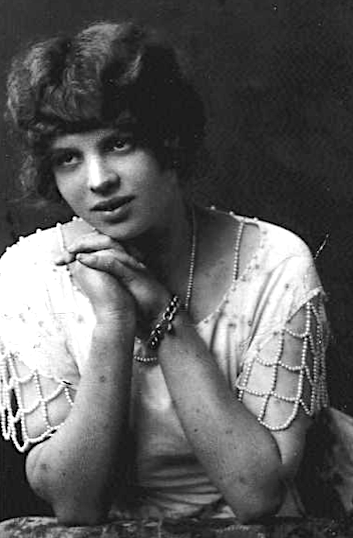
Born in 1902 in Birmingham, she lived with her parents in 264 Links Road, and attended Links Secondary School for Girls. At 18 she was 6 foot 1 1/2 inches in height. She won a four year scholarship at the Trinity College of Music and she possessed a contralto voice of unusual range of power. On the 6th May 1922, at the end of the N.M.I.A. “Pageant and Revels of Merrie Mitcham, the All-Comrades suburb”, in front of a crowd of over a thousand, she sang Land of Hope and Glory, which she had not long before given at the Albert Hall.
(Source: Part 24 of the history of the North Mitcham Improvement Association (N.M.I.A.), and electoral registers).
Later that year a report said that was a new singer of unusual promise.
From the Middlesex County Times – Wednesday 22nd November 1922:
The contralto soloist, Miss Drina Strange, is a new singer of unusual promise. When her voice has reached maturity Miss Strange should make an enviable reputation. Her rendering of the solos in “A Tale of Old Japan” was a fine combination of thought and feeling. As an interpreter, with a keen sense of atmosphere, Miss Strange has remarkable gifts, and her talent in thin direction was revealed even more clearly in Elgar’s beautiful song, “Like to a Damask Rose,” for which she was encored. Her phrasing enunciation, tone-colour, and absorption in the spirit of her songs were some of the best features of an eventful evening.
She took her own life, aged 22, in 1924.
From the Daily Herald – Thursday 19th June 1924
TENSE SCENE AT AN INQUEST
DRAMATIC DEMAND BY A MOTHER
A SINGER’S END
“Can he go into the mortuary and see my daughter and see the ruin he has done?”
This dramatic question was put by a distracted mother at an inquest held at yesterday on a young singer who poisoned herself because her lover had proved “a fraud,” to quote the words of her father. It was to this person that the mother alluded.
The dead girl was Alexandrina Marguerite Stringer (22), known on the concert stage as Drina Strange. Her father, who was much distressed, stated that months ago his daughter introduced a young man to him.
“I saw he was a fraud at the first sight,” he went on, “and I warned her against him.” Later he heard from his daughter that he was married, and sent for and spoke to him. His daughter was much upset — it drove her mad.
The coroner here read letter from Miss Stringer — ‘Moga’ is the nickname of a friend :
“Moga knows all and still loves. I am ashamed and unhappy. Do not blame my lover for this, for I was unhappy before he crossed my path. He was my only star and light. Will my dear mother ever forgive me? I am unworthy to be beneath your honest roof. So here I die to win success in death. God forgive me. I am a vile creature. I die with love for my parents, and gratitude for their forgiveness, and, above all, please let my lover alone.— Good-bye; Dina.”
LETTER TO MAN’S WIFE
Sidney Kibby, Western-road, Southall, a clerk employed by the Maypole Dairy Co., replying to the coroner, said he knew he ought to have told Miss Stringer earlier that he was married. He had done wrong.
Why did you leave it until this girl’s 21st birthday? — I thought it the best thing to do then.
Having told her the facts you still continued take her out? — Yes.Kibby produced a letter written by Miss Stringer to his wife, in which she said:-
“I feel I must apologise …. I realise I have done a wicked wrong, and how you have forgiven I cannot tell I hope you will restore the former love of your husband …. I swear I shall never see him again if only you will continue to give me your forgiveness. Dina Strange.
P.S. — If you care to be a friend of my mother’s she will always welcome you. She is one of the sweetest beings living. I hate myself bringing so much misery to her. Heartbroken. — D.S.”
The medical evidence was that Miss Stringer had taken salts of lemon. The doctor added that he found no trace that she had been interfered with.
In returning verdict of “Suicide during temporary insanity,” the coroner observed that the conduct of Kibby led to this poor girl taking her life, and he was responsible, if not legally, at any rate morally.
Miss Stringer’s father was escorted from the court by police officers and his son, and a police-sergeant escorted Kibby, who made a hurried exit.

 Mitcham History Notes