Tag Archives: The Cricketers

Raising the Ale Garland

Raising the ale garland was an old custom that was revived by Youngs Brewery when they reopened rebuilt, or repaired, pubs after the Second World War. This was done when the Cricketers pub was reopened officially on 8th January 1956 for example.

A letter to the Illustrated Sporting and Dramatic News, published on Wednesday 2nd January 1963, explained the custom:-

SIR,

— When a new inn was opened in Bristol earlier this year, the ancient custom of hoisting the ale-garland was observed. The accompanying photograph shows the garland hanging over the door of the house.

The custom has links with the Romans, who used a bush as their sign to advertise a tavern. Other references to the garland or bush are found over a long period of literature. For instance in 1603 a traveller records that he “spied a bush at the end of
a pole (the ancient badge of a country ale house ) “.

It is from this custom that the saying arose, “good wine needs no bush” —i.e., is advertisement enough for itself. The “bush” was often composed of ivy leaves, not only because of ivy’s lasting quality, but also because of Bacchus’ connection with ivy.”
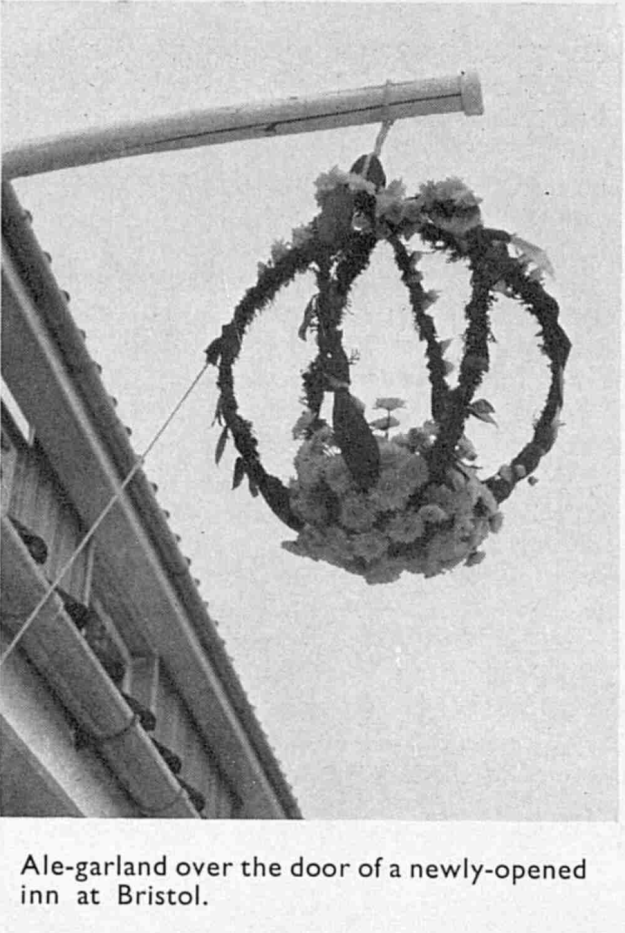
Image © Illustrated London News Group. Image created courtesy of THE BRITISH LIBRARY BOARD!

A longer explanation can be found in this article from the Lewisham Borough News, Tuesday 16th January 1951:

STORY OF THE ALE GARLAND
‘Conning The Brew’ In Ancient Times

By Stephen E. Hutchins

The hoisting of the ale garland in City and suburban taverns which is much observed about the New Year together with what is known as “ale conning” is regarded as the revival of a custom of the time of William the Conqueror and involves an expression of goodwill to all, and a kind of public protest against all sorts of vexatious regulations.

In olden days all garlands were to be seen outside all the inns at the festive season as a sign that fellowship and hospitality reigned within.

To “con the brew” is to sip at the mulled ale, the wassail bowl, and the ale posset, and the lambs wool — (meaning pulped roasted apples, sugar, nutmeg and ginger in warmed ale) — and pronounce it to be an excellent concoction.

The ale garland is usually displayed from a pole known as the “ale-stake” — in former days such ale-stakes had to be exhibited by inn-keepers to tell the travelling ale-conners that the new beers were ready to be tested.

The punishment for brewing poor beer was to be ducked in a pond in the ducking stool.

Under an Act of 1604 ale houses had to be inspected by constables to see if they were properly conducted and the object of the law was “to restrain inordinate tippling in inns and alehouses” and to confirm that the true use of the English inn was to relieve wayfarers and supply victuals, and not to entertain idle people and encourage them to spend their money.

Penny a Quart

Fines were levied by the constables and church wardens on people who indulged in drink for “an unreasonable time” and the money was given to the poor.

There was a fine of 5s. for being drunk and the alternative if the offender was unable to pay was to be awarded a spell in the stocks.

The price of the best ale was fixed at one penny a quart and “small” ale was one half penny a quart.

In 1614 the City had a thousand breweries with 40,000 barrels in their cellars. Beer was made at the back and sold for consumption in the front.

The old English ale was made from malt, yeast and water, and eventually beer flavoured with hops, called “hopping beer,” was brought in from Germany. This beverage became very popular.

Inns were often owned by the Church and we still have reminders of this in titles like the Seven Stars, the King and Keys, the Mitre and the Angel and “The Case is Altered” — the later signifying the period after the Reformation when the inns passed to other ownership.

Many inns were in the nature of hostels for pilgrims to the religious shrines. The poorest often received free hospitality and they were usually situated in a town near to the abbey or cathedral.

Among notable examples of this type of establishment may be listed the Falstaff of Canterbury, the “Star” at Alfriston, and the Pilgrims Rest beside Battle Abbey. The “Star” was a house of call for pilgrims travelling eastward to the noted Abbey at Battle and it was owned by the Monks of Battle.
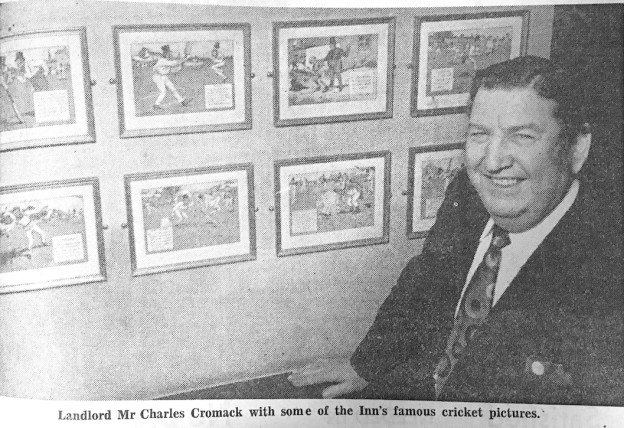
1973 : News article on The Cricketers pub

In 1973, the Mitcham News & Mercury ran a series of articles on local pubs. Here is their report on The Cricketers, published on 16th November 1973:

Landlord Mr Charles Cromack with some of the Inn’s famous cricket pictures.

WARTIME PHOENIX BECAME TODAY’S CRICKETERS

THE worst moment for the Cricketers in Mitcham’s Cricket Green was when they had to decide whether to blow up the pub or the Vestry Hall.

It happened during the war when, with the compliments of the German air force, a land mine dropped between those two most important buildings in Mitcham.

The mine didn’t go off right away and the locals had time to put up a blast shield but, as any ex-air warden knows, there’s no point in setting it up on both sides of the bomb – there has to be somewhere for the blast to go.

There are still people in Mitcham who remember the arguments that raged over which building would be added to the list of bomb sites in the area. And there are some who reckon they made the wrong choice in saving the Vestry Hall.

Bar in store

But, finally, the bomb went off and that made way for the Cricketers as it is today. It was rebuilt about 15 years ago – just as the regulars were getting used to the bottle store behind the pub.

But whatever anyone says about the loss of the old pub which had graced the Cricket Green since the late 1700s, the new Cricketers is a worthy successor.

It has been going long enough not to have that fiercely modern look of the new or “done up” pub yet, it’s not so old as to be plain uncomfortable. And with the atmosphere it inherits from its cricketing tradition, it emerges, rightfully as a well-known pub of character.

The first thing you notice in the lounge bar are the dozens of photographs of cricketing “greats”. A long line of former county players stare down slightly disapprovingly as the customers line up at the bar and the whole of one wall is given over to a colour photograph of Mitcham playing Streatham on the cricket green. On the way to the gents there is a collection of cartoons depicting the rules of cricket.

But, then, it’s only right that the pub should hang on to some of its history – after all, for years it was used as the pavilion.

Atmosphere of a different kind is provided by the licensee, Charles Cromack. He’s an enormous man, given largely to blue suits and yacht club ties, who seems to spend most of his time on the outside of the bar where he calls for drinks on the house as if the stuff was still a penny a pint.

With him is his wife, Joan, with her pewter goblet from the London Victuallers Golfing Association. Together they make the ideal couple to run a pub where businessmen come in to unwind.

They come from the executive floors on the local industrial estates and from the many offices fronting the cricket green. Dozens of them make the daily trek to the pub where they set about a lager, a laugh and lunch.

Overseas representative for Downs Bros of Church Path, Mr. Richard Dickinson, said: “We mostly come here for the beer – after all it is real beer, from the wood. But then there’s the food as well. I think the Cricketers serves real pub food and, for that, it’s one of the best in the area.”

Down’s Transport manager, Mr. Peter Galtrey was there too: “I like to eat in the bar as a rule but people entertaining clients can go in the restaurant upstairs. Anyway, you generally find the lunches here are pretty good.”

And so they are, Charles Cromack admits: “I suppose the food here is as important as the drink. Our restaurant does very well.”

The restaurant is really a small meeting room cosily decorated with a red colour scheme and complete with bar and barmaid. It is perhaps too small, giving the impression of a country tea shop but there’s a good meal to be had there with melon and 8oz. steak, mushrooms, tomatoes, peas and potatoes, then a cheese board and coffee at £1.58p.

For those who prefer to eat in the bar, a good helping of real home-made steak, kidney and mushroom pie comes at 27p and chips and peas at 7p a portion.

Penny bonus

A ham sandwich costs 18p and arrives with a knife.

Service is good and quick, and very reasonable considering there always seem to be about five people milling around behind the bar. Barmaid Irene Hogg, the pub’s 53-years-old heart-throb, dishes out a warm wlcome and refers to everyone under 90 as “young man.”

A bonus heart-throb is 25-years-old Penny Balsom, a very shapely clerk at the borough’s health department in the Vestry Hall. All eyes swivel towards the door when she walks in with an absurdly unintentional sex appeal.

The lunching businessmen were most flattering in their comments but none of them wanted to be quoted: “Wouldn’t want the wife to see it, old man . . . ”

Auburn-haired Penny just opened her eyes very, very wide and said: “I never knew I was any sort of a mascot or anything. I just come here because it’s handy at lunch time and I like the people.”

There was an immediate murmur of approval at these words.

Finding out why the regulars in the public bar liked the Cricketers was more difficult. Almost to a man they said it was the lousiest pub in Mitcham, and Jim Goodsell added that the governor wasn’t too sociable in the “public”. Why not go somewhere else then?

“Because he comes here,” he said and pointed to his brother Fred.

Argument

Fred Goodsell thought for a moment, hesitated over saying he was only there because Jim was there, and finished up with: “You can always find a good argument in here.”

Immediately he had one. New faces popped up to say it was the only place you could get decent beer while others came to play crib or darts.

Certainly none of them could have been attracted by the bar itself. It seems to have missed out on all the effort that produced all those cricketers in the lounge. Instead there is dark green wallpaper, peeling at the edges and an obscene sort of trough at the foot of the bar which catches cigarette ends.

But there’s a lot to make up for it. Just outside the public bar is a rose garden and, although there’s plenty of traffic noise, it’s a real suntrap in the summer.

Strangely enough, not many people seem to know about this, most of them sit out in front of the pub where they can rest their feet on the bumpers of cars in the car park and catch glimpses of the cricket green through the traffic.

The Cricketers isn’t a big pub so there’s no room for bar billiards or any of the more traditional pub games but there’s a flourishing darts club and a football team; every year there’s a coach outing to the races at Goodwood.

The public bar has a TV and in both bars are one-arm bandits which pay out a ceiling of 10p in cash and the rest in tokens.

There is no juke-box – which gives the lads in the public bar something to moan about; but there is piped music on tape.

Mild, disappearing from most pubs these days, is still on draught at the Cricketers; bitter comes from the wood as well. There’s draught Guinness, draught lager and Worthington “White Shield”, as well.