Tag Archives: Western Road

Zion Congregational Chapel

A chapel that was in Western Road, the site of the present Lidl store.
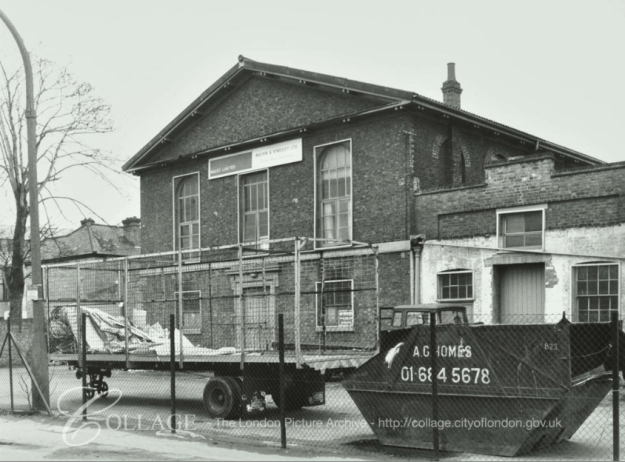
Image courtesy of Collage - The London Picture Library - http://collage.cityoflondon.gov.uk

1978 Image courtesy of Collage – The London Picture Library – http://collage.cityoflondon.gov.uk

1910 OS map shows ‘Chap.’ (chapel) and ‘Sch.’ (school). The site is occupied by Lidl (in 2017).

The chapel and a Sunday school next to it was built in 1819. It was deconsecrated in 1930 and sold off and used by light industrial companies. Around 80 bodies were reburied in the new London Road cemetery.

The building was demolished in the late 1980s.

Source: Mitcham Histories : 14 Upper Mitcham and Western Road, by Eric Montague, chapter 9 ‘Zion Chapel’.


From the Mitcham Advertiser of 1st May 1914 :

One of the old landmarks is Zion Congregational Church, which this week celebrated its 95th anniversary with a series of successful gatherings. For close on a century good useful work has been carried on, and the church has a record for long service. It used to be known simply as Zion Church, one of the real old Independent churches. The Rev. R. Richman, the present minister, has served in that capacity for 34 years, more than one third of the church’s existence.

Mr Richman is a well known and highly respected figure in Mitcham. His work has not been confined to the church alone, for he has always taken a keen interest in the local government, and he has served on the Parish Council. He is still a member of the school managers, and in that direction does good work. In his church he is surrounded by body of zealous workers, many of whom have been engaged there for a long period of years, in fact one at least can boast of a longer record than the pastor himself, and that is Mr Gardener, the secretary of the Sunday school, who has held that post for 39 years.

This has been quite a week of presentations in Mitcham. On Monday night a presentation was made to Mr A. Gardener at Zion church in recognition of his 25 years service as a deacon. He is also Superintendent of the Sunday school. The name of Gardener has been associated with Zion Church for years. Mr Gardener’s mother was a descendant of the Huguenots. Yet another presentation at Zion Church was to Mr Simmons, another deacon, who has also been treasurer of the church, this week celebrated his silver wedding, he having been married at Zion Chapel 25 years ago.

For more details of the early vicars, see the ‘Mitcham entry in the Story of Congregationalism in Surrey‘.

Married at the old Zion chapel on 13th January 1883, was Mr and Mrs Robinson Henery AMBROSE, who celebrated their golden anniversary at the Mitcham Garden Village on 13th January, 1933, according to the Mitcham News & Mercury of that date. They were active members of the Salvation Army.


Maps are reproduced with the permission of the National Library of Scotland.
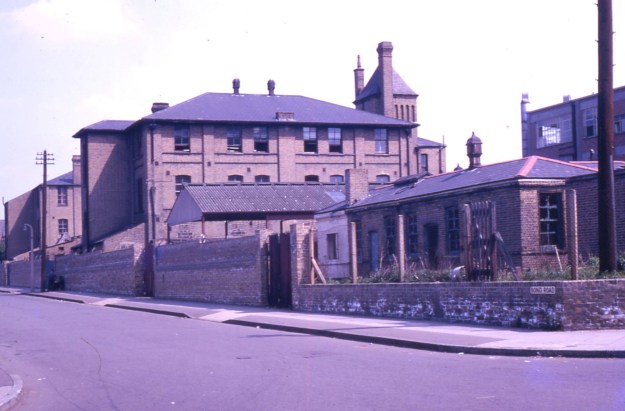
Behind the scenes at Pye Records in 1959

Pye Records Ltd. was on the James Estate, Western Road, part of which can be seen in this photo. The site is occupied today by Asda, Hoo Hing etc.

Clip of photo taken by Eric Montague in 1966. Reproduced by kind permission of the Merton Historical Society. Image reference mhs-em-um-40

From the Mitcham News & Mercury, 23rd October, 1959, page 3.

Behind-the-scenes for your favourite “pops”

IT IS A RECORD-MAKING BUSINESS By Wendy Scott

The green light flickers in a cafe jukebox, an automatic grab arm selects a record and the music plays out of the loudspeaker.

The foot-tapping crowd who listen to their favourite “pops” are not really concerned with how that spinning disc began it’s life or with the marvel of music that is translated from the minute grooves.

Yet the manufacture of gramophone records is an important industry today, with the various companies striving to woo the public with their current releases and gimmick productions.

Since the war, sales have far surpassed the wildest dreams of production managers. Today the factory workshops hum with constant activity in order to keep retailers supplied with large stocks of classical, jazz and other popular music discs.

Pye Records Ltd., whose factory is at Western Road, Mitcham, follow production methods that are typical of the disc industry.

Here thousands of records daily are pressed, packaged in colourful glossy covers, checked and sent out to waiting delivery vans.

The story of how records are made – with the combined skill of the factory’s several hundred employees – is complicated, yet interesting.

The heart of the factory is away from the main office block. It is here, in a secluded room that the taped music is initially transferred on to a lacquer coated aluminium disc. Surrounding the operator are various dials and control knobs which modulate tone and quality.

INTO TUBE

The recording room has all the atmosphere of a science fiction setting. As the sapphire needle on the master cutting lathe gouges into the soft lacquer it is converting the electrical impulses from the tape back into vibrations and inscribing them into the surface of the acetate disc.

The gouged out surplus material is fed into a tube and collects at the back of the machine in a large bottle.

The master acetate, as it is termed, then undergoes some beauty treatment – a little harsh, perhaps as it is mainly bathed in a chemical solution.

For the technically minded, it is coated with a silver solution and placed in an electro-plating bath. It is then treated by workers wearing rubber gloves to prevent injury from the acids, and lowered into a bath where copper anodes are suspended. The reverse side of the metal disc is made in the same way, forming the two halves of the record.

The record, still in a metal state, but polished and trimmed, is then transferred to the pressing department. Here numerous operators sit at the pressing machines. At their side is a sack of plastic composition crystals looking rather like grains of rice.

This is weighed according to size of the record and then gently warmed on an electric hot plate which is reminiscent of the household gadget.

The operator sandwiches the plastic ball between two record labels, clamps the nickel prototypes together and the record emerges.

Near the pressing department are a few operators who hole the records and make incisions so that they may be played on American and other record players that differ from English makes.

CHECKED

Nearby, in soundproof boxes lined with acoustic tiling, a selection of finish records are played through to check for irregularities in sound.

Fifteen girls – most of them live in the Mitcham and Tooting area, – then receive the discs for final checking and wrapping. The discs are dusted and sleeved with paper or polythene protective covers.

They are then neatly slipped into the glossy covers and sent to the packaging and dispatch department.

So next time you walk into your local record store to select a disc, remember the work and processing necessary before your favourite song or classical suite is brought to the living room.