Housing built on a former golf course, and named after it, south of the river Graveney and north of the railway line the connects Tooting and Streatham stations. The area was in the urban district of Mitcham and, despite the SW17 postcodes, is part of the London Borough of Merton today.
The area was part of the Furzedown Estate, owned by Sir Charles Seely, whose name was given to one of the roads. The golf course had been rented by the Tooting Bec Golf Club, who declined Sir Seely’s offer to sell it to them. Source: Golf’s Missing Links.
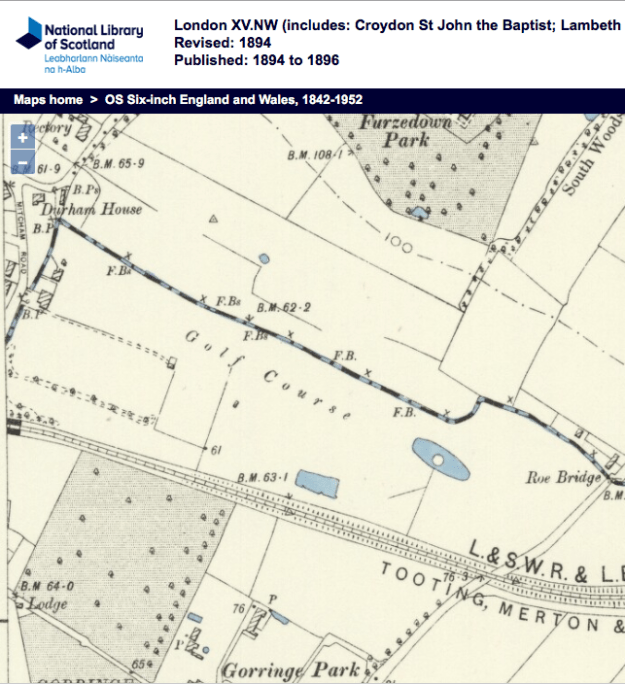
1894 OS map
From the Birmingham Mail – Thursday 15 February 1906
WHERE CHARLES PEACE WAS A VISITOR.
Furzedown Park, one of the few remaining country estates within the county of London, has been sold by Sir Charles Seely to a gentleman who intends to cut it up for building purposes. It lies between Streatham and Tooting, and its mansion commands an extensive view of the Surrey hills. Among notable visitors to the mansion was Charles Peace, who went uninvited, and carried away many interesting souvenirs in the form of plate and other valuables. Instead of entering by the front door, Charlie climbed a tree, and took advantage of a branch that almost touched window. The tree is regarded as one of the curious things of the neighbourhood, for Charles Peace was great man —in his way.
Maps are reproduced with the permission of the National Library of Scotland.
 Mitcham History Notes