Category Archives: Buildings

Walpole’s Stores

General stores that was on the north side of Western Road, as it met Upper Green West and the Nag’s Head pub.

The name Walpole’s Stores can be seen twice on the front of the building and on its right hand side wall.
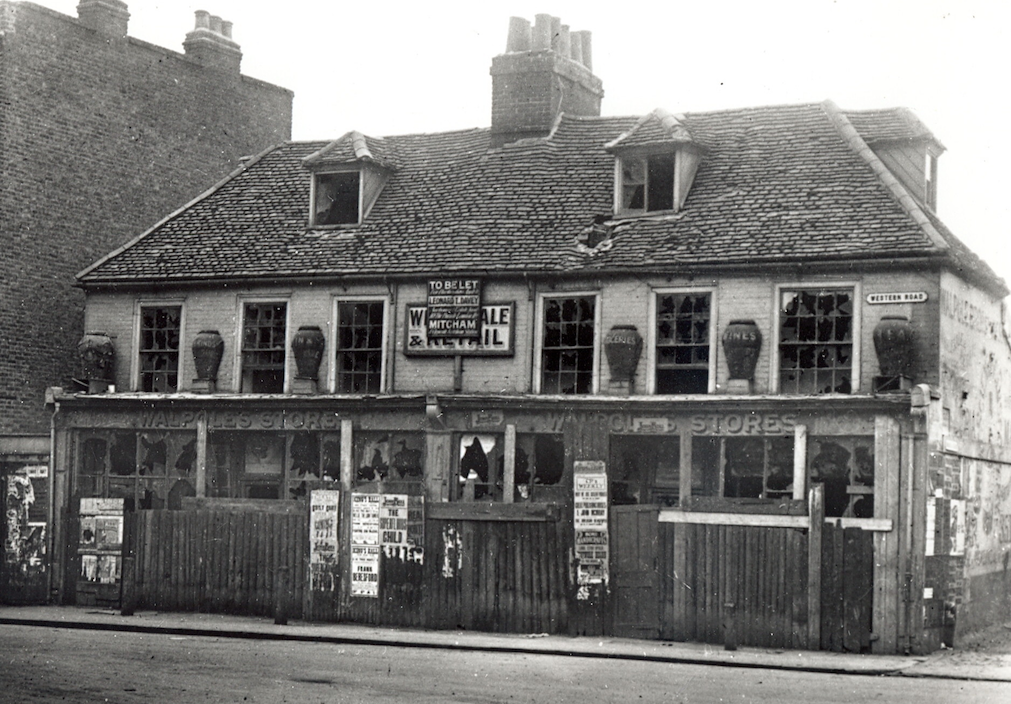
Walpole’s Stores
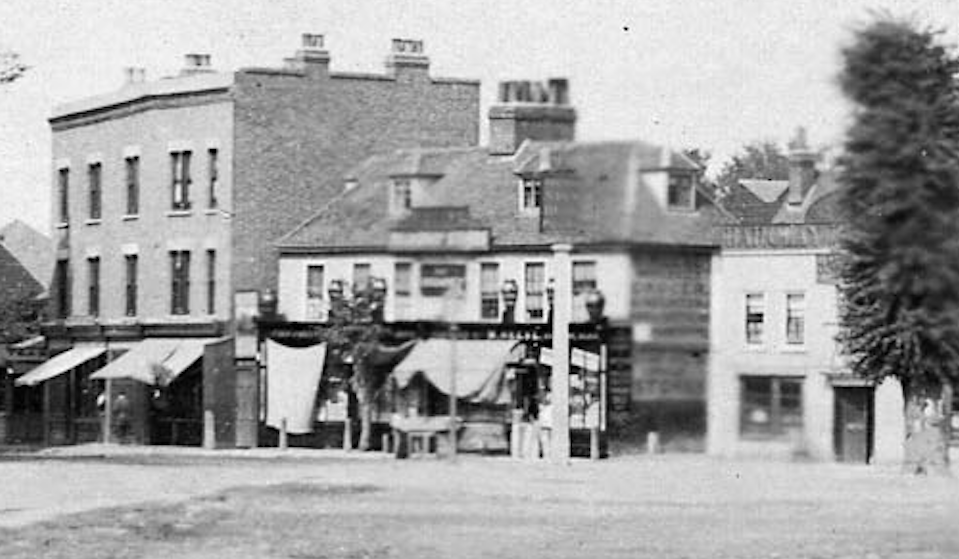
older view of the stores when in use

In the 1896 and 1901 directories, Walpole Brothers is listed at Upper Mitcham. In the 1904 street directory, George Walpole is listed as grocer, but not in the 1911 directory.

Referred to as The Broadway Stores by Eric Montague in the book Old Mitcham.

The newspaper articles below are via the British Newspaper Archive

News Articles

Croydon Guardian and Surrey County Gazette – Saturday 09 June 1906

MITCHAM
RAILWAY FRAUD

— George Walpole, of Walpole Stores, The Broadway, Upper Mitcham was summoned by the London, Brighton and South Coast Railway Company, at Tower Bridge Court, for railway fraud. He pleaded gullty.

— Mr. Austen, who represented the railway company, said that there was a special examination of tickets at London Bridge, and defendant tendered the fare from Queens-road Station, Peckham. After he had been questioned, he said to Mr. Sumner, the chief ticket inspector, ” I can see you are determined to find out. I joined the train at Mitcham Junction without a ticket, and on arriving here and seeing you were examining all tickets, I tendered the fare from Queens-road, thinking it would be all right.’

Defendant expressed sorrow, and was fined 20s. and 23s. costs.

From this news article, it would seem that the Western Road/Upper Green West was known as the Broadway, Upper Mitcham, whereas the Broadway, Lower Mitcham was that part of London Road south of the White Hart.

Croydon Guardian and Surrey County Gazette – Saturday 10 March 1906

NO LIGHT.

George Walpole, of the Broadway, Upper Mitcham, was summoned for driving a cart without a light at London road on Feb. 16th.

— P.S. 26 W gave evidence, and defendant, who admitted the offence, was fined 2s. and 4s. 6d. costs.

Croydon Guardian and Surrey County Gazette – Saturday 27 December 1902

WANTED (after Christmas) a strong, respectable GENERAL; age 20 to 25; clean and willing; knowledge of cooking required; good references. Apply, Mrs. Walpole, Broadway, Upper Mitcham.

Poplars School

Photo originally by Tom Francis. Clip from Merton Memories reference Mit_Schools_18-1

From pages 45 to 47 of Eric Montague’s book Mitcham Histories: 2 North Mitcham

The Poplars was Mitcham’s first workhouse, created in 1737 by the adaptation of what had until that time been a gentleman’s house. The building reverted to being a private residence around the time of the French Revolution, and in about 1825 it became the Poplars Boarding Academy for Young Gentlemen.

The social reformer Havelock Ellis attended the school, and wrote about it in his autobiography My Life; excerpts below are from the Archive.org website.

NOW that I was twelve years old my mother decided that I ought to be sent to a boarding school. It was to be a small private school, for she had heard too much evil of large public schools to care to send her only son to them. Moreover, our means were not sufficient for an expensive education. We lived, indeed, in ease and comfort, from a lower middle-class point of view, on my father’s earnings as sea-captain under more prosperous conditions than have always prevailed in the merchant service since, and on a small income of my mother’s, and until I left home I never knew what money worries meant — though I have often had occasion to know in the years that have followed — but as my parents always lived well within their means a lavish expenditure even on so important a matter as education was out of the question. My mother accordingly visited a school at Mitcham which, from what she had heard, seemed likely to furnish a desirable education at a moderate cost. The house was large and old — one of the numerous houses wherein Queen Elizabeth is said once to have slept — and my mother was of course shown over it with all due consideration. But the ill-ventilated schoolroom full of boys smelt so fusty and dirty that she conceived a dislike of the place and came away without making any arrangements.

On her way back to Tooting Station she had to pass another school, The Poplars – a curious old wooden house, long since pulled down, though the brick schoolroom yet stands — facing an open triangular space with a pond which we called Frogs’ Marsh. She entered, and was so pleased with everything here that she arranged at once with the headmaster to send me to him, although the terms were higher than she had proposed to pay. I was to be a weekly boarder, for my mother, though she never made any similar arrangements for her daughters, wished to preserve a home influence over her son and to direct his religious education.

My mother was pleased with the ways of The Poplars, but it is not possible to make any high claims for its educational methods. My headmaster, Mr. Albert Grover, was an oddity, a tall middle-aged man, looking much older than his years, with a long grey beard, a bald head, and a blind eye. He had some resemblance to Darwin, but he cherished much contempt for that great man’s doctrines, and even published a little anti- Darwinian pamphlet in doggerel verse which so nearly verged on the obscene that it could not be sold on railway bookstalls. Grover had a weakness for verse; he liked to teach facts and dates in doggerel, such as:

“Preston Pans and Fontenoy
Were fought in 1745, my boy.”

It would be easy to write amusingly of the life at The Poplars, but beneath its eccentricities it was essentially commonplace and old-fashioned, quite comfortable, certainly, and without hardship. So far as my headmaster was concerned, the influence of school upon me was neither good nor evil. He was a kindly man who always treated me well. I do not remember that he ever punished me or ever had cause to, but he inspired no love for any kind of learning, and I continued, as I had begun, without aptitude for formal studies.

I had long been interested in the old English dramatists. On my way to and from school at Mitcham I used often to buy one or another of the extensive series of old plays then being published by Dick in small type at a penny each; Marlowe as well, of course, as Shakespeare, I had long possessed and loved.