Category Archives: Industry

Varnish for Maps

Of the companies listed in the 1911 commercial directory of Mitcham, 17 of these were varnish manufacturers.

One of the uses of varnish was as a waterproof coating for maps, as described in this article from 1913.

Waterproof Varnish for Cardboard.

If cardboard is painted with celluloid varnish nice, smooth, washable surface results. This is the varnish with which almost all maps, for land or marine use, are superficially coated, as well as drawings and manuscripts subject to much handling and varying degrees of atmospheric tumidity, even to wetting. The varnishing is effected, either coating the cardboard with the aid of a flat brush and drying in the air, or by dipping. Papers that have been varnished in this way gain after drying 40 to 50 per cent, in strength, and cardboard so treated is perfectly washable, without warping subsequently. Moreover, the coating of celluloid varnish permits the bending of the cardboard in any direction, for it is elastic enough not to break.

Celluloid varnish is made by dissolving celluloid in amyl acetate. The emulsion can be cleaned from waste roll photographic film, and the resultant clean celluloid used. It is simply cut into small bits, placed in the amyl acetate, and allowed to dissolve, shaking occasionally. The usual formula calls for 120 to 150 grains of celluloid to 16oz. of the acetate. But the exact proportion does not matter particularly. Made according to the formula, it is rather too thick, and requires too long to dry. The best way is to let the acetate dissolve about all the celluloid it will take up, and then add nearly enough alcohol to double the bulk of the solution. If too much is added, there will be some of the celluloid thrown down. Made in this way it is much cheaper, dries much quicker, and flows better, being thinner.

—“ Camera Craft.”

Source: Sheffield Weekly Telegraph – Saturday 15 February 1913 from the British Newspaper Archive (subscription required)

Precision Grinding Ltd.

Engineering factory in Mill Green Road, off west side of Carshalton Road, south of Mitcham Junction. Listed in the 1954 telephone directory as Tool Gauge Makers.

Possibly the ‘Engineering Works’ on the 1953 OS map:

1953 OS map

Precision Grinding Mill Grn Rd Mitcham

PG Ltd
The Pioneers of
Optical Form Grinding

Invite your enquiries for:

FORM AND PLAIN PLUGS AND RINGS
FLAT AND CIRCULAR FORM TOOLS
TOOLBITS (C68+)
FORM, GAP AND RECEIVER-GAUGES
FORM MILLING- AND GEAR-CUTTERS
FORM DIES and FORM PUNCHES FOR PRESS TOOLS
SPLINE AND GEAR GAUGES
FORM DRAWING DIES
FORM ROLLS
FORM TEMPLATES
HEAT TREATMENT

Also
OPTICAL FINE MEASURING EQUIPMENT

Precision Grinding Ltd
Mill Green Road, Mitcham, Surrey
‘Phone: MITCHAM 3014/6

A subsidiary of George R. Alexander Machinery Ltd., 82-4 … Birmingham
‘Phone : ASTON ????

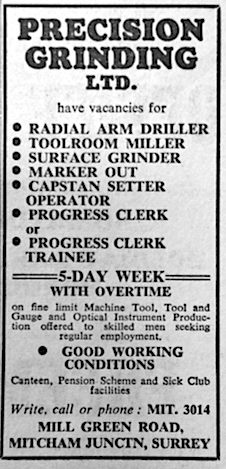
Ad from 1961:

1961 ad

Text of ad:

PRECISION GRINDING LTD.
have vacancies for

  • RADIAL ARM DRILLER
  • TOOLROOM MILLER
  • SURFACE GRINDER
  • MARKER OUT
  • CAPSTAN SETTER OPERATOR
  • PROGRESS CLERK
  • or PROGRESS CLERK TRAINEE

5-DAY DAY WEEK
WITH OVERTIME
on fine limit Machine Tool, Tool and Gauge and Optical Instrument Production offered to skilled men seeking regular employment.

  • GOOD WORKING CONDITIONS

Canteen, Pension Scheme, and Sick Club facilities

Write, call or phone: MIT. 3014
MILL GREEN ROAD,
MITCHAM JUNCTN, SURREY

Earliest ad found on the British Newspaper Archives is from the Daily Herald – Friday 28 October 1938:

ESTIMATOR required for tool and gauge engineers.

Apply Precision Grinding Ltd., Mill Green-road, Mitcham Junction.

Croydon Times – Saturday 10 October 1953

A VACANCY exists the Planning and Estimating Department of a Machine Tool and Small Tool Manufacturing Company in the Mitcham Junction, Surrey, area. Applicant must have served an apprenticeship on this type of work. An interview can be arranged to suit applicants’ convenience.

— Please write Messrs. Precision Grinding Limited, Precision Works, Mill Green Road, Mitcham Junction, Surrey.


On Merton Memories is a photo of foreman Charles Fuller and John Wells who received the Queen’s Jubilee Medal in 1977.

Maps are reproduced with the permission of the National Library of Scotland.