Category Archives: Industry

1908 Pascalls Blackfriars Road Oasis

BLACKFRIARS ROAD OASIS
MAGICAL TRANSFORMATION OF A FACTORY REFUSE YARD.

Messrs. James Pascall and Son, the well-known manufacturing confectioners, of Blackfriars-road and Mitcham, have long enjoyed the reputation of being foremost among considerate employers of labour, and they appear to be ever on the watch to add to the social enjoyment of their eight hundred male and female hands, who not only possess a Club and Institute, but also a Convalescent and Holiday Home at Leigh-on-Sea. Less than six months ago there was large refuse yard at the rear of their factory in Valentine-place, and it occurred to the head of the firm that it might be converted into a recreation ground garden. Twenty-eight of the employees were promised an equal piece of ground to cultivate, and they lost no time in setting to work. The refuse was cleared away, walks were constructed, half-a-dozen cartloads of good soil were carted from Mitcham, and a number of small trees were planted. Soon it was discovered that the female hands had been “left out in the cold,” whereupon Mr. Pascall offered to present plants to all who would undertake to cultivate them and compete for prizes this summer. The experiment was a success; fewer than twelve hundred plants were handed over to the young people, who watched with tender care the growth of the various flowers.

The first show in connection with the scheme was held yesterday (Thursday), when Mr. and Mrs. Pascall, accompanied by Mr. Sydney Pascall, took part in the prize distribution.

Mr. Pascall congratulated the competitors on the success of their efforts. The display was a most creditable one. They could not have a garden city there, but they could do their best to have a garden in the city. He thanked his employees for the way in which they had used the ground placed at their disposal, and expressed the hope that next year they would have even a better show. (Applause.)

Mrs. Pascall, in distributing the prizes, also expressed her satisfaction at the excellence of the show, and said an encouraging word to those who had not been successful in winning prizes.

Mr. Sydney Pascall playfully observed that they had long been famous as the producers of sweet things, but now they were famous as the producers of the wonders of Nature. (Applause.)

The cut flowers exhibited at the show were sent to the Evelina Hospital.

Appended are the names of the prize winners:—

Garden Plots.— Mr. Barrett, 1; Mr. Richardson, 2; Miss Russell, 3.
Geraniums. — Miss Norris, 1; Miss Punter, 2; Miss Burke, 3.
Fuchsia. — Miss Punter, 1; Miss Smith, 2; Miss E. Brigden, 3.
Ferns. — Miss M. Booker. 1; Miss Punter, 2.
Marguerites. — Miss Sanders, 1.
Petunia. — Miss Tuker, 1; Miss Kearney, 2.
Verbena. — Miss Isaac, 2. No 1st awarded.
Cut Flowers. — Miss Smith. 1. No 1st awarded.
Prize for best Garden Plot (A Department).— Mr. Richardson.
Special prize for General Excellence. — Miss Punter.

Source: South London Press – Friday 07 August 1908 from the British Newspaper Archive (subscription required)
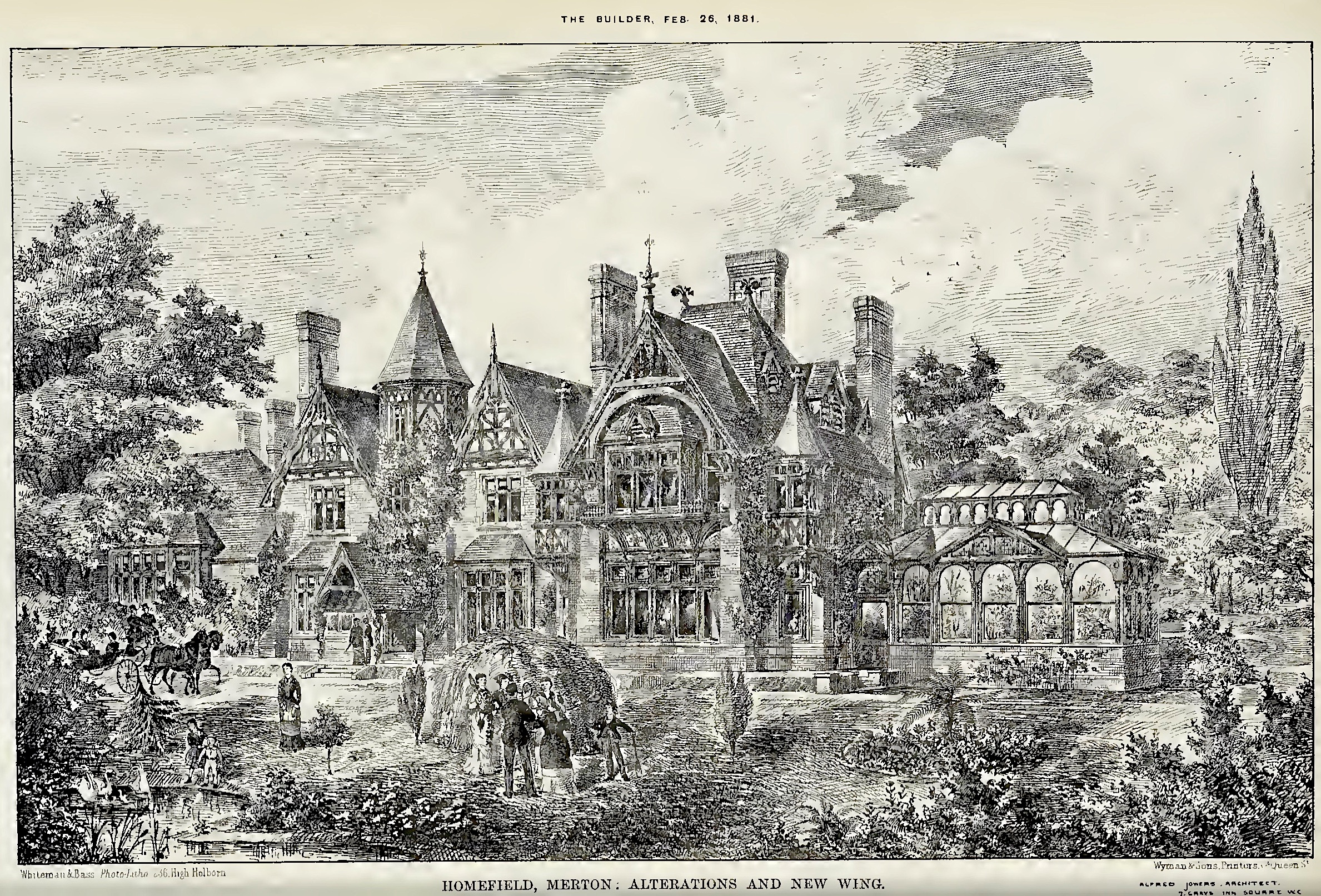
Homefield House

From The Builder, page 245, 26th Feb 1881:

The two view (exterior and interior) which we give in our present number, illustrate a portion of the alterations and additions recently made to this residence, comprising chiefly the construction of a central hall opening to the staircase, with a stone arcade, the erection of a new wing containing a drawing-room, with guests’ rooms and boudoir over, the re-modelling and re-erection of tbe conservatory in a new position, and various alterations and additions to the kitchen and domestic offices.

Tho hall is panelled the whole height in wood-work, the decoration of the panels resembling “Tarsia” work, the ceiling being also panelled, and having moulded beams with pendants at the intersections.

The general effect of the decoration is a golden brown, the floor is of marble mosaic, and the stonework and steps, and shafts are of red Mansfield stone and Belgian “T” grey marble, the windows being filled with stained glass. Teo chimney-piece, in red Dumfries stone, deeply recessed, moulded, and carved, and having a carved and traceried hood in wainscot, running up to the ceiling cornice, with a central painting (by Weekes), forms a picturesque feature.

The lower portion of the staircase has been reconstructed, and now faces the hall, a screen, with carved and moulded shafts bearing a cusped arcade with carved spandrels, being carried across the entrance vestibule; the newels to stairs are also moulded and carved, having between them pierced and carved panels. The wall-surfaces of the staircase are decorated in tones of blue, the woodwork being black.
Tbe drawing-room is panelled to a height of about 8 ft., finished with a moulded and embattled cornice. The architraves to doorways are enriched with carved beads and moulded shafts, carrying coved heads with moulded ribs, open baluster work, cresting, and pendants.

The ceiling has a geometrical setting-out of plaster ribs with enriched pendants at the intersections, and a frieze in low relief, and the floor has a central filling of French oak, “ herringbone,” with a border of wainscot, walnut, and ebonised pear-wood.

The present scheme of colour is kept light, but low in tone, with some gold, increased richness being intended to be given later on by the painted frieze and the introduction of figure subjects,— possibly illustrative of some poem or legend,— in the panels, in colour on a gold ground.

Externally the work is executed in old brickwork, red Mansfield stone, and brown tiles, the roofs of the turrets and all the finials being of copper ; the barge-boards are moulded and carved, and all the mullions and woodwork to the windows, turrets, &c., are fully moulded.

The general contract work was carried out by Mr. Geo. Amer, builder, of Catford, and the whole of the decorative and art work generally by Messrs. Harland & Fisher, who also executed the stained glass and the marble mosaic pavement; Messrs. Strode, Turpin, and Tagnon respectively providing the gasfittings, parquet, and marble work; the whole being executed from the designs and under the superintendence of Mr. Alfred Jowers, architect, of Gray’s Inn-square, London.

House in Phipps Bridge, home to the Harland family. The varnish factory of William Harland & Sons Ltd. was just to the north, as can be seen on this 1894 map:

1894 OS Map

1894 OS Map

Merton Memories Photos
1920 view of factory buildings
aerial view of factory


Occupants

1915 Charles BEASELEY

Western Daily Press – Monday 09 July 1934

Land registered in 1935 by New Ideal Homesteads Ltd., see London Gazette Publication date:10 September 1935 Issue:34197Page:5757

Demolished to make way for Homefield Gardens estate, built by Ideal Homesteads, the same builder of Bramcote Avenue and Denham Crescent.


Maps are reproduced with the permission of the National Library of Scotland.