Category Archives: Places

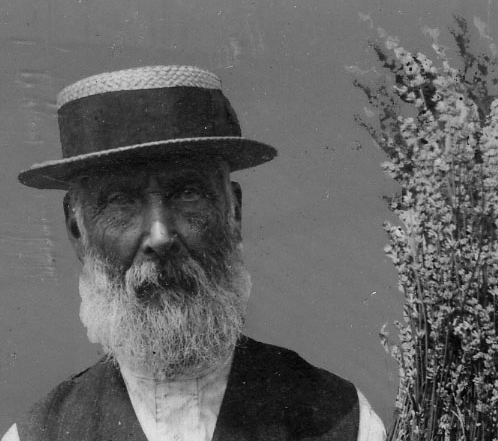
Henry Fowler, Last of the Lavender Growers

clip from Merton Memories photo, reference Mit_People_57-1, copyright London Borough of Merton.

Lavender grower who lived at Lavender House in Bond Road.

He had a stall at Covent Garden from 1882 to 1919, according to this article in the Hull Daily Mail of Monday 28 July 1919:-

Sweet Lavender.

Mr Henry Fowler, one of the largest dealers lavender in the country, who has large gardens at Mitcham, has retired from the Covent Garden stall which he has occupied for 37 years without a break. The first crop of lavender from Carshalton was cut on Saturday, and a few bunches were on sale in the streets.

After the First World War, the price of lavender had doubled, and was grown outside Mitcham, according to this article from 1920:

Mitcham Lavender Dearer.

The first cut of Mitcham lavender, which is ready for market a fortnight earlier this season, has been made by Mr Henry Fowler, of Lavender Nursery, Bond-road, Mitcham, known as the last of the growers. –

It is 1s 6d a bunch this season, which is more than double the pre-war price. The crop, though small, is in fine bloom. Most of it is grown just outside Mitcham, at Wallington and Carshalton.

From the West Sussex County Times – Saturday 17 July 1920.

In 1921 the price was five times that before the war, he said in this article from the Daily Herald of Monday 18 July 1921:

SWEET LAVENDER

Once Flourishing Trade Now Almost Extinct

For the first time in Mitcham’s history, the lavender season has opened without even a sprig of the sweet-smelling plant being on sale in the town.

“It doesn’t pay to handle it nowadays,” said Henry Fowler, well known at Covent Garden as “the last of the Mitcham lavender kings,” to DAILY HERALD representative, “although never do I remember such a figure it fetched in Garden yesterday — 20s. a bundle. Before the war I sold for 4s.!”

Mr. Fowler, who is 76, used to sell as much as 20 tons a season. All the “Mitcham lavender” (offshoots from the original Mitcham stock) is now grown at Carshalton, a neighbouring place, by a Beddington firm of market gardeners.

There are only about five acres left, but next year, Mr. Fowler said, there would be more grown. “And then I shall dabble in it again.”

Mitcham soil grows the finest lavender in the world, but the market gardeners say that other flowers and vegatables are more profitable. Moreover, all the land will soon commandeered for manufacturing purposes.

Distilling lavender is still a big trade in Mitcham, much of the plant coming from Hitchin, Worthing, and other places.

“It is the first time for 40 years I have never had lavender to sell,” were Mr. Fowler’s parting words.

A large lavender distillery was run by W.J. Bush & Co. Ltd.


Henry Fowler had been born around 1846 in Dunstable, Hertfordshire. When he was 35 he was a florist’s labourer according to the 1881 census, which shows him as living at number 6, Dixon’s Cottages (near the present day Gardeners Arms in London Road). In the 1911 census he is listed as a florist, aged 65, with his wife Anna 72, and daughter Nellie 39.

He died in 1925, as reported locally and in the West Sussex Gazette – Thursday 26 March 1925:

Mr. Henry Fowler, the “Lavender King,” hes died. For over 40 years he supplied Covent Garden market with big consignments of lavender. Since 1922 he had been out of the business.

Note that lavender is still grown in Carshalton.

News articles are from the British Newspaper Archives, which requires a subscription.

Rigid rules of the almshouses in old days

Clip from Merton Memories photo, reference Mit_​Almshouses_​1-2, copyright London Borough of Merton. This early drawing shows the original enclosing wall.

From the Mitcham News & Mercury, 13th May, 1960, page 3.

TWELVE middle-aged women, protected from the cold winds by woollen capes that reached their ankles, wended their way to Mitcham Parish Church in 1829.

Parishioners who saw the women demurely stepping out each Sunday, knew by their dress that they lived at the newly-erected almshouses at the Cricket Green, Mitcham.

For in 1829 the Tate’s Almshouses were constructed to provide “a residence free from rent, taxes and outgoings for 12 poor women who shall be respectively widows or unmarried women … members of the Church of England and who have a legal settlement in the parish.”

TRUST FUND

For generations the Tate families had been benefactors in the parish and in this early part of the 19th century decided it was time to build houses for the poor and set up a trust fund.

The building, familiar to residents today, was built to designs by a Mr. Buckler on the site of a former house belonging to the Tates who lived nearby. When completed a board of trustees was set up to choose applicants for admission to the house and to organise the administrative side.

These well meaning gentlemen included the Rev. James Henry Mapleton, Vicar of Mitcham, who acted as clerk to the trustees; George Matthew Hoare, of Morden Lodge; Sir John William Lubbock, of Norfolk, and William Simpson, squire in Carshalton.

Each of these ebullient figures invested some money in the project as did the foundress, Mary Tate who gave £5,000.

EXPENSE

The almshouses, whose exterior has altered little, are built in the style prevalent in the latter part of the 16th century and were erected “at considerable expense.”

For the poor of the parish there was considerable competition to be allocated a room or small flatlet in the almshouses and when, at last, they were successful in gaining admission, there were some fairly rigid rules to be observed.

A copy of the rules was presented by Worthing Public Library to Mitcham Library in the early 1930s.

One of the main stipulations was that the “almswomen” were to be 50 years old and upwards and were not to have received poor relief in the five previous years. They were to be selected by Mary Tate during her life and subsequently by the trustees.

The women forfeited their weekly allowance of three shillings if they remained outside their home for more than 24 hours without official leave.

They were expected to “behave civilly and orderly and to live orderly and religious lives,” attending the church each week and receiving the sacraments four times each year.

The gates, inset in the high brick wall round the building, were locked at 11 p.m. and an hour earlier during the winter months.

No strangers were allowed into their homes without special permission and on receiving the weekly allowance, the women were “enjoined to discharge all debts contracted in the last week.”

They were also not allowed to keep dogs or alter their apartments without permission.

From this early record, it would seem that the establishment was run on rather austere lines with the matron keeping a book with the names of the women and reporting “for infraction of the rules ” to the trustees.

The women also benefited from “Smith’s charity.” Smith was an eccentric retired London jeweller who travelled Surrey on foot accompanied by his old dog. He was dubbed “ Dog-smith ” and was reputed to leave sums of money where villages received him well.

Some of the correspondence between William Simpson and Mary Tate, who moved to a country house at Loughborough, shows how the women were chosen to live at the almshouses.

SAME COURSE

In February, 1837, he wrote. . . ” our course at the last vacancy was to give notice of it at church and invite each candidate to send in her grounds of admission to the trustees … if it is your pleasure we should follow the same course on the present occasion, will you do me the honour to communicate with me.”

Then again he wrote to Sir Lubbock asking if he considered it suitable to ask applicants to go to the almshouses 44 when particulars of each case be laid before Miss Tate for her decision on the next vacancy.”

But now a proportion of the old rules have been changed and a recently completed modernisation scheme has resulted in a transformation within the building.

The residents — still all women who have lived in the locality for not less than five years—have had their two-room flatlets redecorated in pleasant light colours. Electric light has been installed, inside toilets, baths and new gas stoves in some of the apartments.

There is a new roof and drainage system and other renovations completed by a Mitcham firm to make the homes more comfortable.

The women, who now pay a small nominal rent, are chosen by a seven-man committee of trustees. Following former custom, Rev. John Thorold, Vicar of Mitcham, is the ex-officio trustee.

The memory of the Tate family is carried on, however, for there are several tablets and plaques in the parish church commemorating various members of the family.

Among them is a white marble monument erected to George Tate, “a gentleman of aimiable and accomplished manners,” father of the foundress, who died at the age of 77 in May, 1822.