Category Archives: Transport

Wandsworth Gas Company’s Coal Ship “Mitcham”

19461102-mv-mitcham

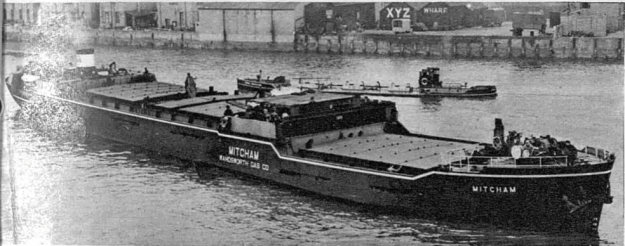
THE LAST WORD IN “FLAT IRONS”: The 1,780-ton coasting collier “Mitcham,” the Wandsworth Gas Company’s new vessel, seen on the Thames at Wandsworth after negotiating the fifteen miles of river from the estuary. When she turns round at Wandsworth there is little room for other traffic to pass. The “Mitcham” has a squat funnel to save her lowering it at each bridge, and her collapsible masts are stepped down into the holds.

The Wandsworth Gas Company are adding several new ships to their fleet, and the “Mitcham” bears a close resemblance to the “Chessington,” details of which were given in “The Sphere” of June 29. She is equipped with sloping wing ballast-tanks, which ensure that the cargo automatically precipitates itself to within the range of the mechanical grabs during the discharging operations.

Source: The Sphere – Saturday 02 November 1946 from the British Newspaper Archive (subscription required)
19460629-mv-chessington

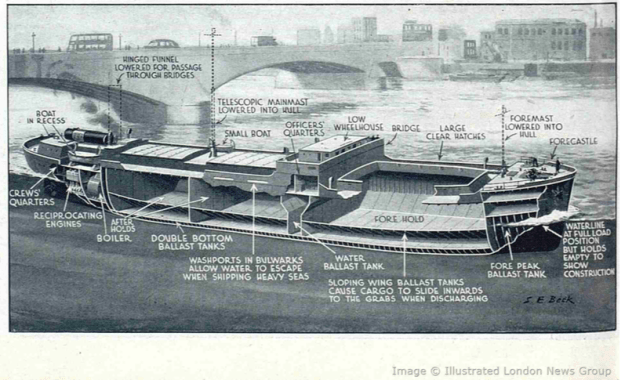
AN IMPORTANT ADDITION TO LONDON’S COLLIER FLEET : A diagrammatic drawing of the S.S. “Chessington,” the largest vessel to pass the Thames bridges. The “Chessington,” belonging to the Wandsworth and District Gas Company, is known as a “flat-iron,” and she is able to carry 2,700 tons of coal on each trip from the Durham coalfields. The ”Chessington” recently completed her maiden voyage, attracting much attention as she came upstream beyond the Pool and Westminster Bridge. She is nearly 260 ft. long, and as she passes under the bridges her funnel lowers in the usual manner and her masts telescope into the holds. The “Chessington” is equipped with sloping wing ballast tanks which ensure that the cargo automatically precipitates itself to within the range of the grabs during discharging operations. The general lay-out of the ship is of much improved pattern, and special attention has been paid to the officers’ and men’s quarters.

Drawing by S. E. Beck

Source: The Sphere – Saturday 29 June 1946 from the British Newspaper Archive (subscription required)
19470308-mv-mitcham

How They Bring The Coal To London

The Colliers which Supply the Gas Works abd the Power Stations

The fuel crisis has thrown into high relief the role of the Thames up-river colliers, the “flat-irons” which supply the gasworks and the power stations with the vital fuel to keep the lights of London burning.

Some of these colliers come from South Wales, making the trip down the Bristol Channel, round Land’s End, through the Straits of Dover and into the Thames Estuary. The majority, however, come from Tyne and Humber ports, and it is upon these that attention has been focused during the recent fateful week.

From Tyne to Thames is no long voyage, but it is very much London’s lifeline and, thanks to the devoted work of the collier skippers and their cres, who through their way through the February gales and ice-floes, London power stations will once again able to build up their stocks. Many of those same men, it must be remembered, braved the perils of the same East Coast trip when they had more than weather to contend with – first the magnetic mine and then the E-boat constantly menacing the ships as they came south laden with their precious cargoes.

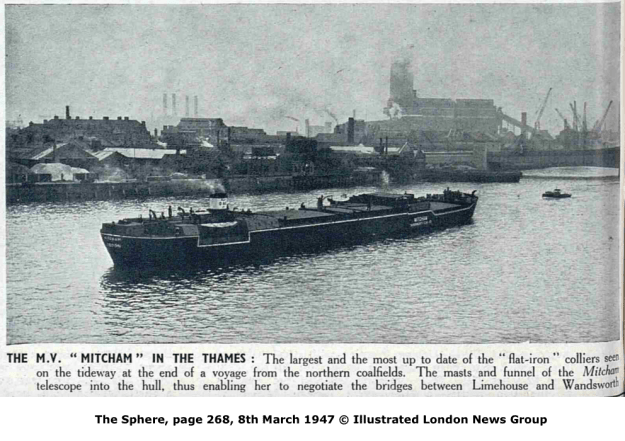
The largest of these ships are found in the Wandsworth and District Gas Company’s fleet, whose works are situated the farthest upstream. Their ships have to negotiate seventeen bridges before they can reach their discharging-point at Wandsworth. This Company has for long set the standard for the design of these of ships, and practically each their ships has been, when built, the largest in this trade. Now they have the first diesel driven “flat-iron” the Mitcham, which can carry a total of 2,700 tons of coal. This compares with 1250 tons for the pioneer ship Wandle of 1909 and 600 tons for the first screw collier, John Bowes, which in turn carried about twice as much as a collier brig.

Depth of water and amounts of head room under bridges are items of paramount importance in up river navigation, and it is essential for the ships to arrive at the wharf during the latter stages the flood-tide. After cargo has been discharged the passage down-river must be begun as soon as the flood-tide appears, for in this light condition the vessel is much higher out of the water.

Source: The Sphere – Saturday 08 March 1947 from the British Newspaper Archive (subscription required)

1855 : Fatal accident on Wimbledon and Croydon Railway

From page 6 of the 30th October 1855, edition of the South Eastern Gazette.

ALARMING AND FATAL ACCIDENT UPON THE WIMBLEDON AND CROYDON RAILWAY.

The above-named line of railway, which it was at first said would be opened on the 1st of October, then on the 15th of the same month, was opened on Monday, the 22nd. The London, Brighton, and South Coast Company issued bills, announcing that they would run 13 trains per diem. The South Western Railway Company also issued bills, stating that they intended running 5 trains per diem, by means of which passengers could be conveyed to the Waterloo terminus. These, however, were not to be what are generally termed “through trains,” but passengers wishing to go to Waterloo station would have to change trains at the Wimbledon station.

The line, which is a single one, is as near as possible upon the same route between Croydon and Mitcham, as that formerly occupied by the earliest railway in England, viz. the old tramway formed at the commencement of the present century, for the purpose of conveying stone and lime from Merstham. Those who recollect the old tramway are aware that after passing Waddon Marsh, there was a short cutting familiarly known as the “high banks,” after passing which it ran upon a level by the side of a farm now occupied by Mr. Atherfold and then across Mitcham-common.

On Wednesday afternoon the London, Brighton, and South Coast train, consisting of a small engine with tender attached, and four carriages, arrived at the Croydon West station, and proceeded on to Mitcham; at the time we learn there were not more than 8 or 10 passengers in the train. When it reached Mr. Atherfold’s farm, and was consequently between the “high banks” and the road leading from Beddington to the Windmill upon Mitcham-common, the engine got off the rails, after which it evidently continued to run for nearly a hundred yards, when the engine and tender went off at the right hand side of the line, and the carriages at the same time went off at the opposite side. The engine immediately tumbled over, and Bingham the engine driver, who it would appear was at the time working the lever, for the purpose of reversing the engine was with the exception of his head and right arm buried beneath the engine. His death must have been almost instantaneous. The stoker (Weller) jumped off and was much scalded, but not otherwise materially injured. The first carriage was completely smashed, but fortunately there were no passengers in it, and those who were in the other carriages escaped with very slight injuries, as did also the guard who was attending to the break, which fortunately was attached to the last carriage.

Intelligence of the event was immediately conveyed to New-Cross station, and an engine, with what they term the tool box, and about a dozen men arrived at the spot at about 7 o’clock; the remains of the unfortunate engine driver however, were not extricated from beneath the engine till past 8 o’clock, when they were conveyed to the Plough public-house, Beddington, to await a coroner’s inquest.

Another report mentions that one of the passengers was from Mitcham.

From page 351 of the 31st October 1855 issue of the Watchman and Wesleyan Advertiser:

On Thursday (sic) night a serious accident occurred on the Croydon and Mitcham Railway to a passenger train in the neighbourhood of the village of Beddington. The line from Croydon to Mitcham, a distance of four miles, was only opened on the preceding Monday. It consists of a single line of rails until its junction with the Croydon and Epsom line, about half a mile from Croydon.

The train to which the accident happened started from the terminus at London-bridge at 4.15. About midway between Croydon and Mitcham, the engine ran off the rails, dragging the tender and passenger carriages after it, for between fifty and sixty yards, until, falling over on its side, its career was suspended. One of the carriages was smashed to atoms, and the driver killed on the spot. There were, fortunately, but five passengers, all second class, and, with the exception of a Mrs. Jacobs, the wife of a retired gentleman residing at Upper Mitcham, who was very much shaken, they all escaped unhurt.

From page 564 of the 7th November 1855 issue of the Watchman and Wesleyan Advertiser, the inquest recommended a speed limit of 20 m.p.h.:

On Monday, the coroner resumed the adjourned inquest on John Bingham, the engine-driver who lost his life on the 24th ult., on the newly-formed West Croydon and Mitcham Railway. Colonel Yolland gave it as his opinion that the accident was caused mainly by the speed at which the engine was travelling. The jury found, “that the deceased met his death by accident, but recommend that the maximum speed, until the lines becomes consolidated, should not be greater than twenty miles an hour.”