Tag Archives: 1874

Blue Houses

Cottages, originally painted blue, near the Ravensbury Arms pub, on land between Croydon and Carshalton roads.

From a Percy Mayhew postcard. The Ravensbury Arms is on the left.

From a Percy Mayhew postcard. The Ravensbury Arms is on the left.

History

Eric Montague, in his book Mitcham Common, says, on page 63, that this area was called Sheldon’s Corner, the earliest mention of which was in 1738. Montague also said that the theory the cottages were painted blue was to match the stables of the Surrey Iron Railway. He agrees though with early railway history expert, the late Charles E. Lee, who dismissed it.

Merton Memories photos

1870
1890
1910 colourised

6 buildings can be seen on this 1866 OS map.

9 houses according to this 1874 auction.

In the booklet 50 Years at Grove Mills, Mitcham by Mr E.B. Hedger, fireman Charlie JORDAN, employed by John S Deed & Sons, lived in one of these cottages in 1907. See page 87 of Mitcham Histories : 6.

Occupants in Electoral Registers
1910

James HOOKER
John JORDAN

4 houses on this 1910 OS map and 1952 OS map.

The Land

Although surrounded by Mitcham Common, Land Registry title SGL704178, it is not part of it.

Mitcham Common - registered land map

Mitcham Common – registered land map

London Borough of Merton own two plots of land, shown on this map in red:
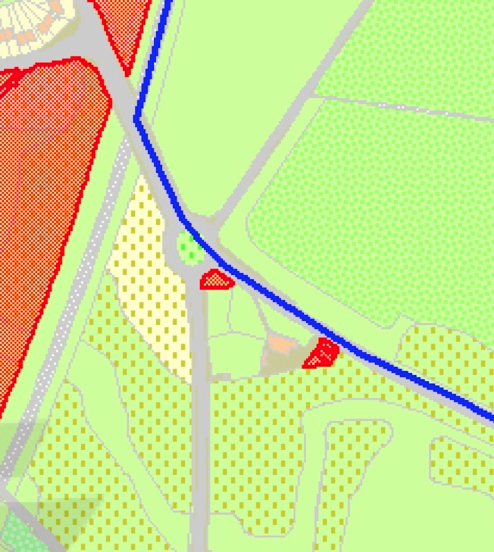
LBM Owned land

LBM Owned land

Part of this land, title number SY258367, showing houses numbered 3 and 4 on the 1952 map, was bought by T.R. City of London Trust PLC (company registration number 34871) in 1984 and sold at Savills auction in February 2015 for £36,000 and again in June 2015 for £96,000.

Plan showing title SY2583677

Plan showing title SY2583677


The houses are presumed to have been demolished in 1963, as they are mentioned as a Clearance Area in these Mitcham Borough Council minutes:

From the Public Health Committee
27th June 1963

6. Housing Act, 1957: Blue House Cottages, Croydon Road, Clearance Area

Further to paragraph 5 of the report of this Committee of 28th February, 1963 (Volume 29, page 747), the Town Clerk reported that the Minister of Housing and Local Government had confirmed the Blue House Cottages, Croydon Road, Clearance Order, 1963, without modification.

Source: Proceedings of the Council and committees, Mitcham Borough Council, Volume 30 1963-4, page 111


Minutes of meetings held by the Mitcham Borough Council are available on request from the Merton Heritage and Local Studies Centre at Morden Library.
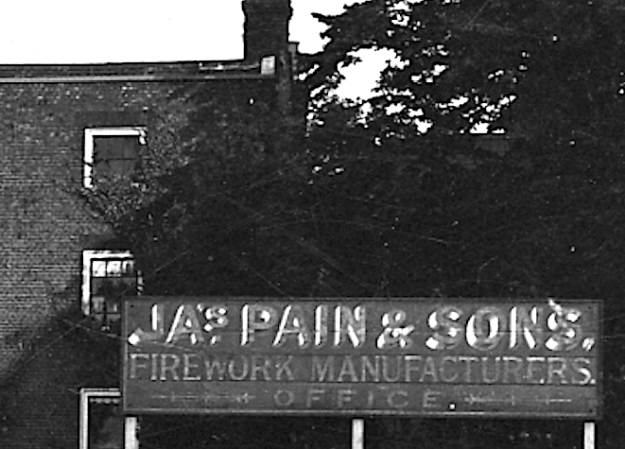
James Pain and Sons, Ltd.

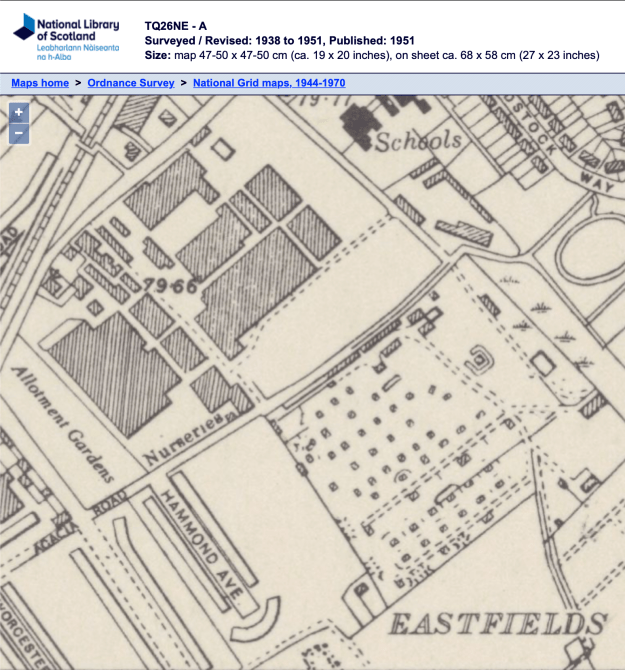
Firework factory, off east side of Acacia Road, that came to Mitcham in 1872. The company was taken over by the British Match Corporation in 1960 and transferred its factory to Salisbury.

The Eastfields Housing Estate was built on the site. The roads were named Clay Avenue, Moore Close, Mulholland Close, Pains Close, Potter Close and Thrupp Close.

Clip from Merton Memories Mit_Work_Industry_6-3 copyright London Borough of Merton.

The offices were at Renshaw Corner until after WW1.

Clip from Merton memories photo Mit_Work_Industry_6-1 of

See also the entry on Grace’s Guide to British Industrial History.


News Articles

MATCH FIRM DO DEAL IN FIREWORKS BRYANT and May, chief operating subsidiary of the £30,750,000 British Match Corporation, is in the take-over field again.

It has acquired Waeco Ltd., whose main products are fireworks and marine distress equipment and a range of smoke pesticides and fungicides.

This company has two factories near Salisbury and a third has recently been acquired at Cambourne to provide room for further expansion.

British Match, which has been carrying out an energetic diversification programme, already owns two firework firms, James Pain and Sons, of Mitcham, and Octavius Hunt, the Bristol makers of sparklers and Bengal lights.

Its other interest, besides matches, range from man-made timber to boxes, steel wool and ticket issung machines.

Source: Newcastle Journal – Tuesday 22 May 1962 from the British Newspaper Archive (subscription required)

Elephant frightener

AT the firework and distress & signals makers, James Pain, they have just finished a consignment of 6,600 gross fog signals — and one of their purposes will be to frighten elephants.

They are part of an annual consignment to Nigeria where fog signals are used for a great variety of purposes on the railways.
They are most useful in frightening elephants and other animals from the tracks.

The Eastfields factory has also completed special smoke signals for a film to be made about the Jordan Army.

Source: Mitcham News & Mercury, 27th January, 1961

BRITISH MATCH
PROGRESS OF DIVERSIFICATION
THE MATCH INDUSTRY

Three-quarters of group sales were again made overseas, mainly in the Commonwealth and South America. In the home market competition was intense; higher sales of SWAN VESTAS offset lower sales of other British matches. Bryant & May’s new match factory in Glasgow, though relatively small, is the most modern in the world.

DIVERSIFICATION

As consumption of matches is static, other interests are hems expanded or acquired. A new £2.5 million ‘WEYROC’ factory is to be built near Annan. Packaging, pulp mouldings, ticket machines, steel wool, scourers and wire products are other main interests in the U.K. In total. 26.4%, of the group profit was earned outside the match industry compared with 14.6% last year. James Pain, the firework makers, joined the group in June 1960.

Source: Birmingham Daily Post – Monday 29 August 1960 from the British Newspaper Archive (subscription required)

Advertisements

Lloyd’s List – Monday 07 September 1874

People
Miscellaneous notes on staff.

from marriage banns 14th June 1905 – Alfred Albert Henry COOPER, 27, living at Eastfields, assistant manager firework factory, father William COOPER, firework maker. In 1911 and 1925 he lived at 5 Langdale Avenue. Died December 1950 in Bognor Regis.


Maps are reproduced with the permission of the National Library of Scotland.