Tag Archives: 1920

Grand Parade, Streatham Road

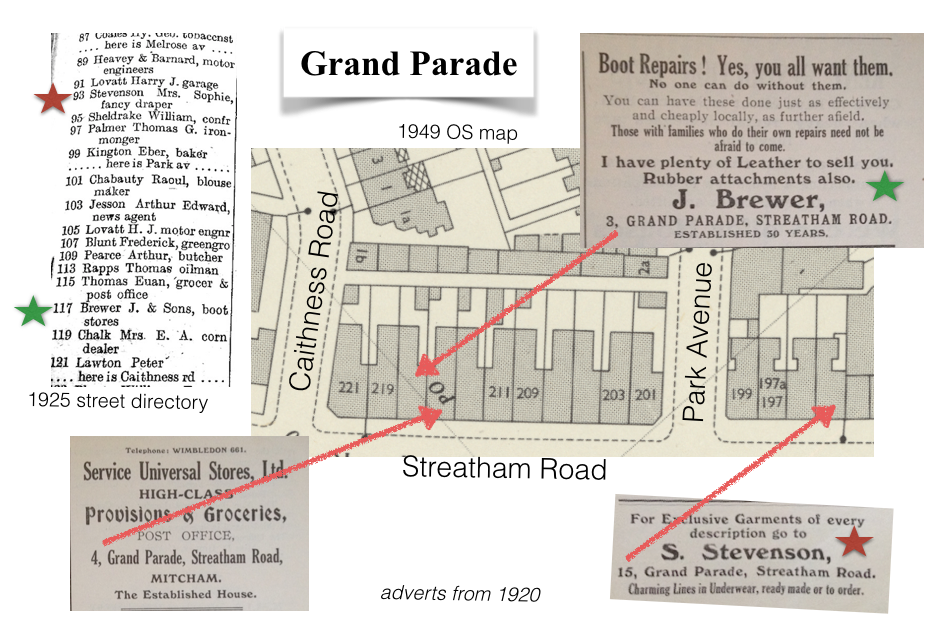
1949 OS map and 1920 ads/1925 street directory

1949 OS map and 1920 ads, with 1925 street directory

Parade of shops on the east side of Streatham Road consisting of eleven shops between Caithness Road and Park Avenue, and four more from the southern corner of Park Avenue.

Mentioned in 1920 adverts as ‘Grand Parade’, the numbering was from north to south, 1 to 15, which was then numbered as 121 to 93 in the 1925 street directory. In the OS map of 1949, the numbers are 221 to 193, as they are in 2016.

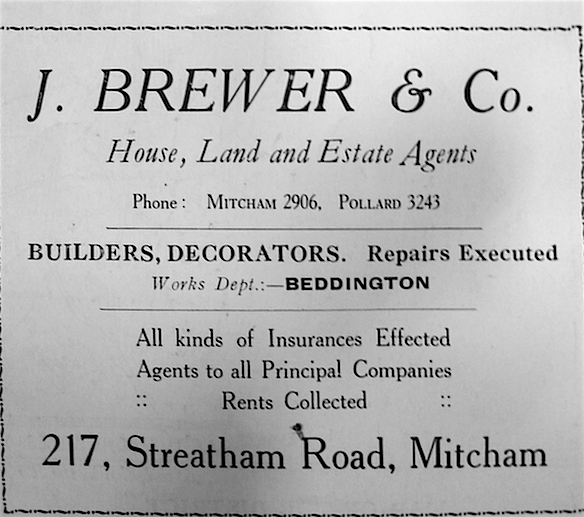
This ad for J Brewer at number 217 shows that the final renumbering occurred between 1925 and 1938.
1938

1938

Merton Memories photo of 1930 shows the parade from corner of Caithness Road looking south.


Occupants from 1911 Commercial Directory

Number Occupier Trade
1 Percy Beard wine & spirit merchant
2 Thomas James Mills laundry
4 Jas. Benj. Austin grocer,& post office
5 Thomas George oil & color man
6 James Pigg dairy
9 Edward Huntley & Sons house & estate agents
10 Edward Arthur Jesson newsagent
12 Albert Keirle baker
13 Thomas George Humphrey Palmer ironmonger
14 Miss Babette Reiss confectioner

In the 1915 directory, Raoul Chabauty is listed as a draper at 11, Grand Parade, and in the 1925 director as draper at 101 Streatham Road. This implies that the first renumbering was between 1915 and 1925.

World War 1 Connections
Able Seaman Walter Thomas Edmonds

Private Peter F Lawton

From a postcard posted in December 1932. Note that all but two of the gables are left today.


Maps are reproduced with the permission of the National Library of Scotland.

1920 Refugees from Russia in Workhouse

79 YEARS IN RUSSIA.

England is Heaven.” Mrs Harkness, who has lived in Petrograd for 79 years and who left England at the age five, and is now in the Western Road Workhouse Infirmary, Mitcham, Surrey, considers that after Russia “England is just heaven.”

A old English lady with a high, intellectual forehead, hair of silvery hue, and twinkling brown eyes, Mrs Harkness looked very peaceful she lay in bed and discussed with a representative of “The Daily Mail” what she thought of England after her long life in Russia.

“Petrograd was a miserable state when left,” she said. “People were literally starving in the streets. We had to pay a fabulous sum even for 1lb. of potatoes. Now (oh, it is too wonderful!) I get as much as I want to eat and drink, even eggs and abundance of milk. The few people I have met have been exceedingly kind. In Russia there is

Neither Religion Nor Morality,

“I was a governess when Russia was happy home, but now it is all havoc and hunger and death. Petrograd when we left was city of desolation. People with money in their pockets could not buy provisions, and motor cars were openly stolen. Nearly all the shops were shut, and hunger was common complaint.

“Three of the doctors in our home at Petrograd died from lack of food. We were not allowed to bring any luggage, and the only books I have are my Bible and Prayer-Book. England has progressed wonderfully since my days. There were, of course, no aeroplanes then, no electric trains, and none of your modern wonders of civilisation. Paraffin lamps and sewing machines were thought to be quite up to date in my earlier days.”

Mrs Harkness is one of 56 Britons recently repatriated from Russia.

Source: Motherwell Times – Friday 20 August 1920 from the British Newspaper Archive (subscription required)