Tag Archives: 1936

Sunshine Way

Crescent-shaped road off of Bond Road, Mitcham. The road is named after the “sunshine houses” that had an open air sleeping area for TB sufferers. This photo, as seen from the road, shows the walled area above the first floor. These areas were later converted to bedrooms.
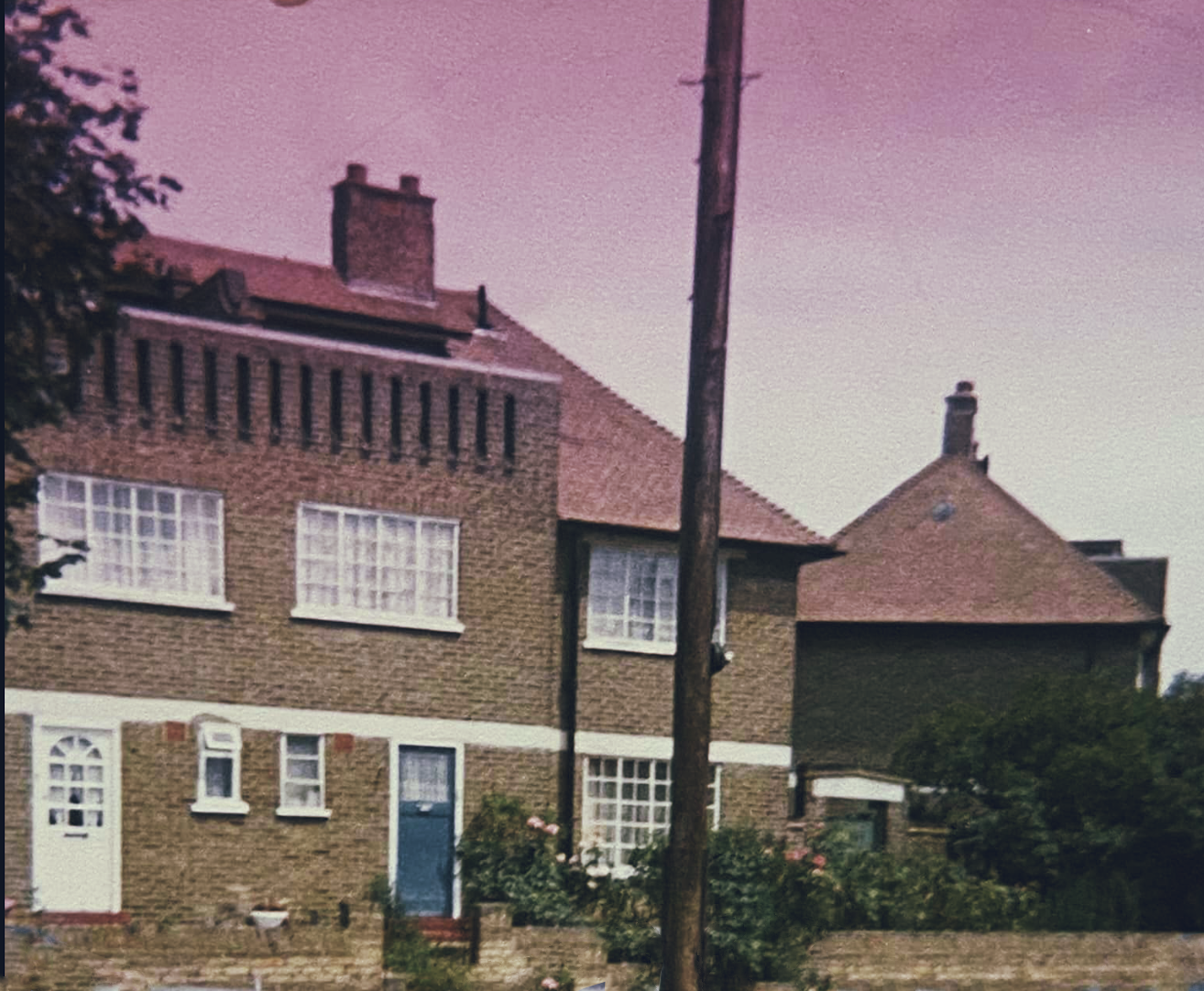
Photo kindly provided by a member of the Facebook Mitcham History Group.

From Google StreetView showing the sunshine patios converted to bedrooms.

old road name sign of Sunshine Way – photo taken in 2007
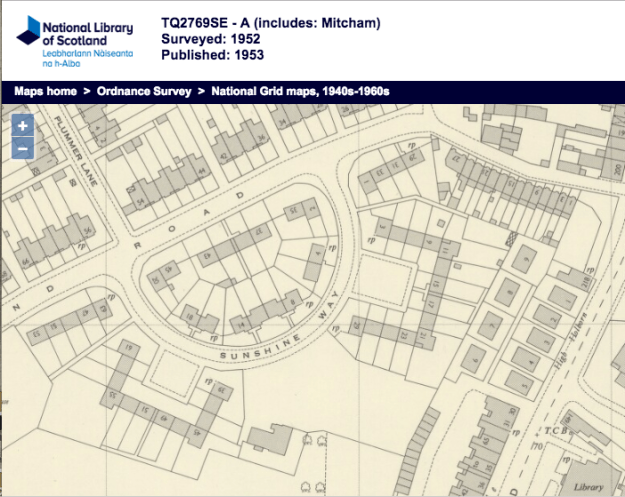
1952 OS map

The site for Sunshine Way was bought by the Church Army Housing Ltd. and the total cost including building the houses and hall came to £31,000 (or about £1,400,000 in today’s money when allowing for inflation).

For current owners (as of January 2018), see Sunshine Way – Ownership.

As reported in the Church Times, Friday 13th November 1936:

NEW COTTAGES BY THE CHURCH ARMY

On Monday next, Lord Horder will open fifty-one cottages at “Sunshine Way,” Bond-road, Mitcham, which have been built by Church Army Housing, Ltd., at a cost of £31,000.

Six of the cottages are of a special sunshine type, in which windows open outwards to their full extent, and each has a sun balcony suitable for sleeping out. The sunshine houses are for those, with tuberculosis or tuberculous tendency. Every house has its own garden and is fitted for electric lighting and gas cooking.

The rents will be on a differential basis, i.e., the lower paid workers will pay a lower rent than those who earn higher wages.

The net-average rent under this system will work out at seven shillings a week. The majority of the new tenants will come from Southwark and Walworth, some of whom have waited ten years for a house.

The estate was officially opened on 20th November, 1936 by Lord Horder, KVCO, and was blessed by the Bishop of Kingston. It consisted of 51 houses, 47 of which had three bedrooms and 4 had four bedrooms. Six were special ‘sunshine houses’, being built for those with TB tendencies. Rents ranged from 8 shillings to 12 shillings and threepence a week, or the equivalent of £18 to £30 today.

Mr F.M. Elgood chairman of the company, said that in the 51 houses were 277 children, 167 of them under 10 years old.

From the Church Times, 13th November 1936

NEW COTTAGES BY THE CHURCH ARMY.

—On Monday next, Lord Horder will open fifty-one cottages at “Sunshine Way,” Bond-road, Mitcham, which have been built by Church Army Housing, Ltd., at a cost of £31,000. Six of the cottages are of a special sunshine type, in which windows open outwards to their full extent, and each has a sun balcony suitable for sleeping out. The sunshine houses are for those with tuberculosis or tuberculous tendency. Every house has its own garden and is fitted for electric lighting and gas cooking. The rents will be on a differential basis, the lower paid workers will pay a lower rent than those who earn higher wages. The net average rent under this system will work out at seven shillings a week. The majority of the new tenants will come from Southwark and Walworth, some of whom have waited ten years for a house.

From the Mitcham News and Mercury, 20th November 1936

LORD HORDER OPENS
NEW
HOUSING ESTATE
——
Not Anxious About Fall in Population
——

Lord Horder, K.C.V.O., visited Mitcham on Monday and declared open the new estate of house built by the Church Army Housing Ltd.

Lord Horder referred to the fall in the population, and added: “I am not anxious about it. I would rather give my vote for quality than quantity. All the same we may find that we don’t get quality or quantity and that would be a calamity of the first magnitude.”

The Bishop of Kingston, speaking of rents, said there is no sense in charging rents to keep people perpetually poor in good homes.
——————-
A new chapter in the history of the site of the old Holborn Schools had commenced in Mitcham on Monday when the new estate of houses built by the Church Army Housing Ltd. known as Sunshine-way, Bond-road, Mitcham, were declared open by the Right Honourable Lord Horder, K.C.V.O.


Church Times 20th November 1936

BIGGER AND BETTER!

the Church Army Builds Homes for the People

(By Our Special Representative)

“‘OO LIVES UPSTAIRS MUM?”
“ Why, son, we live upstairs.”
“ Then ’oo lives downstairs, Mum? ”
“ We live downstairs, too.”

But he could not believe it. Not one of the children who had been cramped and
cabined in the tenement houses of South London did believe it. They had been used
to living five in a room and sleeping three in a bed. When they came to the new
houses, they could not understand the idea of separate bedrooms. They had never seen
a whole house that is a home. So a Church Army Sister told me at the
opening of the wonderful little estate built by the Church Army at Mitcham, which was
opened on Monday afternoon. In “ Sunshine Way,” fifty-one new cottages have
been built, and they have been specially designed for families that are not touched by
the slum-clearance schemes—the families, that is, which are too large for the tiny flats of the mean streets, too poor to pay high rents and, some of them, too sickly to thrive in the great blocks of Central London. All the families come from overcrowded rather than specifically “ slum ” areas, and have had, therefore, little hope of a new home under Government schemes. Some have been waiting for proper accommodation for
three years; some for as long as seven years.

Before the official opening of the estate, a meeting was held for tenants and friends
of the Church Army in Welcome Hall, the religious and social centre for the new
buildings. Prebendary Carlile, who, as he said, is “ getting on for ninety, not out,” took the whole meeting on his shoulders as soon as he entered the hall. He knew everybody. He chaffed everybody. He put the praise for all the work on everyone but himself. Above all, he made everybody laugh and feel at home. He called suddenly upon
workers hidden at the back of the hall to come and give their own little part of the
story of the building of the cottages. He insisted that Church Army Sisters should
tell their own tales about the social and religious side of the work. And, by the way,
how splendidly these workers speak at a moment’s notice! They have none of the
formalities of the trained speaker. But their straightforward, simply-phrased stories come from a store of experience and a fund of humour and understanding.

Mr. F. M. Elgood, chairman of “ Church Army Housing, Limited,” related the
history of the estate. The cottages were built, he said; for large families with small
incomes. There were fifty-one new cottages, and among the new “ tenants ” in them were
two hundred and seventy-seven children. The hall was built so that there might be a
place for a Sunday school for the children, a meeting place for mission services, for
clubs and for social gatherings. The speaker explained how greatly the
Church Army was concerned with the problem of rent. With its complementary
system of loan stock and voluntary donations, “ Church Army Housing ” was able to
build cottages, without help of Government subsidy, and to let them at differential rents.

The cottages at Mitcham all have three bedrooms and some of them have four. The
highest rent, inclusive of rates, is 12s. 3d., and the lowest is 8s. But the majority are let for 9s. 7d. a week. Care is taken that the rent shall be small if the father of the family has to travel far to his work. There are special houses with sunshine roofs-that is, open air shelters-for families with a tubercular member. Help is given with beds and blankets for the families whose ramshackle furniture from ramshackle tenements is fit only for the fire. The new furniture is paid for from weekly savings.

The Church Army shield was unveiled by Lord Horder. The Bishop of Kingston,
acting for the Bishop of the diocese, stood, pastoral staff in hand; at the centre of the estate, and blessed the houses and all the tenants in them.

Children crowded round Sunshine Way for the ceremony. Tenants were at their windows or standing in their gardens – their well-prized new possessions. Some of the families from Camberwell, Lambeth and Southwark had ” hardly seen any soil for years.” All, in the five short weeks of tenancy, had made gallant efforts to tidy and to lay out ” their bit” in spite of the fact that slabs of cement belonging to cellars of former buildings were found heaped up a few feet beneath the surface of the gardens, while other places seem to have been the depository for old china for the whole of Mitcham during at least a hundred years.

” The people are settling down now,” said a Church Army Sister to me. ” It is always
a bit of a job at the beginning. Children, eight in a family, who have lived in two
tiny rooms, are inclined to be frightened of a dark ‘upstairs.’ They are used to going
to bed in the living room. And, of course, there is the problem of furniture. Most of
these families have had room only for bedroom furniture in their old places. Now they
want tables and dressers and chests of drawers; and the cost is a terrible strain on
their tiny resources.

” There’s the Smith family, now. There are ten of them – eight children. They lived
in two tiny rooms, and had to have a double bed in the kitchen. It stretched right from the wall to the fire-place, so there was no room for a table. They always had their meals off the bed. Then there is the Jones family. Some of the children slept on a bedstead. And the rest lay round it on the floor.”

19361120 Lord Horder and some of the children

Lord Horder Unveiling the Church Army shield. Bishop of Kingston holding his staff. Prebendary Carlile on his left.
Lord Horder Unveiling the Church Army shield. Bishop of Kingston holding his staff. Prebendary Carlile on his left.


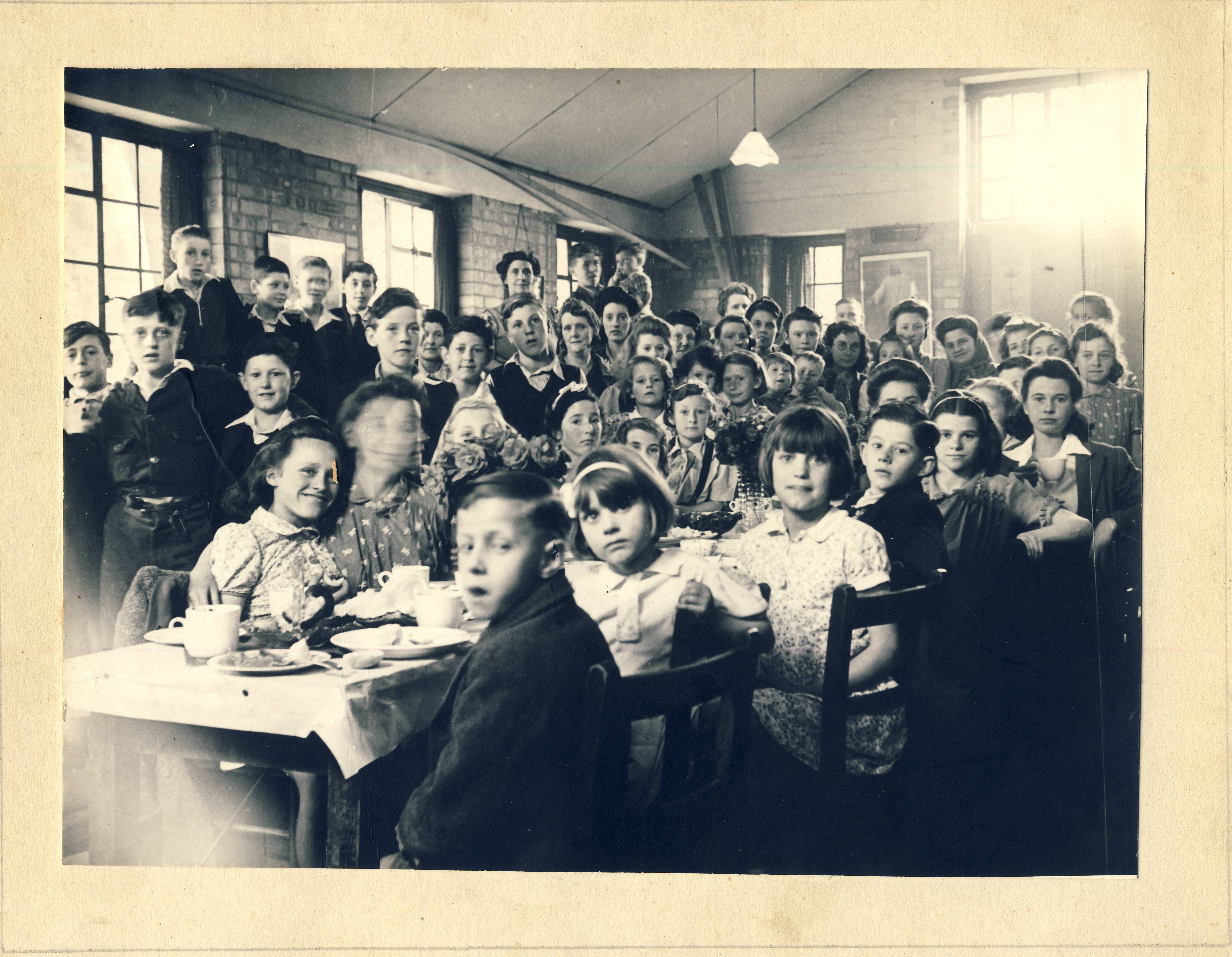
A children’s party, possibly photographed in the Welcome Hall, in the 1950s by Phox Studios.


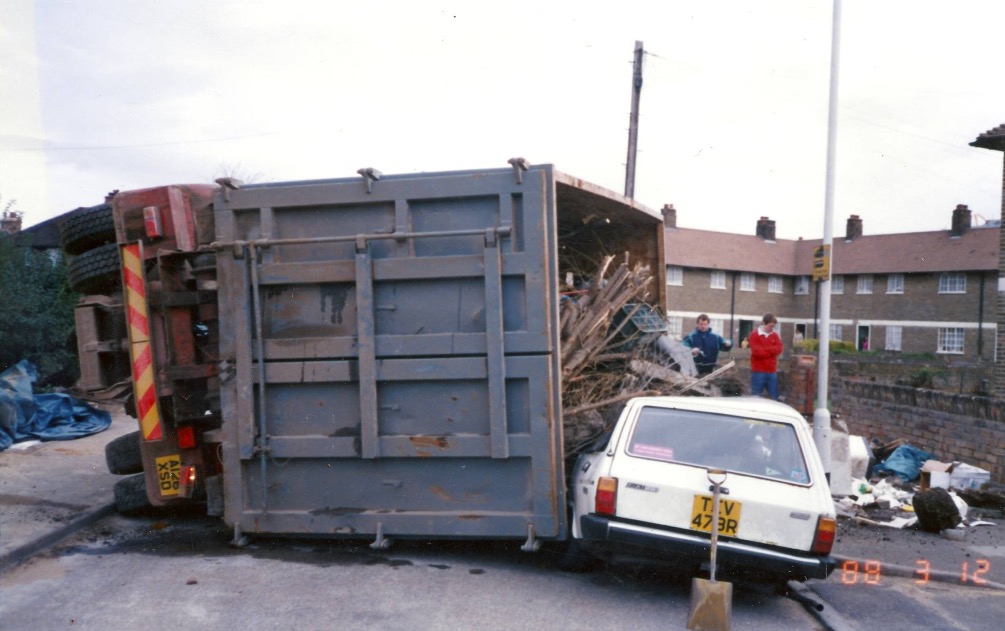
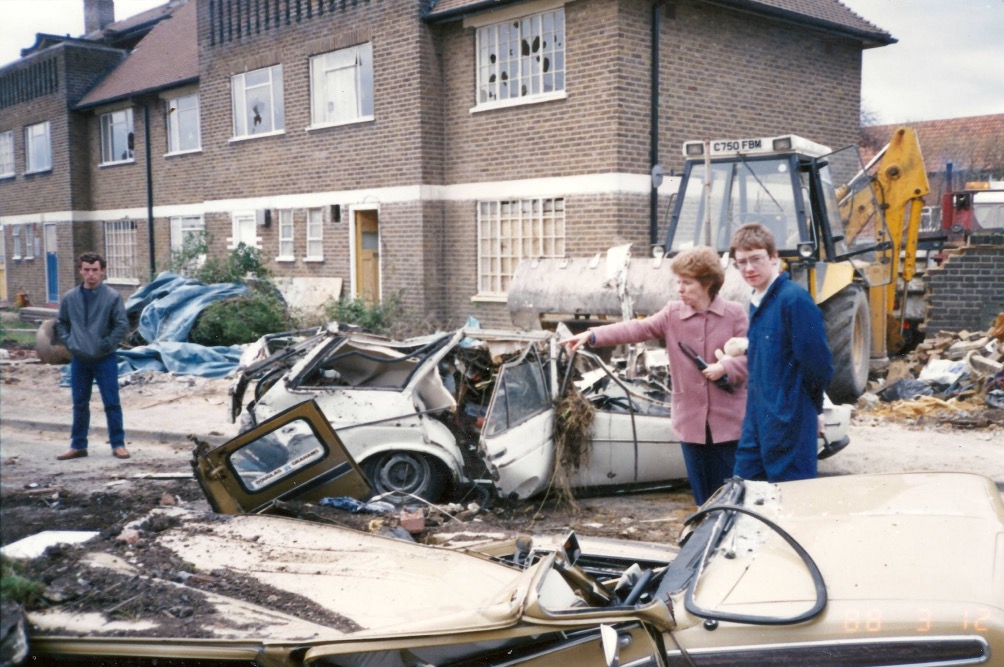
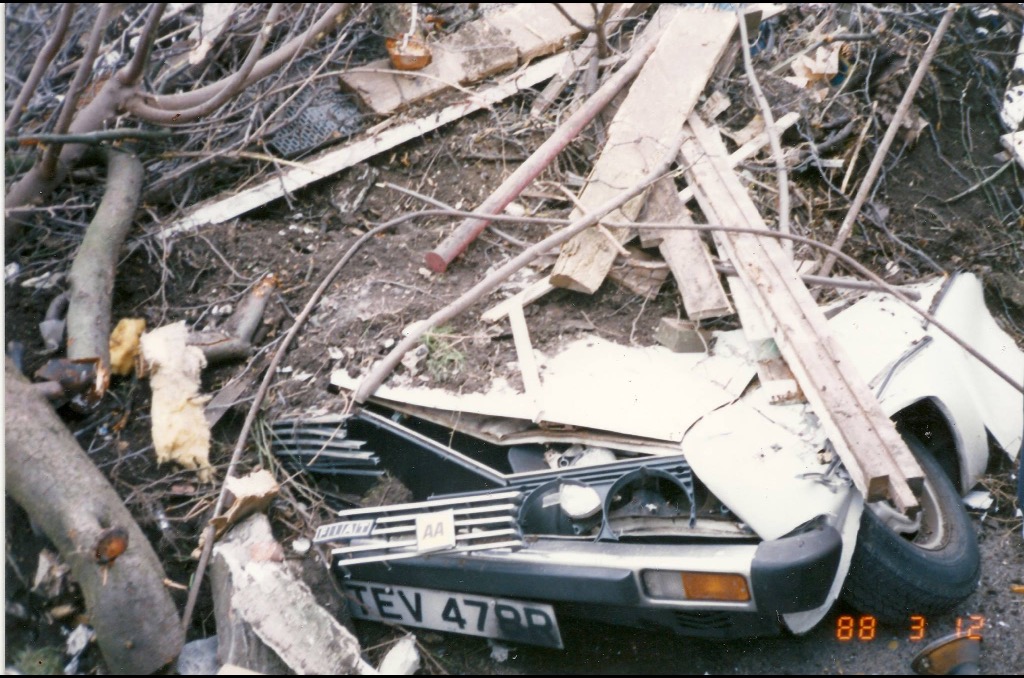
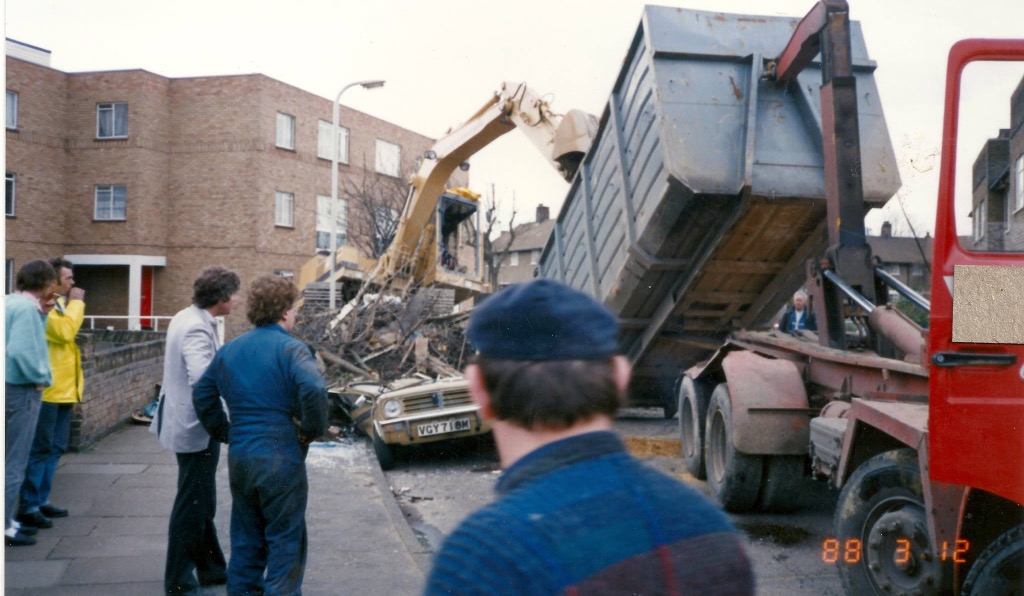
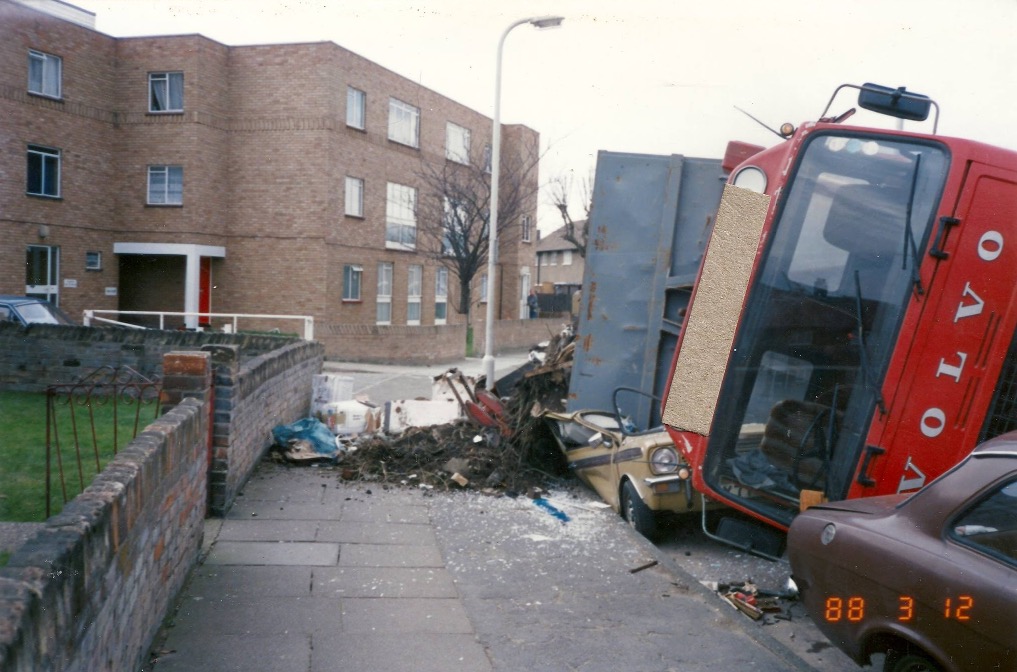
In March 1988, the houses were being renovated, which included converting the ‘sunshine patios’ to an extra bedroom, when a skip lorry overturned crushing some cars. Thanks to Keith and Marie Drake for these photos.
image

image

image

image

image

image

image


List of tenants in 1937

Sir Harry Mallaby-Deeley

From Wikipedia:

Sir Harry Deeley Mallaby-Deeley, 1st Baronet (27 October 1863, London – 4 February 1937, Cannes) was a British Conservative Party politician.

Harry Deeley was educated at Shrewsbury School and Trinity College, Cambridge. His brother was the theatrical producer Frank Curzon.

In 1913 he purchased the whole of the Duke of Bedford’s Covent Garden estate for £2m., having already been involved in the purchase of the Piccadilly Hotel and St. James’s Court, Buckingham Gate.

In 1922 he famously acquired control of the large estates of the cash-strapped Duke of Leinster during the latter’s lifetime. Fitzgerald had previously sold Mallaby-Deeley his reversionary rights to the estate for a notional consideration, not expecting, as a younger son, to inherit.

Deeley was elected Member of Parliament for Harrow in 1910 and for Willesden East in 1918, resigning in 1923. In 1922 he assumed the additional name of Mallaby, his mother’s maiden name, by deed poll and was created a baronet.

Although the wikipedia article cited stated he was founder and first president of the Prince’s Golf Club in Mitcham, it has been pointed out that this was not the case. The following has been provided to correct this error:

Prince’s Golf Club Mitcham was formed by members of the Prince’s Racquets and Tennis Club of Knightsbridge in 1891 with Robert Hippisley Cox the prime mover. The first President was Arthur Balfour M.P.

Mr Mallaby Deeley came rather later and in 1900 had risen to the position of chairman. The Prince’s Golf Club Company Limited was restructured, went into voluntary liquidation and the same day a new Prince’s Golf Club Company Limited was formed with Mallaby Deeley as controlling shareholder.

Source: information available at the National Archives

News Articles
From the British Newspaper Archive which require a subscription.

1937 Obituary

Sir H. Mallaby-Deeley

During the twelve years he sat in the House of Commons Sir Henry Mallaby-Deeley was content to be for the most part a silent member. He was a picturesque figure, and regular in his attendance, but his friends were always a little puzzled to understand why he cared to belong to an assembly in whose affairs he took little active part. His name came frequently before the public in connection with gigantic transactions in real property—among them the purchase of part of the Bedford estates, at a cost of about £2,000,000, and the Foundling Hospital site, most of which has since been re-acquired for preservation as a children’s playground. A much more surprising venture, and one having no relation with his other interests, was his opening of a shop in the Strand for the sale of men’s clothes at about half the prices then prevailing for readymade suits. As was to be expected in view of his lack of experience the enterprise was a commercial failure, and he admitted having lost about £60,000 during the two years it – was carried on. He claimed that the experiment was worth while for the sake of the stimulus it gave to others with a better knowledge of the trade to reduce their prices. Sir Henry was a keen golfer, and, among his many enterprises, he controlled the Prince’s course on Mitcham Common, now under municipal direction, as well as the Prince’s course at Sandwich.

Source: The Scotsman – Saturday 06 February 1937

1936

SIR H. MALLABY-DEELEY MARRIED
Private Ceremony a Month Ago

It became known on Monday, says “The Times” that Sir Harry Mallaby-Deeley, Bt., of Mitcham Court, Surrey, was married on December 9 to Miss Edith M. Shoebridge, his private secretary.

The arrangements were made so quietly that even the household staff at Mitcham Court were not aware that on the day when Sir Harry Mallaby-Deeley left for the Continent Miss Shoebridge was going with him as his bride. The marriage took place by special privilege in the Bishop of Southwark’s private chapel at Bishop’s House. Kennington, the Bishop officiating.

Sir Harry Mallaby-Deeley made the acquaintance of Miss Shoebridge a little more than a year ago. She had been private secretary to Lord Derby. Sir Harry Mallaby-Deeley was first married in 1890 to Miss Joan Parson-Smith, who died In 1933. and has one son. He is well remembered In Chester as a son of a once prominent citizen, the late Wm. C. Deeley, a director of the Dee Oil Company. Saltnev. and a onetime chairman of the Chester Liberal party.

Source: Cheshire Observer – Saturday 11 January 1936

1933

LADY MALLABY-DEELEY DEAD

Lady Mallaby-Deeley, wife Sir Harry Mallaby-Deeley. Bart., the financier and former Conservative M.P. lor Harrow and East Willesden, has died at Sir Harry’s Surrey home, Mitcham Court. She had been ill for only a week with bronchial pneumonia. Lady Mallaby-Deeley, who was formerly Miss Joan Parson-Smith and a member of a well-known Shrewsbury family, was married to Sir Harry 43 years ago. There are four children, two sons and two daughters.

Source: Gloucester Citizen – Wednesday 20 December 1933

SIR HARRY MALLABY-DEELEY Bart., of Mitcham Court, opposite Mitcham Cricket Green, and a Mitcham Conservator, is credited with one of the most important property purchases in London of recent years. Sir Harry has bought the whole of the interests of the Foundling Estates, Ltd., in the Foundling Hospital estate in Bloomsbury. The estate consists of 34 acres, exclusive of streets and squares, and the total price is stated to be in the neighbourhood of £1,750,000.

Sir Harry and Lady Mallaby-Deeley left for the south of France on Saturday. For more than 25 years Sir Harry has been one of the most striking figures in London finance.

In 1924, Sir Harry handed over to the public Prince’s Golf Club, Mitcham. He has given large amounts to charity, notably £15,000 to the London Hospital. He was Unionist Member for Harrow, 1910-18, and for East Willesden, 1918-22: He was made a baronet in 1922. One of his most famous deals was with the Bedford estate in the Strand a number of years ago now.

Source : Mitcham News and Mercury, 14th April 1933

1910

West Sussex Gazette – Thursday 20th October 1910

Mr. H. Mallaby-Deeley, of Mitcham Court, has just bought-up the whole of St. James’ Court, Buckingham Gate. This parcel of property consists of eight blocks of flats, with a present yearly rent roll of £30,000. It is understood the price paid was in the neighbourhood of a quarter of a million.

Mr. Mallaby-Deeley was the buyer of the Piccadilly hotel, for about £500,000. It is said he is now building a mansion at Harrow, and will shortly be leaving Mitcham. He is the controlling spirit of the Golf Club, and chairman of the Common Conservators.

Croydon Advertiser and East Surrey Reporter – Saturday 29 January 1910

A MITCHAM M.P.

MR. MALLABY-DEELEY RETURNED FOR HARROW.

The campaign in the Harrow Division of Middlsex was followed with considerable interest by Mitcham because the fact that the Conservative candidate was Mr. H. Mallaby-Deeley, ot Mitcham Court. opponent was Mr. Percy Harris, a well known London Liberal, and the fight was a very keen one. Polling took place on Monday, and the result was declared about two o’clock on Tuesday as follows :

Mallaby-Deeley (C.) ...,. 16,761 
Harris (L.) ............. 13,575 

Conservative majority ... 3,186

This was a Conservative gain, the turnover of votes amounting to less than 3,602. The new member is a director of the Norwich Union Life Insurance Society, a governor of the Whitgift Foundation, Croydon, and Chairman of the Mitcham Common Conservators, and one of the principals of Princes Golf Club.

Though there are more popular men at Mitcham than Mr. Mallaby-Deeley, there are none more striking in their personality or more keen in a business capacity. It is not expected that his Parliamentary duties will interfere to any great extent with his work Chairman of the Board of Conservators.


From the Surrey Coats of Arms:

MALLABY-DEELEY Sir Harry Mallaby Mallaby-Deeley, 1st Bart., JP, MA, LL.M (Cantab), of Mitcham Court, (1863-1937), was
created Baronet 1922. The title expired on the death, 1962, of his grandson Sir Anthony Meyrick Mallaby-Deeley, 3rd Bart., of Slater’s Oak,
Effingham.
Arms: Quarterly, 1 and 4, Sable a chevron engrailed Ermine between in chief two fleurs-de-lys and in base a crescent Or (Deeley);
2 and 3, Or a bunch of nettles Proper and a chief Sable (Mallaby).
Crests: 1, A sinister cubit arm in armour gauntleted holding in the hand a dagger point downwards Proper pommel and hilt Or
between two spurs Gold (Deeley); 2, Issuant from clouds Proper a demi Pegasus Argent winged and charged on the shoulder with a fleur-de-lys Azure.
Motto: Quod Deus vult. (BP99)

Motto means What God Wills.

From Debretts Peerage of 1923:

Sir HARRY MALLABY MALLABY-DEELEY,
M.P., 1st Baronet, second son of the late W. Clarke Deeley, of Curzon Park, Chester, by Elizabeth, da. of Joseph Mallaby, of Loxley Hall, Staffordshire ; b. Oct. 27th, 1863; ed. at Shrewsbury Sch., and at Trin. Coll., Camb. (B.A. Honours in Law and LL.B. 1885, M.A. and LL. M. 1888); is Lord of the Manors of Ravensbury, Biggin and Tamworth, a Member of the Inner Temple, a J.P. for Surrey, a Director of Norwich Union Life Insurance So., a Gov. of Roy. Agricultural So. of England, a Member of Committee of Roy. Orphan Asylum, Chm. of Board of Conservators of Mitcham Common, and patron of five livings; sat as M.P. for Harrow Div. of Middlesex (Co.C) Jan. 1910 to Nov. 1918; elected for E. Div. of Willesden Dec. 1918 and Nov. (C) 1922; assumed by deed poll (enrolled in College of Arms) 1922, the additional surname of Mallaby: m. 1890, Joan, third da. of J. Parson-Smith, J-P-, of Abbotsmead, near Shrewsbury, and has issue.

Seats — Mitcham Court, Surrey; Elgars, Bexhill, Sussex.
Clubs – Carlton, Wellington, Surrey; Magistrates’; United Empire; Royal Automobile.

SON living — GUY MEYRICK MALLABY, b. May 23rd, 1897 ; ed. at Trin. Coll, Camb,, and at R.M.C.; Lieut. 5th Dragoon Guards : m. 1920, Marjorie Constance Lucy, only da. of James E. Peat, of Cranmers, Mitcham, Surrey.