Tag Archives: 1945

Hengelo Gardens

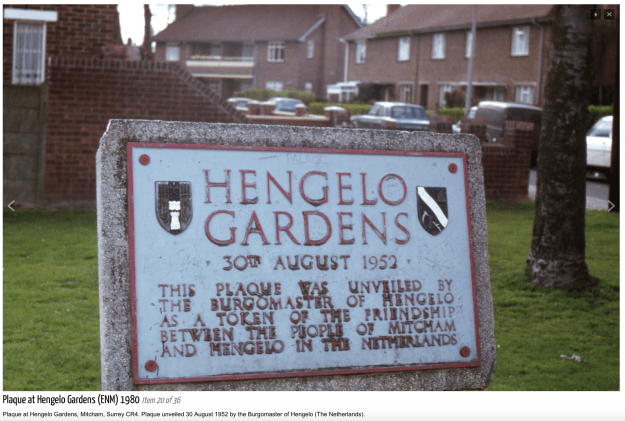
Photo taken by Eric Montague in 1980. Reproduced by kind permission of the Merton Historical Society. Image reference mhs-em-rav-31

This plaque was unveiled when the road was opened.

HENGELO
GARDENS

30th August 1952

This plaque was unveiled by the Burgomaster of Hengelo as a token of the friendship between the people of Mitcham and Hengelo in The Netherlands

The road was named after the town of Hengelo, in the Netherlands. In 1945 an Anglo-Netherlands Sports Scheme was started between Mitcham and Hengelo, see news article below.
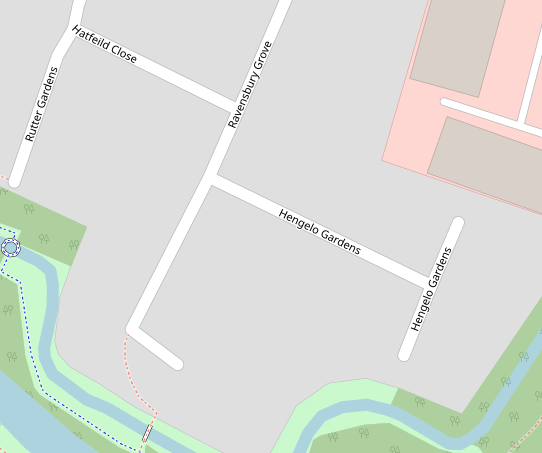
2019 Open Street Map of Hengelo Gardens

In 1955, a square in Hengelo had been renamed Mitchamplein. It is now a car park.

It is not known when the plaque was removed.


News Articles about Hengelo and Mitcham

Norwood News – Friday 29 June 1945

Mitcham Adopts Hengelo

Anglo-Netherlands Sports Scheme

A representative body of Mitcham sportsmen held an inaugural meeting last week in the staff canteen of Messrs. Stewart and Gray, Paisley Works, Mitcham, in connection with the Anglo – Netherlands Sports Scheme. The Mayor of Mitcham (Ald. A H. Bailey), who presided, spoke of his great friendship for the Dutch people, and how pleased he felt with the idea of the Anglo-Netherlands Sports Scheme, and it gave him much pleasure to accept the presidency of the Mitcham section.

After an address by Mr. Yapp, who convened the meeting, it was unanimously agreed that Mitcham should adopt the scheme and link up with Hengelo, in Holland, Hengelo being on a par with Mitcham in size, population and industries. Everyone at the meeting felt that Mitcham was about to enter into an era of great sporting events, and that the happy associations made between the people and their brave Dutch Allies during the war would be continued and improved through the activities of this sports scheme.

The following officers and committee were unanimously elected: President, the Mayor of Mitcham ; chairman, Mr. A. R. Hillen; general hon. secretary, Mr. J. W. Yapp ; treasurer, Mr. J. Beverige ; Finance Committee, the chairman. general hon. secretary and treasurer, with Messrs. J. Forsyth and J. Simper ; General Purposes Committee, Messrs. S. Mackinnon, R. Murphy, W. Wilder, P. W. Collard, Thos. Sibley. A. Lacey, E. Willard. C. Smith, Thos. Bicknell, E. Chambers, C. Runcieman, W. Wilson, Flying Officer Judd, and the hon. secretary. The committee agreed to co-opt other local sportsmen. Anyone interested should write to the general secretary, Mr. J. W. Yapp, 60 Streatham-road, Mitcham, Surrey. Sportswomen are particularly invited.

West Sussex Gazette – Thursday 23 August 1945

The link-up of Mitcham with Hengelo, Holland, for sport and social purposes has been completed by the Netherlanders’ hearty acceptance and reciprocation of the scheme. For the present, transport is the difficulty, but it is hoped to send two Mitcham football teams over before the end of the year. At Hengelo there are plenty of football-minded enthusiasts, and two teams awaiting International contests between the goal-posts The local papers there are co-operating in forewarding this happy way of fraternisation

West Sussex Gazette – Thursday 30 September 1948

VISITORS FROM HOLLAND

Glorious week-end weather greatly enhanced the cheerfulness of the Mayor of Mitcham’s informal welcome to the Burgomaster of Hengelo, Holland, and his party of 60 sports players to spend a week in Mitcham.

It is the return visit of the Mitcham pilgrimage to Hengelo in 1946. On Saturday morning the sights of London were toured. including the Houses of Parliament. In the afternoon the visitors saw the first of Mitcham’s football and the last cricket match of the season on the elm-bordered Green now tinged wIth russet tints of autumn. The evening was filled with a gala at Mitcham Baths attended by several ex-Olympic competitors. Sunday brought another London tour and korfball.

The formal civic welcome to the guests (put up in Mitcham homes) was at the Town Hall on Monday evening. Thereafter a full programme till the young Netherlanders return next Saturday.

West Sussex Gazette – Thursday 09 December 1948

As others see us. A journalist who came to Mitcham with the friendship pilgrims from Hengelo, Holland, afterwards wrote in his home paper that Mitcham was “a simple factory town without many attractions”! The other Dutch reporter visitor discovered that our ” pubs ” close early, and that cafes, known in the Netherlands, do not exist here. Moreover, at our public-houses, “strangely enough,” he wrote, you have to stand, and the beer is bad; and, what is more, very expensive”!

1945 : Memories of 40 years in signal boxes at Mitcham Junction

From the Mitcham Advertiser, Thursday 11th October, 1945, page 1.

FIFTY YEARS ON RAILWAY

Golden Wedding Memories of Old Mitcham

Fifty years on the Southern Railway, and forty of them spent in signal boxes at and about Mitcham Junction, is the record of Mr. Arthur G. Funnell, of 32a, Mitcham Garden Village.

Yesterday (Wednesday) he and Mrs. Funnell celebrated their golden wedding.
Mr. Funnell reminded “The Advertiser” reporter that he signalled Queen Victoria’s funeral train through Mitcham Junction on its way from Gosport to Victoria. He also signalled the only royal train that ever was on the branch Croydon-Whnbledon line. It had on board the late King Edward (then Prince of Wales) and no less a person than the Kaiser of Germany. They had been to a review of troops on Wimbledon Common and were on their way to the Crystal Palace. The late Mr. W. Martin was stationmaster at Old Mitcham at that time.

“There was a big crowd of people all along the embankment of Mitcham Common when Queen Victoria’s train went through.” Mr. Funnell said, “and not a few to see Kaiser Bill go by.”

Mr. Funnell served under seven stationmasters at Mitcham Junction. “We had plenty of celebrated people round us in those days.” he sold. “The golf course on the Common, then in its prime, attracted everybody who was anybody in London. Including five Prime Ministers, Mr. Asquith, Mr. Balfour, Mr. Lloyd George, Mr. Ramsay Macdonald and Mr. Winston Churchill, who, however, came before he rose to that high rank. Sir Harry Mallaby-Deeley was as good a player as any of them, and better than most. It was said.”

All sorts of queer things happened at Mitcham Junction, or thereabouts, during Mr. Funnell’s reign as signalman. A big barrel of red powder belonging to a local paint firm rolled off the platform one day in front or a non-stop train, which smashed it literally to dust. The engine, the driver and fireman, most of the passengers, a good length of the train and half the station were painted red and for half an hour a red mist hung about over a wide area, like a sunset reluctant to come to an end.

Mr. Funnell’s initiative led to the capture of several wrongdoers. From his lighthouse early one morning he saw several men being chased across the railway and the Common. He promptly telephoned the station staff, who bagged one.

On another occasion, going off night duty, he saw two sacks partly hidden near the station. He informed the police. Officers dressed as porters got into the brake van when the first train rolled into the Junction, and were not surprised to see two men soon follow them with the sacks. But the men were surprised when the “porters” grabbed them.

Mr. and Mrs. Funnell’s own home in Love Lane was broken into. They lived in it for forty years, till they were bombed out. The garden there was one of the sights of the village, for Mr. Funnell is a good gardener, with a passion for flowers. He has cultivated an allotment on the railway embankment at Mitcham Junction for over fifty years. The housebreaker in Love Lane was captured by Mr. Funnell himself, after a chase into Western Road. He happened to reach home as the intruder was leaving, with two watches and other articles.

“I began my railway life on the old London, Brighton and South Coast Railway,” Mr. Funnell said. He was born at Littlehampton and is now 74. Mrs. Funnell. who is 75, is a native of Mitcham. She was born in Church Road, and remembers the village when it was mainly a vast garden, glowing in the Summertime with all the colours of the rainbow.

Like all good Mitchamers, the whole family are interested in cricket. Mr. Funnell played regularly in the railway men’s team. His younger son, Bombardier George Funnell, is an excellent bat in the Mitcham first eleven. Mrs. Funnell still helps with the teas in the pavilion.

Lance-Corporal Arthur Ernest Funnell, of the Military Police, is their other son, and a married daughter lives at Worthing.

After being bombed from Love Lane, Mr. and Mrs. Funnell were bombed from the Garden Village for a time. The Garden Villagers were naturally among the first to congratulate them on their golden wedding day.

“We were married at Mitcham Parish Church by the late Canon Wilson.” said Mrs. Funnell.“ on the same day that Tom Richardson, the great fast bowler, was married at Beddington. In fact, we used the same carriage.”

Mr. Funnell retired from the railway eleven years ago. He looks back on his past at the Junction as the most colourful patch in his history. They were happy and pleasant days to him. When “The Advertiser” reporter left the house Mrs Funnell was making the golden wedding cake.

“Sometimes I still fancy I can hear old George Sawyer calling out the names of the stations.” said Mr. Funnell. George had a voice like Stentor himself. The late Sir Cato Worsfold declared that at The Hall Place, a mile away, he could hear George calling so plainly that every word was distinct.