Tag Archives: 1947

Wandsworth Gas Company’s Coal Ship “Mitcham”

19461102-mv-mitcham

THE LAST WORD IN “FLAT IRONS”: The 1,780-ton coasting collier “Mitcham,” the Wandsworth Gas Company’s new vessel, seen on the Thames at Wandsworth after negotiating the fifteen miles of river from the estuary. When she turns round at Wandsworth there is little room for other traffic to pass. The “Mitcham” has a squat funnel to save her lowering it at each bridge, and her collapsible masts are stepped down into the holds.

The Wandsworth Gas Company are adding several new ships to their fleet, and the “Mitcham” bears a close resemblance to the “Chessington,” details of which were given in “The Sphere” of June 29. She is equipped with sloping wing ballast-tanks, which ensure that the cargo automatically precipitates itself to within the range of the mechanical grabs during the discharging operations.

Source: The Sphere – Saturday 02 November 1946 from the British Newspaper Archive (subscription required)

19460629-mv-chessington

AN IMPORTANT ADDITION TO LONDON’S COLLIER FLEET : A diagrammatic drawing of the S.S. “Chessington,” the largest vessel to pass the Thames bridges. The “Chessington,” belonging to the Wandsworth and District Gas Company, is known as a “flat-iron,” and she is able to carry 2,700 tons of coal on each trip from the Durham coalfields. The ”Chessington” recently completed her maiden voyage, attracting much attention as she came upstream beyond the Pool and Westminster Bridge. She is nearly 260 ft. long, and as she passes under the bridges her funnel lowers in the usual manner and her masts telescope into the holds. The “Chessington” is equipped with sloping wing ballast tanks which ensure that the cargo automatically precipitates itself to within the range of the grabs during discharging operations. The general lay-out of the ship is of much improved pattern, and special attention has been paid to the officers’ and men’s quarters.

Drawing by S. E. Beck

Source: The Sphere – Saturday 29 June 1946 from the British Newspaper Archive (subscription required)

19470308-mv-mitcham

How They Bring The Coal To London

The Colliers which Supply the Gas Works abd the Power Stations

The fuel crisis has thrown into high relief the role of the Thames up-river colliers, the “flat-irons” which supply the gasworks and the power stations with the vital fuel to keep the lights of London burning.

Some of these colliers come from South Wales, making the trip down the Bristol Channel, round Land’s End, through the Straits of Dover and into the Thames Estuary. The majority, however, come from Tyne and Humber ports, and it is upon these that attention has been focused during the recent fateful week.

From Tyne to Thames is no long voyage, but it is very much London’s lifeline and, thanks to the devoted work of the collier skippers and their cres, who through their way through the February gales and ice-floes, London power stations will once again able to build up their stocks. Many of those same men, it must be remembered, braved the perils of the same East Coast trip when they had more than weather to contend with – first the magnetic mine and then the E-boat constantly menacing the ships as they came south laden with their precious cargoes.

The largest of these ships are found in the Wandsworth and District Gas Company’s fleet, whose works are situated the farthest upstream. Their ships have to negotiate seventeen bridges before they can reach their discharging-point at Wandsworth. This Company has for long set the standard for the design of these of ships, and practically each their ships has been, when built, the largest in this trade. Now they have the first diesel driven “flat-iron” the Mitcham, which can carry a total of 2,700 tons of coal. This compares with 1250 tons for the pioneer ship Wandle of 1909 and 600 tons for the first screw collier, John Bowes, which in turn carried about twice as much as a collier brig.

Depth of water and amounts of head room under bridges are items of paramount importance in up river navigation, and it is essential for the ships to arrive at the wharf during the latter stages the flood-tide. After cargo has been discharged the passage down-river must be begun as soon as the flood-tide appears, for in this light condition the vessel is much higher out of the water.

Source: The Sphere – Saturday 08 March 1947 from the British Newspaper Archive (subscription required)

Scaffolding (Great Britain) Ltd.

The headquarters and works of Scaffolding (Great Britain) or SGB was in the Willow Lane trading estate.

Photo taken May 2022

Photo taken 2006. Reproduced by kind courtesy of Geoff Mynn.

In an ad from 1947, head office was shown as Plough Lane, SW17.

1947 ad from Grace’s Guide to British Industrial History

In an ad from Building magazine in 1951, the head office is shown as Mitcham, with telegrams to Scafco, Mitcham

1951 ad fromBuilding magazine

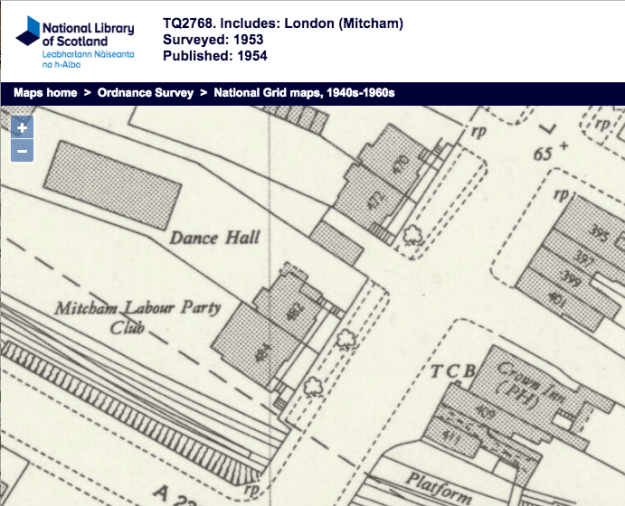
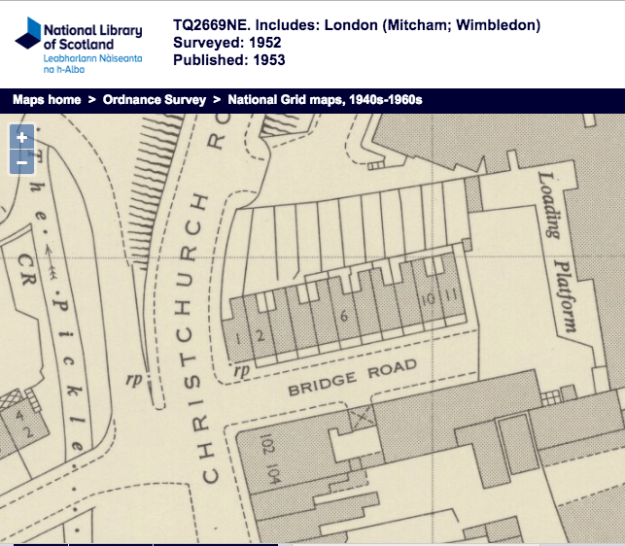
The Scafco Works can be seen on this 1953 OS map:

1953 OS map

A news item from January 1950 refers to a radio tower being erected on the 12 acre site:

West Sussex Gazette – Thursday 19 January 1950

One of the new sights of Mitcham Is a wireless aerial 175 feet high on the 12 acres at Willow-lane occupied by Scaffolding (Great Britain), Ltd. The company specialises in steel tubular scaffolding, the Inventor of which founded the business as a firm in 1904. This scaffolding is In use on 1,500 jobs, from the Houses of Parliament downwards. The radio system Installed is, after the police fashion. for keeping headquarters in touch with supervisors on their rounds, and with estimators who are sometimes wanted at very short notice.

Grace’s Guide to British Industrial History says that in 1960 the firm was the largest scaffolding company in the UK.


From the Norwood News, 5th November 1965:

COMPUTER PROGRAMMERS REQUIRED BY SCAFFOLDING (Great Britain) LTD.
WILLOW LANE,
MITCHAM,
for I.C.T. 1301 Card/Tape Computer, previous experience although desirable is not essential, and recent school- leavers will be considered.

Applicants must have G.C.E. pass in Maths preferably at A level. Excellent conditions of employment including Staff Cafeteria, Company Buses, Sports and Social Club.

Apply COMPUTER MANAGER, MIT 3400 ext. 389

For more on the ICT 1301, The National Museum of Computing are restoring one.

From the Mitcham News & Mercury, 6th June 1969:

THE SGB BUS

The Mitcham scaffolding firm of S.G.B. Ltd., who already run their own bus service between the Willow Lane industrial estate and central Mitcham, have extended the service into Morden. Employees can use the yellow staff bus on the route from Rose Hill, along Middleton Road and Goat Road, to the S.G.B. premises on the estate.

Other News Articles
1972 : SGB and the last 50-mile stretch of the M4

Memories from former staff (as posted on the Mitcham History Group on Facebook)
Geoff wrote:

I worked at Scaffolding (Great Britain) Ltd from 1974-75 in the Costing department. The place was completely self-contained with a network of service roads connecting each department. There was also a Burt Road and several others that I recall. The Personnel department was in a new building opposite.

SGB were always buying up other companies, Youngman System Building & Spurgeons Clean Plan were two of them. They also owned The Hire Shops, which I believe still exist under the name HSS Hire Shops. I think the newer building in Willow Lane is their head office, or at least it was when I took the photo. The company was sold in 1999 and trades under another name, but I read an article recently suggesting the SGB brand name may be restored……

Janette said:

Worked there for a very short period of time in the typing pool….we were all facing forward like at school and absolutely forbidden to speak to each other during working hours…..run by a very stern lady who sat at the front of the ‘class’ and shouted at anyone who slacked for even a moment……had to ask permission to use the toilet and she timed you!!! I dared to ask another typist for the spelling of a directors name and she blew her top.. I tried to explain but she was so enraged I dared to explain….I was so shocked at her rage I stood up, told her to keep her job and walked out…..in those days you had ‘your cards’ which were a record of tax and National Insurance and you couldn’t start another job without them… she shouted she would keep them for a week as punishment ……No worker rights in those days (1962)!!!!!

Sandy recalled:

For several years before they moved, I used to cook all the meals for Directors meetings which were held weekly. They had a fully furnished bungalow on site where prospective clients were wined & dined too. They had a fully equipped kitchen there that I used.

Florence said:

My first job from leaving school in 1960 was with SGB in Willow Lane. I worked in the coding and costing department. We would get the company bus (yellow double decker) from the three Kings pond to and from work. Remember the Directors cars, Aston Martin’s parked opposite my office window. Great Christmas parties and many lunches in the, then called, the Goat Pub. SGB gave me a good start in working life.


Maps are reproduced with the permission of the National Library of Scotland.