Mitcham and Tooting Advertiser, 7th July, 1960, page 1
GOODBYE TO
TROLLEYS630 service makes way for buses
DETAILS of the change from trolley-buses to the new 64-seater diesel “Routemaster” buses on the 630 West Croydon-Hammersmith route which passes through Mitcham were announced by London Transport this week. The alteration will bring an improved bus service in Mitcham.
Diesel vehicles will begin to run across Mitcham Common for the first time on Wednesday, July 20, following the same route as the trolley-buses. The number on the front of the buses will be changed from 630 to 220 and the diesels will take passengers through to Park Royal at the northern end of the run at peak periods, instead of stopping at Harrow Road (as the present 630s do).
When the change-over comes, London Transport plan to augment their service during weekday rush hours between Mitcham and Shepherd’s Bush with extra vehicles.
At the Southern end of the present 630 route, an important alteration will be the extension of the existing bus route 64 (Addington—Selsdon—West Croydon).
FUMES
London Transport will run this service from West Croydon over the common through Mitcham and Tooting along the 630 route to a terminus at Wimbledon Stadium. The extension of the 64s will also improve the regularity of service between Croydon and Tooting – the 630s have for years been seriously affected in this area due to traffic congestion on more northerly stretches.
This change in the services at Mitcham marks the half-way stage in the replacement of L.T.E. trolley-buses by diesels. Routes 626 and 628 will go at the same time and Hammersmith depot will close down.Trolley buses followed trams at Mitcham in 1936. London Transport say the main factor behind of preferring diesels to silent, smell-free trolleys is the maintenance of an absolutely flexible service.
Running costs for the two systems are said to be about the same, but the present generation of trolleys are nearing the end of their useful economic life and to continue with the overhead-wire system would involve a large capital expenditure.
A spokesman for London Transport said a continuous close check was kept on the exhaust fumes of their vehicles to ensure that irritation from dirty smoke was eliminated as far as possible.
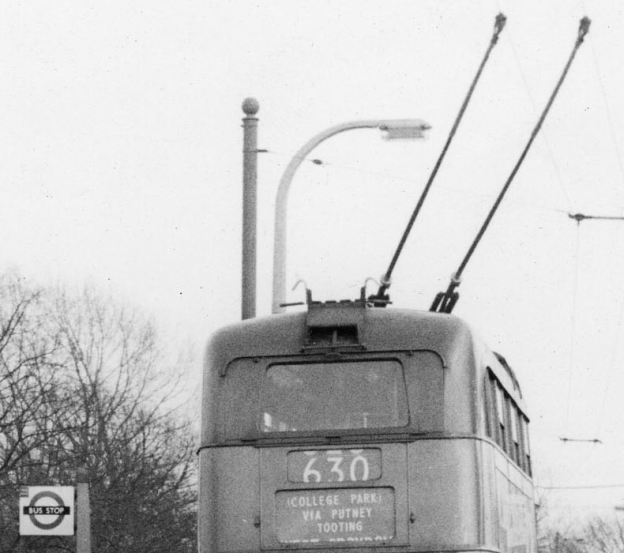
clip from Merton Memories, photo reference Mit_Transport_25-1 of trolley bus 630 – copyright London Borough of Merton
See also history of bus route 220.


 Mitcham History Notes