A curved road that runs from the London Road, north of the Mitcham Library, southwards to St Marks Road, with council housing built after the Second World War.
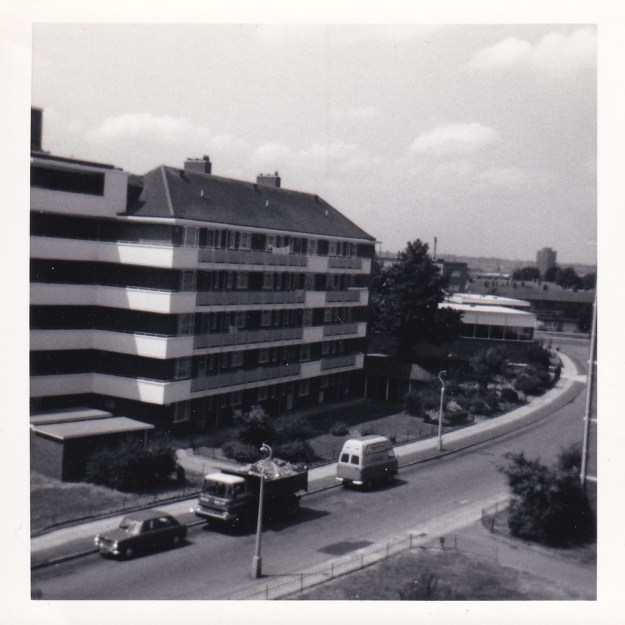
View of Armfield Crescent from Mainwaring Court, Paxton Court is on the left. Photo taken in 1968.
There were originally four blocks of flats, three on the east side and one on the west, housing in total approximately 200 families.
On the east side the blocks are named, from the London Road end, Elm Court, Mainwaring Court and Coningsby Court. The latter two are of the same design, in that they are mostly maisonettes with a downstairs of kitchen and living room with an upstairs of bedrooms and bathroom.
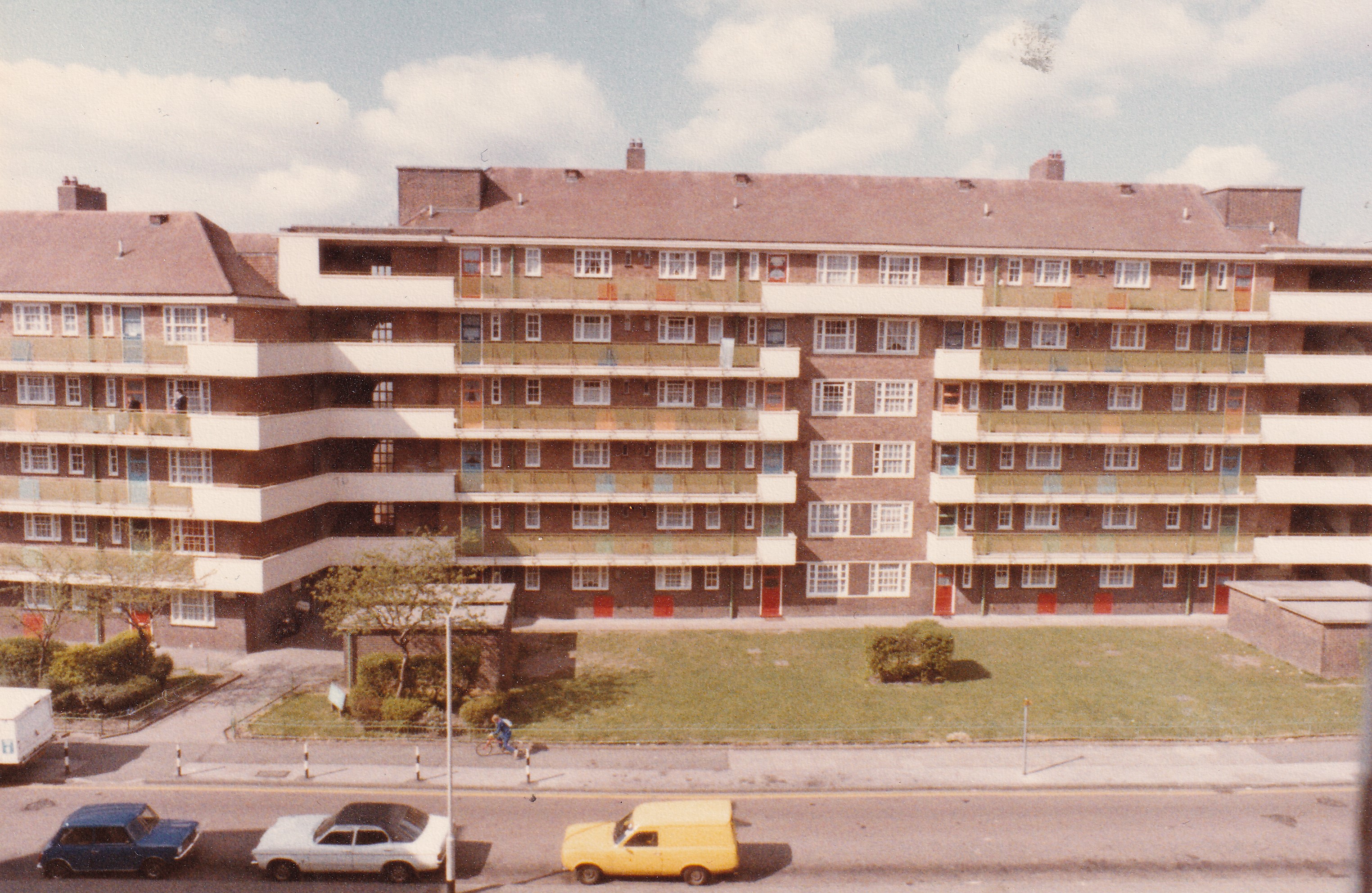
Paxton Court, photo taken possibly mid 1980s
On the west side is Paxton Court which consists of single level flats only. All of these blocks had four or five storeys and so included lifts. The use of sloping tiled roofs served to hide the lift’s engine room from view.
Each flat had use of one shed, for bicycles and prams, which were grouped into rows at the back of the blocks. Paxton Court also had sheds in front of the block. A row of sheds that faced away from the flats were frequently vandalised and broken into, with their contents stolen.
Flats are numbered sequentially, and all except Paxton Court, have their own postcode.
| Block | Postcode | Flat Numbers |
|---|---|---|
| Coningsby Court | CR4 2JT | 1 to 56 |
| Elm Court | CR4 2JU | 1 to 47 |
| Mainwaring Court | CR4 2JW | 1 to 56 |
| Paxton Court | CR4 2JY | 1 to 27 |
| Paxton Court | CR4 2JZ | 28 to 54 |
In addition there are eight houses, originally for old people, called Armfield Cottages, near the St Marks Road end. They have a postcode of CR4 2JJ.
A block of flats built around 2015 on the site of garages that were between Armfield Cottages and the playground was named Calico House and given the postcode of CR4 3FB.
The road is probably named from the Armfield family and their connection with the Potter and Moore farm near Figges Marsh. In 1859, Elizabeth, daughter of James Bridger, married John Armfield.
The housing site is also called Elm Nursery Estate, as it was originally a Mizen nursery. This name is preserved in a horse watering trough located in front of Coninsgby Court, at its southern end.
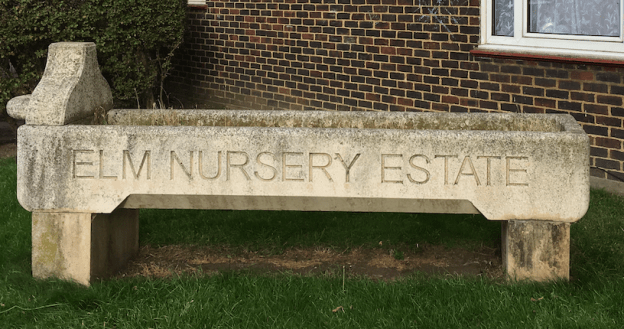
Photo taken 1st November 2017.
This council housing estate was developed in 1951/2. Flats were accessed via stairwells or lifts to communal balconies. In Mainwaring Court for example, the ground, second and fourth floors were in the main part of the block and had 12 flats each. On the ‘wings’ of the block were the ground, first and third floors.
Heating was by coal or coke fires in each flat, and a coal bunker was provided in the kitchen with access from the communal balcony. An example of the costs is shown from this extract from my mother’s diary, shortly after moving in to Mainwaring Court.
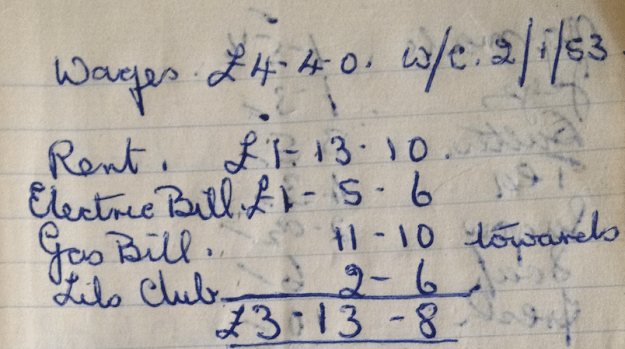
2nd January 1953, cost of living in a flat in Mainwaring Court
Rent was £1 13s. 10d, about 40% of the wages of £4 4s. Electricity cost £1 5s. 6d., gas (for cooking) 11s. 10d.
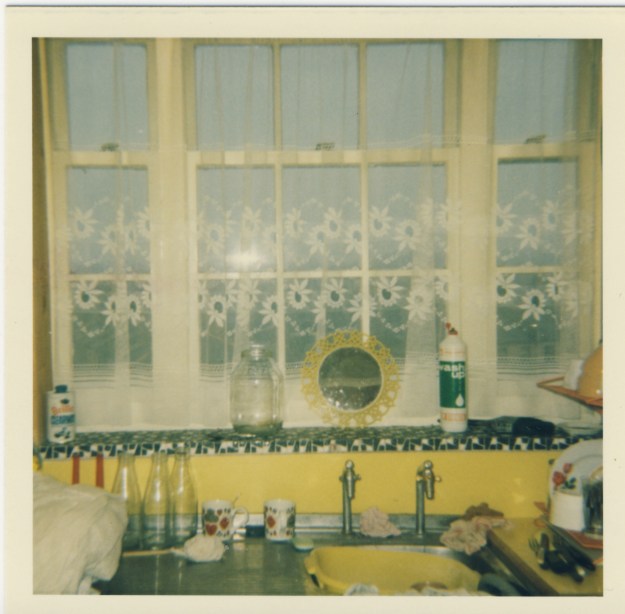
Kitchen sink in flat in Mainwaring Court. The coal bunker was under the draining board on the left. Photo taken c.1972
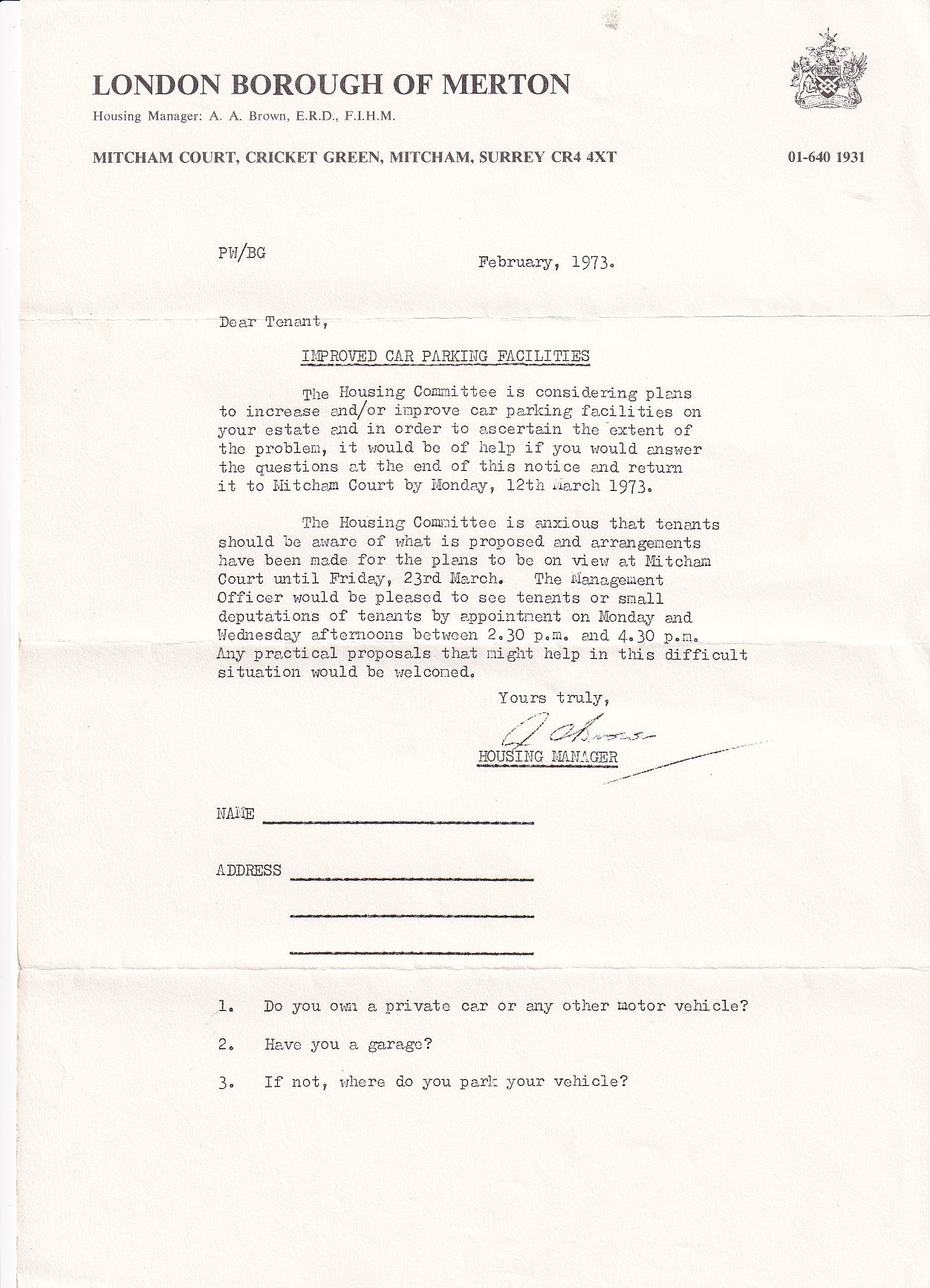
The blocks of flats on the east side of the road had grass areas at the back for children to play on. Survey letters were sent to residents in February 1973 asking for views on car parking.
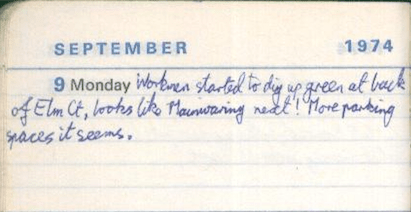
Numbered car parking bays replaced the grass area, starting with Elm Court, in September 1974, as noted in my diary.
The bays were numbered sequentially from north, at the rear of Elm Court, to south, at the rear of Coningsby Court. As the numbers didn’t relate to flat numbers, e.g. there was one bay 20 and three flats numbered 20, this did cause some confusion with residents. I used two bays at one point, much to the irritation of my neighbours.
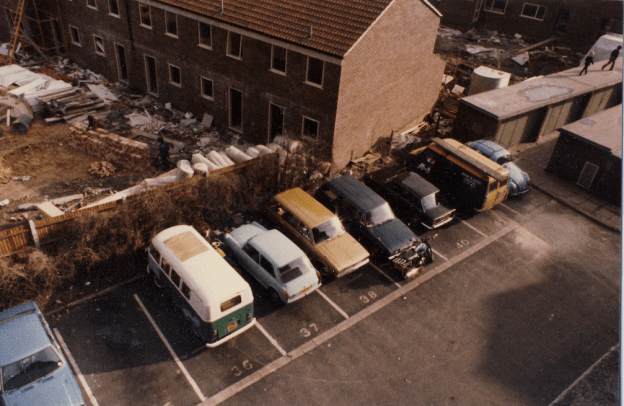
My Hillman Hunter estate in car parking bay 38, and my Singer Sunbeam estate plus Triumph TR62R motorcycle in bay 37. Photo taken in 1979.
Land to the east of between Armfield Crescent was kept for allotments, although later it was planned by Mitcham council to build a bypass road, the ‘Eastern Loop’ to run from the London Road around the centre of Mitcham. This didn’t happen, and in 1979 the land was cleared.
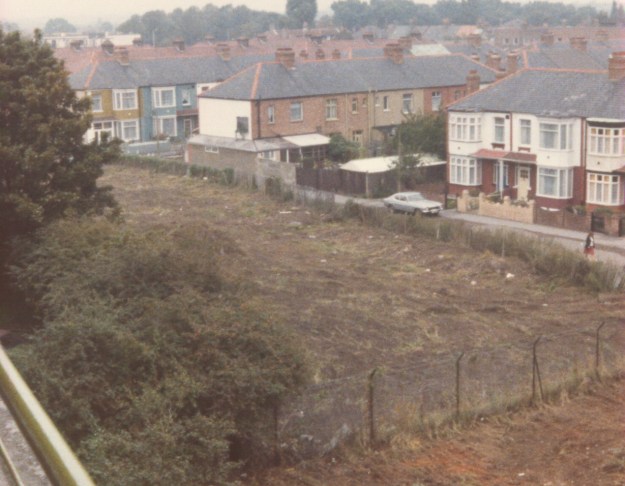
Northern section of allotment land behind Elm and Mainwaring Courts
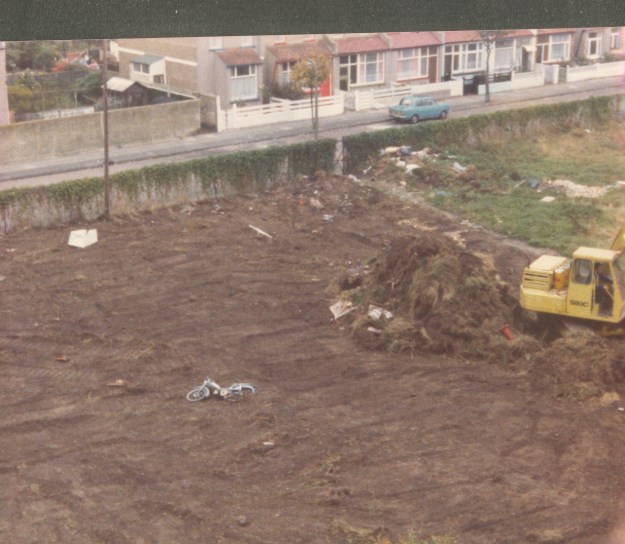
Allotment land cleared between Mainwaring Court and Feltham Road.
Housing was built on this land from 1979.
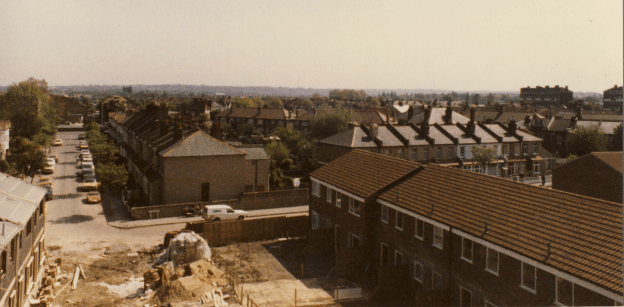
View from 4th floor of Mainwaring Court of Feltham Road housing being built on former allotment land.
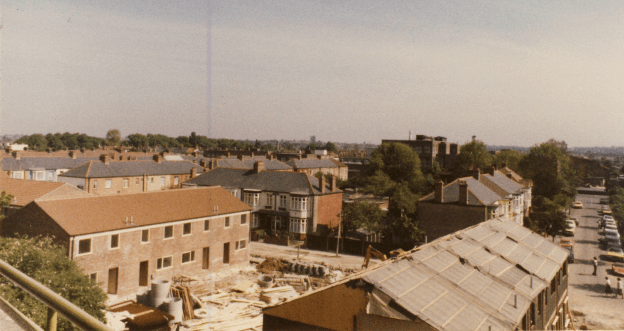
1979. View of housing being built on former allotment land behind Elm Court.
News Articles
From the Mitcham & Tooting Advertiser
3rd May, 1951
£180,505 borrowed by Mitcham Council over 60 years to build 103 flats and maisonettes on the Elm Nursery estate.
2nd August, 1951
“WHY CALL NEW FLATS MAINWARING COURT?”
Labour councillor Tom RUFF complains that the names chosen for the new blocks on the Elm Nursery estate have no relation to local history. He said that MIZEN would be better for Mainwaring Court and CAREY or CAREW for Coningsby Court. The POLE-CAREW family once owned land in Mitcham and Carew Road was named after them. The new flats were adjoining a road known locally as Carry Close, although it should be called Carey Close. Conservative councillor MINGAY said that the names chosen did have a connection with Mitcham.
See also Armfield Crescent Block Names.
8th September, 1951
“200 FAMILIES IN NEW FLATS
Elm Nursery scheme will be completed next Spring”About 20 families have moved in so far, into Elm Court first. The first block, Elm Court, has 40 3-bedroom flats and 7 2-bedroom flats. The second block, Mainwaring Court has 56 2-bedroom flats as does the third block Coningsby. The fourth block, Paxton, will probably have a high proportion of 3-bedroom flats.
Mr & Mrs D.M. O’KELLY were among the first tenants in Elm Court. Mr G.C.A. PANNEL, caretaker for the whole estate, also moved in.
The rents for 2-bedroom flats in Elm Court are £1 12s. 6d. and £1 17s. 6d. for the 3-bedroom flats.
The flats include special drying cupboards and electric water-heaters.


 Mitcham History Notes