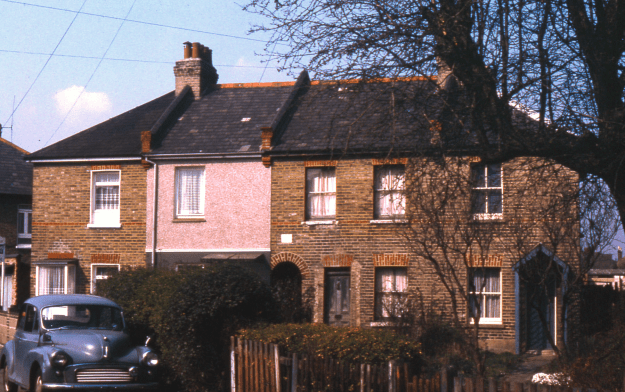
Two roads that were built after 1932 on the Pollards Hill Golf Course.
Contents
Maps
WW2 Connections
Newspaper Articles
Maps</>
Out of copyright Ordnance Survey maps are reproduced by permission of the National Library of Scotland, reuse CC-BY.
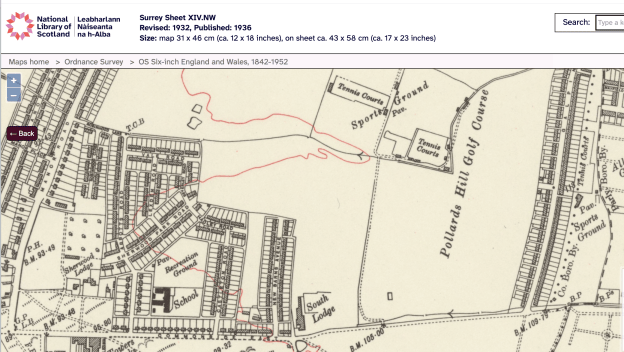
Rotated 1932 OS map showing Manor Road, Commonside East to Galpins Road
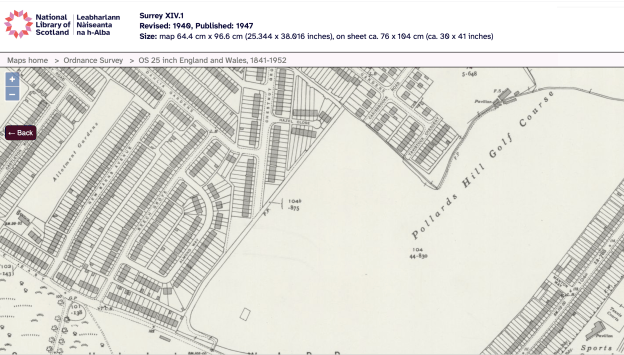
1940 OS map Beech Grove and Almond Way
World War 2 Connections
No. 75 Beech Grove, H.E. EASTER joined Home Guard on 12th July 1940
No. 1 Almond Way, Sgt. C. ?. JORDAN joined the Home Guard on 10th September 1940
No. 12 Almond Way, P.G. JAMES joined the Home Guard 3rd October 1940
Newspaper Articles
Mitcham Advertiser, 18th July 1935
BOROUGH OF MITCHAM.
PRIVATE STREET WORKS ACT, 1892.
NOTICE IS HEREBY GIVEN that the Borough Council of Mitcham, being the Sanitary Authority for the above-named district, did, on the 25th day of June, 1935, in accordance with the provisions of the above-mentioned Act, pass the following resolution:
“That the specification of the works proposed to be done with respect to the making up of Almond Way, within the sanitary district of the Council, and the plans, sections, estimate and provisional apportionment relating to such works, now submitted by the Borough Engineer, be and the same are hereby approved.”
And Notice is Further Given that for a period of one month from the 11th day of JULY, 1935, the specification, plans, sections, estimate and provisional apportionment, referred to in the above resolution, will be kept deposited at the Town Hall, Mitcham, and will be open to inspection at all reasonable times.
Dated the Eleventh day of July, 1935.
By Order of the Council,
STEPHEN CHART,
Town Clerk.
Town Hall,
Mitcham.
Mitcham Advertiser, 24th October 1935
ROAD CHARGES DISPUTE.
TENANTS’ OBJECTION.
ALLEGED THAT EXPENSES ARE EXCESSIVE.
Beech Grove and Almond Way.
Residents in Beech-grove and Almond-way, on the Pollards Hill estate, disputed at Croydon County Police Court on Tuesday the provisional apportionment of their liability in respect of the making up of the two streets by Mitcham Borough Council, on the ground that the expense of executing the work was excessive.
The two streets, said Mr. J. Hodson (who represented the Council), were newly developed and adjoining, and on both sides of the streets were houses which were let or sold. Neither of the streets was a highway repairable by the inhabitants at large (out of the rates), not having been taken over by the Council, so the frontagers were liable under the Act for street works.
The developers of the estate had done a certain amount of work in connection with the carriageways, but this was not wholly satisfactory from the Council’s point of view, and there were no footways.
It was resolved by the Council to complete the carriageways and construct footways, constructing kerbs, laying paving and surfacing.
The objections were all in regard to the alleged excessive expenditure estimated. There were a good number of objectors.
A typical objection cited by Mr. Hodson was that of Mr. Exton, of 2, Beech-grove, who had written in reply to the notice of apportionment: “I consider the amount excessive. It is double the estimate given us by the builders.”
“I am not aware,” commented Mr. Hodson, “what the builders told him.”
Mr. Exton, he added, objected on the further ground that the work should not be done by direct labour without inviting tenders from outside contractors.
“Direct labour as such,” observed Mr. Hodson, “is not an objection that can be taken under the Act (Private Street Works Act, 1892). The only objection that the owner can take is that the cost as estimated is excessive. Direct labour is a matter of policy only.”
ESTIMATES OF COST.
The Council’s surveyor originally estimated, in June last, in the case of Beech-grove, that the cost would be £1,395 13s. 7d., and in the case of Almond-way £1,038 18s. 2d. In those estimates the surveyor had to allow for possible fluctuations in prices—upwards; any reasonably cautious surveyor would make an allowance for this. However, since he prepared those estimates the surveyor had completed and had ascertained the actual cost of other roads in Mitcham, so he was in a position now better to estimate the cost of completing Beech-grove and Almond-way. He had found that they worked out lower than he originally estimated, and he was now prepared to reduce the original estimates by 12½ per cent. of the total sums. The revised estimates were: Beech-grove, £1,323 1s. 11d.; Almond-way, £907 6s. 3d.
Giving evidence, Mr. Riley Schofield, the Borough Engineer and Surveyor, said that in Beech-grove, which was 959 feet long, it was proposed to construct a carriageway 18-ft. wide, using the existing carriageway as foundation, and provide two 9-ft. wide footpaths. The apportionment, according to his original estimate, was 13s. 6d. a foot frontage.
The same applied in regard to Almond-way, the carriageway being 16-ft. wide, 828-ft. long and with a 7-ft. wide footpath on either side; the cost a foot frontage was proportionate.
Since June this year, he had made up streets to the value of £4,000 by direct labour, and, with the greater experience acquired in the process, he was now able to reduce the estimates by 12½ per cent.
Originally, he recalled, the estate developer was invited to make up the streets to the Council’s specification, and under the supervision of the Council, when it would have been extremely likely that the Council would then take over the streets. But the builder declined to enter into a contract with the Council. In their present state, the carriageways were not satisfactory, continued Mr. Schofield, and he did not feel justified in recommending the Council to take over the streets.
DIRECT LABOUR NOT EXPENSIVE.
Mr. F. M. Parris (who appeared for all the objectors)—It is a recognised thing that when a Council does a thing by direct labour the cost is higher than by private contract?
Mr. Schofield—Decidedly not.
Mr. Parris then invited Mr. Schofield’s opinion on a contract prepared by a Streatham firm of contractors who undertook to make up the streets to the Council’s specification for £1,045 (10s. 6d. a foot frontage) and £737 (8s. 10d. a foot frontage) respectively.
Mr. Schofield—I should strongly exhort my Council to accept their offer because I cannot do it at that figure.
Mr. Schofield added that the work could not be carried out economically at these rates.
An engineer with a considerable experience of private street works by direct labour declared that the costs compared favourably with contractors’ rates.
A representative of the Streatham firm which prepared the rival estimates agreed, under cross-examination, that the figures were only lump sum estimates.
Mr. Hodson contended they were “hazy estimates” and all the details were in the witness’s head.
In the circumstances, Mr. Hodson went on to tell the magistrates, if the firm was satisfied to enter into a contract with the Council to do the work at the prices named, to the Council’s specification and under supervision, then, of course, the surveyor would advise the Council to accept it, obviously. In those circumstances, the proper course was for the case to be adjourned for them to enter into negotiations.
It was not for him to argue if a firm was willing to undertake to do work at less than economic rates, he observed.
The magistrates (who were presided over by Mr. W. G. Storer) adjourned the case until November 20th.
Mitcham Advertiser, 2nd April 1936
TO LET, Modern Flat; 3 large rooms, 1 as kitchenette; own gas cooker and meter; electric light, use of bathroom; 17/- including light.—50, Almond Way, Commonside East, Mitcham.
Mitcham Advertiser, 12th November 1942
BUS AND LORRY
Two women were injured when an omnibus and a lorry collided on Commonside East, Mitcham, just before eleven o’clock on Monday morning.
They were Mrs. Eileen Ruth Lancaster, the conductor, of 23, Lavender Grove, Mitcham, and Mrs. Helena Hibberd, of 6, Almond Way, Mitcham, a passenger. After treatment at Wilson Hospital they were able to go home.
The lorry driver was Mr. G. L. Franks, of 3, Eland Road, Thornton Heath. Apparently in passing a stationary vehicle near Pentlands Close in the fog the lorry, swerving, came into collision with the bus. Little damage was done.
Mitcham Advertiser, 16th March 1944
NAVAL OFFICER LOST
Sinking of H.M.S. Penelope
Sub-Lieut. Edward Draper, aged 20, whose home until recently was 53, Beech Grove, Mitcham Common, was one of the naval officers reported missing after the loss of H.M.S. Penelope.
He was an old boy of Pollards Hill School, where he won prizes and cups for sports, and also of Mitcham County School. His parents now live at Wimbledon Chase. He was promoted from the lower deck to be a midshipman, and it is but a short time since he was made a sub-lieutenant.
It was regarded locally as a strange coincidence when he was posted to the Penelope, for on that ship had served Leading Stoker J. G. Hollebon, who in private life is the caretaker of Pollards Hill School. Miss Phyllis Hollebon, the eldest daughter of Leading Stoker and Mrs. Hollebon, received a cheery Christmas and New Year message from him on the back of a new photograph showing him in his officer’s uniform.
Leading Stoker Hollebon was himself posted missing after the fall of Singapore. He was then on H.M.S. Durban. Two months later his wife and family heard the good news that he was safe, and later he came home. After an operation he returned to active service.
“He would have been on the Pehelope but for the operation” Mrs. Hollebon told “The Advertiser.” “He was on that vessel when he overstrained himself and was prevented from rejoining the ship.”
Mitcham Advertiser, 18th February 1954
NEW SCOUTMASTER
Mr. Ron Allfree takes up his duties as new Scoutmaster of the 23rd Mitcham (The Ascension) Scout Group this week. He is at present on demobilisation leave from the R.A.F. His home is in Beech Grove, Pollards Hill.
Mitcham Advertiser, 4th November 1954
Surrey award trophy to Mitcham boy
ROY HOOPER, a 17 year old apprentice bricklayer from Almond Way, Mitcham, has been awarded the Brookes Trophy for the best performance at the Surrey youth championships at Motspur Park in June.
Hooper’s javelin throw of 159-ft. 5-in. was an improvement on the old record by 8-ft. 7-in. He is a member of Mitcham Athletic Club.
Mitcham Advertiser, 17th April 1958
Bus route: Reader’s plan
A new idea for the re-routing of buses to serve the Pollards Hill Estate and Mitcham has been put forward this week by Mr. C. F. Anderson, of Almond Way, Mitcham.
In a letter to “The Advertiser” Mr. Anderson comments upon the routes which have been suggested in the controversy over the Pollards Hill service.
Mr. Anderson suggests that the No. 44 buses, or at least some of them, should be diverted by the Three Kings Pond, Commonside East and Sherwood Park Road or Wide Way to South Lodge Avenue where there are two bays.
“There are plenty of other buses between The Cricketers and Fair Green which would obviate any objection that cutting this service would be unreasonable,” he adds.
Mitcham Advertiser, 8th May 1958
Fight over 100 yards of land?
A BATTLE may arise during the next few weeks between three of Mitcham’s strongest organisations — Pollards Hill Tenants’ Association, Long Thornton and Tamworth Residents’ Association and Mitcham Common Preservation Society.
The committee of the tenants association have written to the Mitcham Common Conservators asking them to relinquish a 100 yd. stretch of land between Beech Grove and Galpin’s Road, so that a bridle path can be extended and made into a road.
They feel that this would allow simpler and quicker access to the Pollards Hill Estate for the residents and for fire engines or ambulances in an emergency.
The matter was brought up at last week’s meeting of the Conservators, when the clerk put forward the views of the tenants’ association.
A member of the Conservators pointed out that the land in question was no use to anybody in its present state and was just a “patch of hard dirt.”
Close attention
The Conservators decided to leave the problem to their Improvements Committee to investigate and report back.
Mr. A. S. Hutchin, a vice-chairman of Long Thornton and Tamworth Residents’ Association and a member of the Mitcham Preservation Society, told an “Advertiser” reporter this week that both his organisations would study the matter
“It will need a lot of close attention and thought,” he said, “but I should say at first glance that we shall object very strongly if the Conservators agree to the plan. We don’t want to see any of the common land lost.”
Mitcham Advertiser, 5th June 1958
ROAD ACROSS COMMON ‘NOT WANTED’
“Strong protests” against suggestions for a road being built from Commonside East to Galpins Road, Mitcham have been made by Mitcham Common Preservation Society and Long Thornton and Tamworth Residents’ Association.
Pollards Hill Estate Tenants’ Association asked Mitcham Common Conservators whether a track leading from Beech Grove to Galpins Road could be built into a road for easier access to the estate.
Last week the preservation society and the Long Thornton association decided that the existing roads to the estate were adequate for the traffic, and fears were expressed that a new road might become “a race track for motor cyclists”
Both associations have written to the conservators expressing these views, and emphasising that common land would be taken in the development, and could not be replaced.
Mitcham Advertiser, 17th July 1958
Footpath: ‘It’s all a mistake’
The refusal of Mitcham Common Conservators to extend a footpath from Beech Grove to the Pollards Hill Estate may have arisen from a mistake over the distance and cost, claims Mr R. Pattison, secretary of the Pollards Hill Estate Tenants’ Association, who are pressing for the path to be turned into a through road.
He said this week that it was mentioned at the Conservators’ meeting that a roadway from Galpin’s Road to Beech Grove was wanted, and that a figure of £3,000 was also mentioned for the work.
“We only want a quarter of that distance—a matter of 100 yards or so I am sure that the cost would not be so high as that,” Mr. Pattison told ” The Advertiser.”
“Our request was turned down because of the cost, and I think that it should be reconsidered.”
Access to the estate was very bad, and in connection with the matter he was asking the borough engineer to erect “no through road” notices at the end of Chestnut Grove, to stop drivers who thought they could get through to the common.
Mitcham Advertiser, 24th July 1958
‘TRYING TO CLIMB DOWN’
The Pollards Hill Estate Tenants’ Association “are trying to climb down” after “a hard knock” from the Mitcham Common Preservation Society, it was stated at the society’s meeting on Monday.
Mr. A. S. Hutchins said that the estate tenants’ association had asked for a road from Commonside East to Galpins Road, but, after protests from the society, permission had been refused by the Common Conservators.
“Now it is reported that the tenants’ association are saying they did not want this road, but only a short road from the common to Beech Grove,” Mr. Hutchins said. “Whatever they want, it will mean taking some of the common away to build the road, and they must not be allowed to do this.”
Mitcham Advertiser, 2nd October 1958
Track to be improved
Mitcham Common Conservators have agreed an estimate amounting to £1,930 for making good a track from houses east of Beech Grove, Mitcham.
The estimate, put forward by Croydon Corporation, involves filling in a ditch and laying grass, laying a drain along a length of the ditch, and laying grass between the track and some playing fields.
Mitcham Advertiser, 18th June 1959
The Mitcham and Carshalton women’s swimming team posed for a picture just before they took part in a match against Hengelo at the Weusthag Pool in Holland last week. Their chaperon, Mrs. M. Gorvin, of Almond Way, Mitcham, on the left, is herself a former Scottish Olympic swimming trialist.
Mitcham Advertiser, 10th September 1959
THE wedding of 68 year old Mrs. Eleanor Hibberd and 78 year old Mr. Ernest Butler took place amid a crowd of friends at Morden Registry Office on Saturday.
The bride and groom are members of Pollards Hill Good Neighbours’ Club, where they first met. After their honeymoon they will return to Mrs. Hibberd’s home in Almond Way, Mitcham.
In the general excitement one of the wedding guests accidentally closed the registry office door, which was self-locking—and for a while the next couple about to be married could not get in.
Mitcham Advertiser, 24th March 1960
Proceeds for the society
Anyone in Mitcham who enjoys fresh marmalade and would like to help the Church Missionary Society as well, should call at 18, Almond Way, Pollards Hill.
Mrs. Janet Spayne, a parishioner of the Church of the Ascension, sells home-made marmalade. This novel idea of hers succeeded in raising £10. for the Church Missionary Society, last year.