Tag Archives: Lower Green

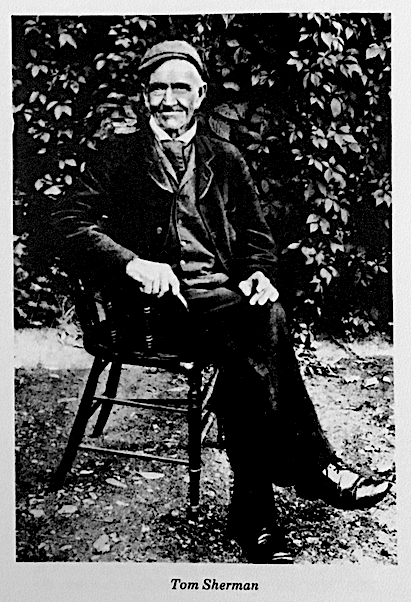
Tom Sherman, the fastest bowler of his time

Cricketer who made 82 appearances in first class matches in the 19th century.

Born in Mitcham on 1st December 1825, his father James Sherman was also a cricketer. He died 10th October 1911.
A letter dated 30th November was published in the The Sportsman of Thursday 1st December 1904:

TOM SHEARMAN.

Sir.,

I thought it would be of interest for you and others interested in cricket to know that Mr Tom Sherman attains his seventy-ninth birthday to-morrow. He is the oldest Surrey cricketer, and has the unique distinction of having played continuously for fifty years. His health haring quite failed him, and circumstances for this reason being anything but comfortable, I would be glad if something might be done to make his position a little more comfortable during the winter months. I feel quite sure that some of the older generation who knew him in his famous bowling days would willingly help him if they knew his position.

— Yours, etc.,
Arthur B. Wilkinson.
Studio,
Carlton-gardens,
Lower Green,
Mitcham, November 30.

Source: The British Newspaper Archive

His obituary was reported in the Croydon Guardian and Surrey County Gazette of Saturday 14th October 1911.

TOM SHERMAN DIES AT CROYDON.

A Famous Surrey Cricketer.

The Inquest.

The death of Tom Sherman, of Mitcham, who succumbed at Croydon Hospital, Tuesday, after breaking his leg at Mitcham, leaves William Caffyn the only survivor of a great band of professional cricketers who were in their prime nearly sixty years ago.

In “Scores and Biographies,” Sherman, who was born 1827, is described the as the fastest bowler of his time, and himself recalled the fact that in one of Surrey matches against Yorkshire at Sheffield he broke stump into five pieces. For this feat an admirer gave him a case of razors.

For the greater part of his long life, says “Unknown” in the “Morning Leader,” he lived at Mitcham, one of the famous nurseries of the game, and it was on the village common nine years ago that I last saw Sherman, on the occasion of his annual benefit. It may the vanity of old age to compare the present with the past to the disadvantage of the former, but I remember the wrinkled veteran as very emphatic in expressing an opinion that the bowling in his time was a great deal faster than that of modern days. In the matter of physical power, he believed that Alfred Mynn and himself were considerably ahead of latter-day bowlers when it came to question of pace. “This right knee,” he said, ” was put out as result of a scorching ball from Mynn. and it has never been right since.”

Sherman played for Surrey during eleven or twelve seasons with Julius Caesar, Caffyn, Lockyer, Martingell, and Mortlock. Sherman never bowled against Dr. W. G. Grace, but the man for whom he had the greatest respect as a bat was Fuller Pilch. Sherman dropped out of county cricket when his county were at their best, taking scarcely any part in the great things achieved by the Surrey team under Mr. F. P. Miller, who led the side to victory against All England in 1861. Appearing at Lords in 1846, Sherman met with most success in season the of 1850 and 1851, taking 99 wickets in the course of ten matches during two years. This was before bowling analyses were taken. Described as one of the fastest round-arm bowlers, he earned fame as a contemporary of Alfred Mynn, Fuller Pilch, George Parr, William Caffyn, Felix, and Martingeil. Two months older than Caffyn, Sherman was the oldest professional cricketer living.
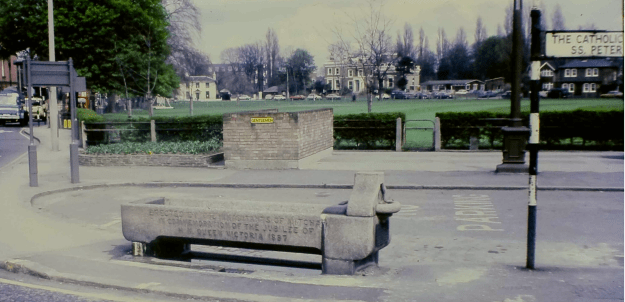
Lower Green Public Conveniences

Built around 1929 underground, opposite the Burn Bullock, and behind the water trough.

Clip of 1975 photo taken by Bill Rudd, and reproduced here by kind permission of the Merton Historical Society

The gas lamp post shown between the toilets in this photo was added to the local list by Merton Council on 12th July, 2017, as a result of a campaign by Mitcham Cricket Green Community & Heritage.

The need for a public convenience at this spot was debated in 1923.

From the minutes of the Mitcham Urban District council
Volume IX April 1923 to March 1924
Pages 291 to 292

Report of Sub-Committee appointed to consider the question of the provision of Public Conveniences.
Meeting held Monday, October 15th, 1923.

Present : Mr. R. F. Langley (Chairman), Messrs. H. J. Davis, J. Fitch and W. H. Parslow.

The Sub-Committee considered the matter referred to them by the Public Health Committee, and beg to submit the following suggestions :-

1. The need for public conveniences in certain parts of Mitcham is becoming more and more apparent every year, and with the constant increase in the number of visitors brought into the district by the omnibus and tramway services it is essential that the matter should be taken in hand at a very early date.

2. The Sub-Committee consider that the most pressing needs are for public conveniences (for both sexes) upon the Fair Green and the Lower Green.

3. The site upon the Fair Green has already been determined by the Council, and the plans of the Surveyor have been the matter is now before the Ministry of Health.

4. The provision of a convenience on the Lower Green is, therefore, in the opinion of the Sub-Committee, the most pressing need at the present time. every day a large number of persons are brought to this spot owing to its being the terminus of a well patronised bus service.

5. The Sub-Committee suggest that the most suitable site for a convenience is upon the triangular piece of ground, now planted as a shrubbery, between the ” Cricketers ” Inn and Messrs. Barclays Bank ; and the Committee further suggest that a convenience constructed upon this site could be of an external design which would be in no way a disfigurement to the Green.

6. The Sub-Committee look upon the provision of a convenience in the vicinity of the omnibus terminus as an essential.

From the minutes of the Mitcham Urban District council, volume XIV, 1928 to 1929, page 124:

32. PUBLIC CONVENIENCE, Lower Green. – It was Resolved, That the Council be recommended to instruct the Surveyor to report as to suitable sites for a public convenience on or adjacent to the Cricket Green.

The council had also considered removing the water trough, but held off until they could get agreement on widening the London Road.

In considering the sites for the toilets, the council considered next to the Cricketers pub, and the island opposite Barclays Bank. Page 201 of the above minutes says:

An overground convenience … would destroy the amenity of this corner of the Cricket Green

The problem with an underground convenice though was the cost, as Riley Schofield concluded:

I would like to point out to the Committee that underground conveniences are a very costly proposition. The site will have to be wholly excavated and carted to tip. The walls must be constructed as retaining walls, and also covered on the outside with asphalte to render the structure waterproof. The roof will have to be constructed of
reinforced concrete and provided with prismatic pavement lights, or, as an alternative, the structure could project 2 feet or so above the ground and be lighted by means of lantern lights. Steps will have to be provided, and these are costly and wasteful of space. Ventilation is also an expensive item. It may be necessary to raise the sewage by
mechanical means, necessitating a constant charge for the supply of water.

The decision to go with an underground convenience, behind the water trough, was made and reported on pages 276 to 277, although the Surveyor was asked to provide estimates for a partially underground as well wholly underground. Page 451 shows that his estimates were close, £2,100 for partially vs £2,500 for wholly underground, and he recommended the latter. Page 457 shows that the council agreed with his recommendation.

In volume XV, 1929 to 1930, page 104, the council asked the Ministry of Health for a loan of £3,500 to build the underground public convenience. Adjusted for inflation, this is equivalent to around £200,000 in 2017 values. Page 207 shows that the Ministry approved the loan and so the Surveyor was instructed to put it out to tenders. Page 311 reports that 11 firms had submitted tenders for the job, and that the Horley firm of Mr J. CREWDSON had been accepted, for the amount of £2,672. The Horley Local History Society has more on this builder, who also has a road there named after him.

No further details are available in council minutes as to when the convenience was completed.

From the minutes of the Mitcham Urban District council
Volume XVI, 1930 to 1931
Page 178

9. PUBLIC CONVENIENCE The Surveyor reported that he would find it necessary to engage the services of a full time attendant at the public convenience on the Lower Green, and that the annual cost thereof would amount to £352, this being a sum somewhat in excess of the original estimate. Resolved, That the Surveyor be authorised to make the necessary appointment.


Minutes of meetings held by the Mitcham Urban District Council are available on request from the Merton Heritage and Local Studies Centre at Morden Library.