Tag Archives: Mitcham Common

1879 : Gipsy Life on Mitcham Common

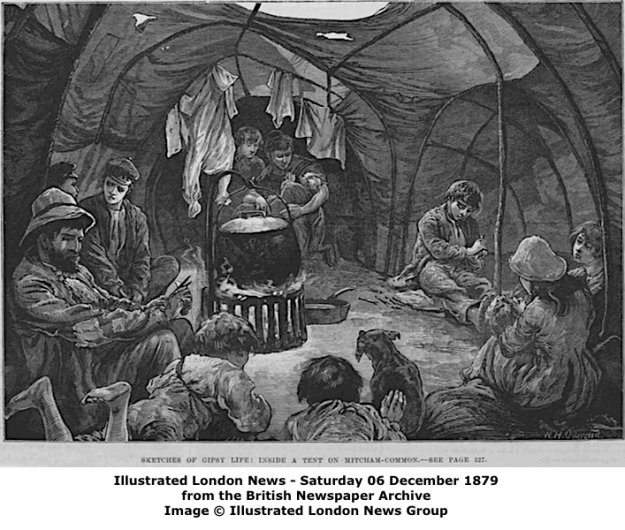
Sketches on Gypsy Life : Inside a tent on Mitcham Common

GIPSY LIFE NEAR LONDON. Another sketch of the wild and squalid habits of life still retained vagrant parties or clans of this singular race of people, often met with the neighbourhood of suburban villages and other places around London, will be found in our Journal. We may again direct the reader’s attention to the account of them which was contributed by Mr. George Smith, of Coalville, Leicester, to the late Social Science Congress at Manchester, and which was reprinted in our last week’s publication. That well-known advocate of social reform and legal protection for the neglected vagrant classes of our population, reckons the total number of gipsies in this country at three four thousand men and women and ten thousand children. He is now seeking to have all movable habitations—i.e., tents, vans, shows, &c. —in which the families live who are earning a living travelling from place to place, registered and numbered, as in the case of canal boats, and the parents compelled to send their children to school at the place wherever they may be temporarily located, it National, British, or Board school. The following is Mr. Smith’s note upon what what was to be seen in the gipsies’ tent on Mitcham-common:-

“ Inside this tent —with no other home—there were two men, their wives, and about fourteen children of all ages : two or three of these were almost men and women. The wife of one of the men had been confined of a baby the day before called —her bed consisting of a layer of straw upon the damp ground. Such was the wretched and miserable condition they were in that I could not do otherwise than help the poor woman, and gave her a little money. But in her feelings of gratitude to me for this simple act of kindness she said she would name the baby anything I would like to choose ; and, knowing that gipsies are fond of outlandish names, I was in a difficulty. After turning the thing over in my mind for a few minutes, I could think of nothing but Deliverance.’ This seemed to please the poor woman very much; and the poor child is named Deliverance G——. Strange to say, the next older child is named Moses.’

Source: Illustrated London News – Saturday 06 December 1879 from the British Newspaper Archive (subscription required)

1866 – Six die when bridge collapses during construction of Mitcham – Sutton railway

From the South Eastern Gazette, 1st May, 1866, page 6:

Frightful Accident at Sutton, Surrey — Six Men Killed by the Falling of a Bridge.

— A lamentable catastrophe occurred at Sutton on Saturday afternoon. The South Coast Company are constructing a new line of railway, which is ultimately intended to connect the London termini with Portsmouth by a direct route. A portion of this line is known by the name of the Mitcham and Sutton Railway, and after crossing Mitcham-common runs at the back of Carshalton and joins the existing Epsom line on the London side of the Sutton station.

A deep cutting through chalk, about half a mile from the junction, renders a bridge necessary for the public road. The work was here in active progress, and the bridge which fell was constructed by means of leaving a keystone of the native chalk and building the brick work upon the chalk abutments. The bridge was nearly completed, but some weeks since a doubt of its stability was entertained, and reports are current in the neighbourhood that the bridge was condemned, and that workmen had absolutely been discharged by the contractor for refusing to work at it, under apprehension of danger. Notwithstanding this, on Saturday afternoon, at half-past two, six men and a ganger were employed. Three of the six were cutting away the chalk, and three others were scraping the brickwork to make it ready for pointing, from which it appears that there was no intention of pulling down the bridge. At half-past two the whole mass of brickwork gave way and buried six poor fellows. The ganger, John White, escaped. Every effort to get at the buried men was made, but it was nearly two hours before they were extricated.

All six were of course dead, and there is reason to hope that their death was almost simultaneous with their apprehension of danger. On visiting the spot on Sunday morning we found the six poor fellows were lying on the floor of a cottage adjoining, and exhibiting a frightful aspect of violent deaths. One of them had his face and head absolutely torn in halves horizontally; another’s countenance could scarcely be recognised.

The names of the poor fellows are Edward Berry, Chas. Collard, Wm. Cook, Henry Hyder, and Hutchinson ; the sixth was not identified at the time of our visit. The contractor for the line is Mr. Joseph Firbank, of Newport, Monmouth, and the construction of the bridges is underlet to Mr. Henry King, of Lower Norwood.