The Vestry Hall, London Road, Mitcham, was opened on Wednesday 18th May 1887, as show on this tablet, which is on display in the entrance.
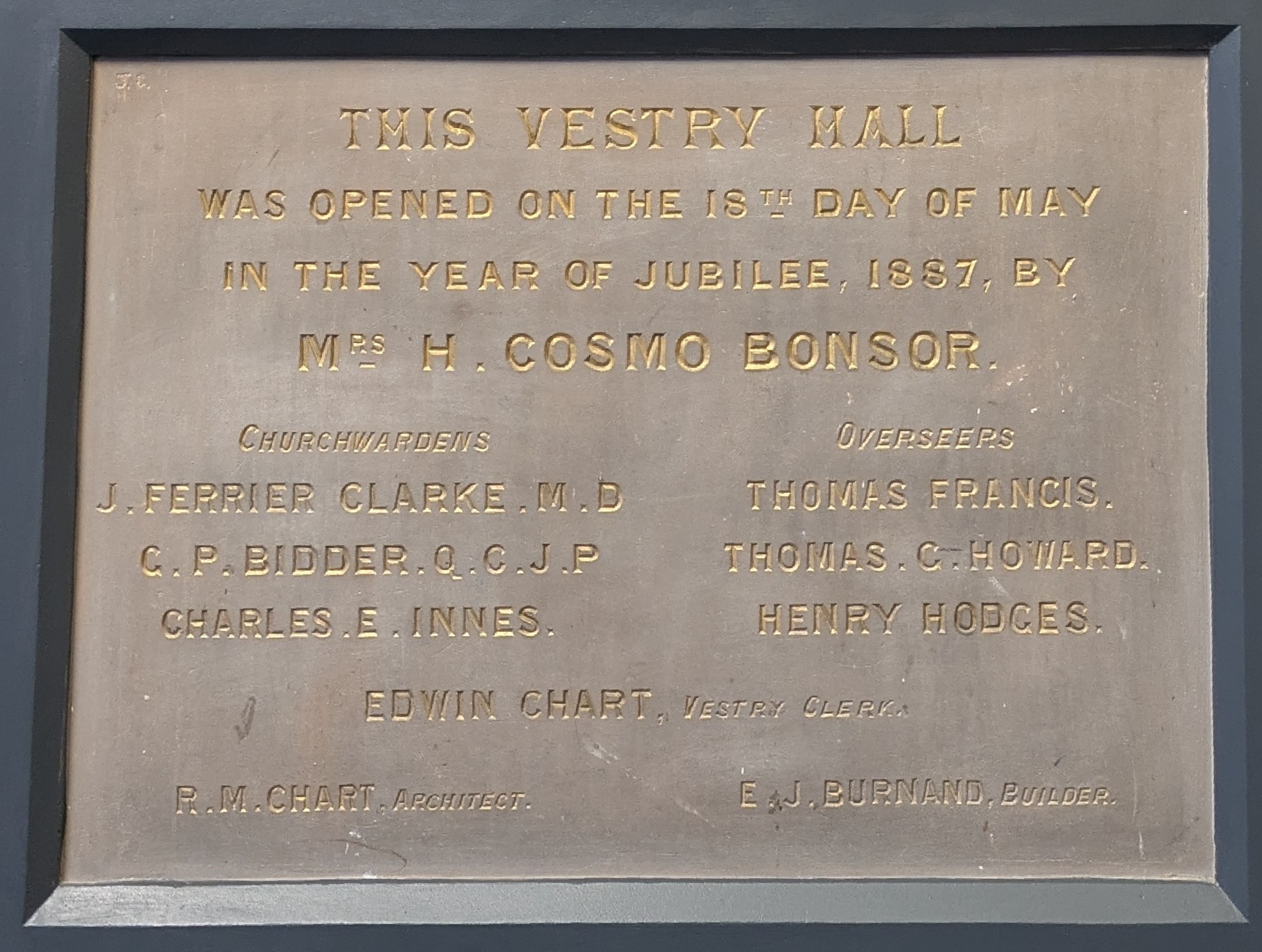
From the Wallington & Carshalton Herald – Saturday 21 May 1887
OPENING OF THE
MITCHAM VESTRY HALL.THE HISTORY.–THE CEREMONY
–THE DINNER.SPEECHES BY MR. H. C. BONSOR, M.P., AND MR.
SIDNEY GEDGE, M.P.Wednesday–a Mitcham “Red Letter” day–broke gloomy and overcast with lowering clouds, which ultimately discharged their watery contents just in the nick of time to avoid making any of the outdoor celebrations connected with the opening of the Vestry Hall a miserable failure. The sky and atmosphere rapidly cleared about 11 a.m., and welcome Phoebus made his appearance, to enliven with his presence a scene that was probably unique in the annals of Mitcham. Shortly before noon the lower Green was rapidly filled with the expectant forms of 1600 school children, brought together by a happy fore-sight to witness the first formality connected with the opening of the hall, namely, the starting of the illuminated clock, purchased by the surviving members of the “Original Mitcham Penny Readings, 1866-73” (Messrs. J. C. Barter, W. Smith, and W. R. Harwood)
In addition to the children a very large number of the general public had assembled, and as twelve o’clock approached, Mrs. W. R. Harwood, in company with a select party of ladies and gentlemen, ascended the clock tower, and when the hour was announced, started the “Mitcham Ben”; everything, of course, in the way of winding up, &c., having been prepared before hand. This was the signal for immense cheering, on the part of the children more particularly, and the band (composed of lads from the Holborn Union Schools) struck up “God Save the Queen,” in which the children heartily joined. The children having been presented with a bun each, then dispersed or loitered about to swell the crowd that awaited the arrival of the guests invited to the opening ceremony, at 2.30. Long before that hour, however, the hall was crowded. All particulars concerning the building are given below in the statement read by Mr. Clarke, suffice it to say that the construction of the hall is such as to suit the varied requirements of those speakers, singers, and others who will have occasion to exercise their vocal powers within its walls. On Wednesday afternoon the base of the platform was handsomely set off with arum lillies, marguerites, geraniums, ferns, &c., and presented a very pleasing appearance. The vicar, the parish officers, the vestry clerk, and the local authorities assembled at the vestry clerk’s office at 2 o’clock. To await the arrival of Mrs. H. Cosmo Bonsor, who was to declare the building open. On her arrival they met her at the principal entrance to the hall where a key was presented to her. In company with Mr. H. C. Bonsor, M.P., and the Rev. D. F. Wilson, the party then proceeded upstairs to the hall amidst cheers. Arrived at the platform, Miss Blenke, daughter of Dr. Clarke, presented Mrs. Bonsor with a magnificent bouquet, which was gracefully received. On the platform or immediately around it at this time, we noticed Messrs. C. E. Innes and Dr. Clarke (churchwardens), J. Nobes (chairman of the Lighting Inspectors), J. B. Nicholls (chairman of the Highway Board), H. Hodges, F. Francis, and F. G. Howard (overseers), Rev. I. F. Wilson, Dr. W. Smith, Rev. — Seddon (Baptist Minister), Rev. F. S. Legg (vicar of Christ Church), Messrs. O. W. Berry (guardian), J. Knight (vice-chairman of the Burial Board), W. R. Harwood, J. C. Rutter, R. M. Chart, C. Robinson, S. W. Reading, J. Somerfield, H. List, and Dr. Marshall.
The VICAR first offered the following suitable prayer:
Almighty God, who hast taught us that Thy wisdom rejoiceth in the habitable parts of the earth, and that its delights are with the sons of men, let Thy blessing rest on this Hall which we this day are opening. May it be for the profit and well-being of the people who shall use it. Grant also, O Lord, we beseech Thee, Thy grace to all who shall be chosen to any office herein, that they may discharge their duties as unto Thee and not as unto man, and that in wise counsels, resolute efforts, and the conscientious discharge of duty, they may promote the social welfare of all classes in this large parish, and this we ask in the name and for the sake of Jesus Christ our Lord. Amen.
After which Dr. FARRER CLARKE read the following statement “The idea of erecting a Vestry Hall such as this originated some years since in the need that was felt for a Parish room other than the vestry of the church, which was often found too small to accommodate the ratepayers desiring to be present. Plans were prepared for a small building to accommodate 100 people at a cost of £150. Difficulties arose which delayed the erection, and later on it was thought desirable to increase the proposed accommodation by a Parish office and Committee room, and a second set of plans was prepared with this object for a building to cost about £1,000. It is now a satisfaction to think that the many obstacles which presented themselves prevented the original idea being carried out for building then proposed would by this time have been found quite inadequate to meet the needs of this large and growing Parish. The site of this building was formerly occupied by three relics of bye-gone times, a parish pound, a cage or lock up, and the parish stocks, a grant being made to the parish for that purpose by the Lords of the Manor some 200 years ago, which is recorded in the parish minutes. The difficulties that have had to be overcome in order to arrive at the satisfactory conclusion which we now celebrate may be judged of when I state:—
1st. That the Authority to erect a building combining the accommodation here found, is derived from three distinct Acts of Parliament.
2nd, That it was only by a combination of the local bodies, who put it in force the statutes
that the work could be carried out.3rd, That the consent of the adjoining owners, of the Lords of the Manor of Fauxhall, and of the parish in vestry assembled had to be obtained, and the approval of the Local Government Board.
4th. That the funds have to be provided from several sources, those for the erection of the Hall from a loan repayable in 10 years, those for the offices from the sale of two Parish Cottages, the balance being lent by Mr. G. P. Bidder, without interest; those for the Engine House from out of the Lighting Rate. The building has been erected in accordance with plans prepared by Mr. R. M. Chart, the local architect and surveyor, and approved by the Local Government Board, at a cost of £3,500, the works being satisfactorily completed by Mr. E. J. Burnand, builder, of Wallington. The exterior dimensions of the building are — length, 88 feet, and breadth, 35 feet; height to summit of the vane, 82 feet; this hall has internal dimensions of 58 feet by 31 feet; the three offices each measure 24 feet by 15 feet; two of these are let to the District Sanitary Authority at a remunerative rent, the third will be devoted to parish business. The Lighting Inspectors have permitted (under conditions which will satisfactorily ensure a first class engine being always at their command) the occupation of the engine house by our efficient Volunteer Brigade. The clock in the tower is the gift of the surviving members of the original penny reading committee, who held some years ago a series of successful penny readings, resulting in the accumulation of a sum of £105, the cost of the clock.” He then welcomed Mr. and Mrs. Bonsor to the hall, expressing his regret that a “Mayor and Corporation ” representative of Mitcham were not there to meet them.” (Cheers.)
Mrs. Bonsor, who was greeted with tremendous applause, then said: “I have great pleasure in declaring this hall open.” (Cheers.) Three cheers having been given for her with much heartiness.Mr. INNES, on behalf of the ratepayers of the parish, and the company present, thanked Mrs. Bonsor for her kindness in declaring the hall open. They had all heard of the great difficulties that had been connected with the raising of the building, but there was one difficulty that had not been surmounted until close upon its finish, and that was to find someone to open it. The gentlemen felt that they ought to have a lady to do it, for they felt that they would utterly fail, whatever their success might be in other matters, if they did not have some lady to come and open the hall for them. Mrs. Bonsor was asked, and she responded in the most kind manner. Without any sort of hesitation, she at once placed herself at their service, and therefore he thought that to her their best thanks were due. (Cheers.) To her, he was sure they were all deeply obliged. He was there to represent the ratepayers of all shades of opinion. They were not all of one thought, perhaps, but they were all Conservatives that day in wishing that she might often come amongst them, and that she might long retain the memories of that day. (Cheers.) And they were all Liberals in their gratitude to her for, if she would come and make her home amongst them they would all, he was sure, be amenable to Home Rule. (Cheers and laughter).
Mr. H. Cosmo Bonsor, M.P., in re-sponding on behalf of Mrs. Bonsor, remarked that she wished him to tell them that she was not at present quite practised enough in public speaking to return thanks for the very kindly way in which Mr. Jones had thanked her on behalf of those present, and she had also commissioned him to say just a few words to them of thanks for the cordial welcome they had given her on that auspicious occasion. (Cheers.) He could assure them in Mrs. Bonsor’s behalf and on his own, that it was the greatest possible relief to them to get away from London and politics, and other matters which were not so pleasant as occasions like the present, and to come among people who were thoroughly harmonious and thoroughly unanimous, in wishing success to an undertaking. (Applause.) They had heard a statement as to the difficulties connected with the building of that hall, as to how it was erected and how it was provided. (Applause.) They had heard a statement as to the difficulties connected with the building of that hall, as to how it was erected and how it was provided. (Applause.)
He did not doubt but some of them had a good idea what was to be expected. If he were to tell them he was not quite clear in the statement he had heard from Dr. Clarke and that he could not tell them what it was intended for, that was one thing; but when he reflected on the great utility, or usefulness, of the building it might be for anything. For instance it could be used to transact local matters and other things. And he thought that they had in Mitcham got a very good and useful building. He, however, did not like to anticipate in this way in this his first visit amongst them as he had been informed that there were many things which needed doing there. He said he did not wish to anticipate because he did not know what to say. If he had had time for more contemplation he should not have been so surprised. If they had built a place like this, well provided in all that it had, and it would answer their purposes, in other words they had it for the good of all. When they had made good arrangements they had nothing further to consider than that they would conduct their business in such a way that all should be satisfied. There was one thing they could all claim for it, that it was a handsome building, and one that would be a great credit to them. It was a pleasure for him and his wife to have been amongst them. They were all of a very friendly nature, which they would always remember. They had done great things in the parish. He had heard all the history of the place in a very short time, but he knew from experience that they were a hard working people. He hoped that when he got away from the parish he should hear that they were more successful than they had ever been.
(Applause). He then proceeded to move that the best thanks of the parish be given to the chairman of the building committee and to the architect, Mr. R. M. Chart, in which was associated the names of the rest of the committee, and also those who had helped to promote the undertaking. He had also to thank Mrs. Bonsor for coming down and attending there to open the hall, and had also to thank all who had come forward and helped on that occasion.
Mr. J. B. NICHOLS seconded.
The resolution was carried unanimously.THE DINNER.
At 1.30 p.m., the Vestry Hall was filled with a select company, who partook of dinner. A cold, but recherche repast was served up in excellent style, the tables being laid out with flowers, ferns, &c., placed down the centre. Mr. G. P. Bidder, Q.C., J.P., presided, and was supported amongst others by Mr. H. Cosmo Bonsor, M.P., Mr. Sidney Gedge, M.P., Drs. F. Clarke, Smith, and Lowe, the Revs. D. F. Wilson, F. S. Legg, A. E. Seddon, O. H. Leton, and Jackson, and Messrs. C. E. Innes, Nobes, Wolsey, R. M. Chart, C. Czarnikow, T. G. Howard, H. Hodges, O. W. Berry, G. Mckal, J. H. Bridges, J. P. Harvey, J. R. Nicholls, W. R. Harwood, J. Wells, E. Mills, F. Lowe, T. Francis, G. Pitt, B. Green, W. Pile, S. Lowe, W. Readings, R. Shillington, J. Summerfield, H. List, J. J. Churchill, E. Burnant, J. M. Coates, C. Palmer, H. B. Ayard, A. T. Williams, G. W. Barter, &c.
After dinner, THE CHAIRMAN proposed the usual loyal toasts, remarking that they had special significance in this the 50th year of Her Majesty’s beneficent reign. The satisfaction which existed in the hearts of Her Majesty’s people was not due to her long reign, because that was simply an accident of a good constitution, but to the virtuous and thoroughly constitutional manner in which she had carried out her many difficult duties. (Cheers.)
The toast having been honoured with enthusiasm, THE CHAIRMAN proposed the “Houses of Parliament,” coupled with the name of Mr. H. C. Bonsor, M.P. He felt that they could congratulate themselves upon the fact that their member of Parliament was the first to try the acoustic properties of that new building. Although they had not got the honour of the presence of a member of the Upper House they had the pleasure of the company of Mr. Bonsor–(cheers)–their member-(new cheers)–and also of Mr. Gedge, who was also a parishioner. (Cheers.) A few years ago he might be as a Liberal, having great influence and influence among his constituents; however, there was no politics in their meeting that day, and they were all Conservatives, and they hoped Mr. Bonsor would long continue to represent them. They also knew he had the support of the Liberal party in the constituency. The meeting gave them the chance that day of meeting together as friends. The first speech that day had been made by a lady, which was a proof they were not narrow minded. The hall he hoped would do great good in the parish, and he had no doubt the parish would be able to maintain its position amongst other parishes in the surrounding country. As he had said before, they were all Conservatives, and he would now give them the toast, coupled with the name of Mr. Bonsor.
Mr. H. COSMO BONSOR, M.P., responded. Having heartily thanked those present for the kind and cordial reception they had accorded him, he remarked that at the present time the House of Commons was in an awkward state, and therefore it was not so pleasant to talk of it as it usually was. They had been sitting since the 20th of January, and had done remarkably little; but notwithstanding that fact he was proud to occupy the position he did occupy, as a representative of an important Constituency. (Cheers.) They must remember that members of Parliament gave up their family ties and business occupations in order that they might devote their attention to the legislative duties of the nation. (Cheers.) There were certain Constituencies at the present moment who would send a man up to Parliament for the special purpose of stopping Parliamentary work, and until they came to their senses he was afraid they would have a great deal of trouble in Parliament. (Cheers.) Mr. Bidder had kindly alluded to him as the member for the constituency. He (Mr. Bonsor) had, ever since he had occupied that post, endeavoured as far as possible to represent all shades of political opinion in the district—(cheers)— irrespective of party, so long as he had been able to stick to his own political convictions, and he was bound to say that so far as he was concerned he was very well satisfied indeed if he had been able to earn the esteem of his political supporters without losing the support of his political supporters. (Cheers.) He thanked them immensely for the kind and friendly manner in which they had received his health, and he assured them that he threw on one side personal feeling in the matter, and believed he was returning thanks for the House of Commons. (Cheers.) He thought that they should have every confidence that in a few days it would resume its work as an executive and legislative assembly. (Cheers.) He believed that when they toasted the Constitution they would remember that it had been the supporter of the liberties of this country for many many years; that it had ungrudgingly voted money for the maintenance of our vast Empire; and in the hope and in the trust that it would maintain its position in the hearts of English men, he returned his cordial thanks for the honour they had done him by coupling his name with it. (Loud and continued cheering.)
The next sentiment, that of “The Parish Officers,” was given by Mr. Sidney Gedge, M.P., who commenced by humorously asking those present not to think that in leaving members of Parliament and coming to the parish officers they were taking a downward step. (Laughter.) Just the reverse. He remembered many years ago reading of an old Latin writer who had been writing or talking about some affairs of state and concluded by remarking “Now let us sing of greater things.” Well, they had been hearing a great deal about the traditional House of Commons, and from those little things, of a kind so trifling—(laughter)—let them turn to the Parish Officers. When he looked around him—he did not say that with any sarcastic or mocking spirit—(laughter)—he assured them that after four months hard labour in the House of Commons they could not produce anything like the unanimity that prevailed in that room. (Laughter and cheers.) He looked forward to that room being of the greatest use to Mitcham. He could see it holding political meetings—they were not to talk politics that night—(laughter)—so he should not do it. (Further laughter.) He could see meetings for all purposes, parochial, missionary, scientific, and religious. He could also look forward and fancy it being occupied by a bazaar, and people spending freely in aid of this or of that good object. If report was true it would not be very long before they would have to do that, and he hoped they would
come with their pockets full and go away with them empty; but with large burdens for their families. (Laughter and cheers.) Anyhow, he hoped the hall would be used for every good purpose and amusement. (Cheers.) To whom were they indebted for the room? They were indebted very much indeed to their parish officers and he asked them to drink their health, because he was told they would only have their rates increased a penny in the £1 by the erection of that building, and not only that, but they had kindly provided for that increase of a penny by reducing the rate 2d. Long might they continue to levy a penny rate if they would only take off 2d. (Great laughter.) Parish officers were not usually toastful at public meetings, but there was a toast always given which was something like it and that was “The Volunteer Forces,” Parish officers were “Volunteer Forces.” (Laughter). They were the great unpaid. (Further laughter). They gave their time and talent and took trouble, and did not get any reward at all that he (Mr. Gedge) was aware of except the good will and applause of their fellow parishioners, which he hoped they would give them that evening. (Cheers). He supposed in the subject of parish officers they all took some interest and in Local Government for they knew there was looming in the distance, a bill—he was not talking politics,—(Great laughter)—which was to be brought into Parliament as soon as they had cleared away a few matters which their Irish friends took care there should have considerable trouble over. There was to be a Local Government Bill. While in the tea-room of the House of Commons, reclining on a sofa, reading a paper and waiting until the dinner bell rang, he espied the President of the Local Government Board, a day or two ago. He (Mr. Gedge) said, “I am going down to my parish—the most important village of Mitcham—(uproarious laughter)—and I am going to propose the health of the parish officers. They have a burning desire to know what your bill is?” (Great laughter). He (Mr. Gedge) could tell them as inaccurately—(laughter)—as he could remember what the answer of the President of the Board of Trade was. “Mitcham,” he said, “is to have a Lord Mayor before long, who will have a retiring allowance of £1,000 a year.” (Uproarious laughter.) That was all the answer he (Mr. Gedge) could get out of him. He (Mr. Gedge) did not see why Mitcham should not have a Mayor and Aldermen. Although he had lived in that charming village—(laughter)—he had never had a chance of rising to that dignity. Why should not they? He was sure they all would welcome the local Government Bill, and cordially–without talking politics (laughter)—support a Government that was going to bring in such a Bill. With those few words he would ask them to drink the health of the parish officers.This toast was drunk with enthusiasm, and Dr. CLARKE replied. They could not expect a good speech from a parish Doctor. He was sure they were extremely obliged for the way in which they had drunk their healths, and could only say that they were extremely happy, as Volunteers, to do their best for the parish. (Cheers.)
The Chairman then proposed the “Local Authorities and Officials.” Whilst he would not attempt to draw that fine line of distinction between parish officers and local officials that his honourable and learned friend Mr. Gedge had done, he did desire to propose their health, especially in connection with the new vestry hall in which they were now assembled. (Cheers.) Mr. Gedge had alluded to the question of local government which was coming to the fore. If a certain other question would allow parliament to entertain any other matter. (Laughter). They all knew that it was recognised now as desirable that they should so amend their local and county governments that people in each district should be better able to manage their local affairs—always of course under the supreme control of the Imperial Parliament. And in connection with that and looking to what would probably come in the near future he thought that Vestry Hall was likely to serve a very useful purpose. If anyone thought he exaggerated the importance of a parish and of a vestry—and after all a vestry was not a particularly august or important body, let him (Mr. Bidder) remind them that the parish was the unit of their local government, and that of the aggregate of such units their polity was built up. (Cheers). The word “parish” was a good old word, (laughter), and had a meaning and a lesson of its own. It meant those who dwelt together in a neighbourhood. They all knew in theory their duty to their neighbour, but he must confess that sometimes in parochial questions which were discussed at a vestry they did not give the practical effect to it which perhaps they might and they all might find themselves sometimes a little liable of course unconsciously, to look at questions a little too much from the standpoint of how they affected their own interest, and their own rates. (Laughter.) That was perhaps natural, but at the same time there was the very opposite principle which they all knew was at the root of the prosperity of every Society. That principle was “Each for all.” (Cheers.) That was the essence of all corporate life, and no society could be thoroughly progressive or prosperous that did not recognise that. (Hear.) There was another disadvantage to which, in a suburban parish, they were always liable, and that was as they all knew that a portion of their residents were people who had their business in the great Metropolis. They went from Mitcham in the morning, did a hard day’s work at the shop counter or office and came back tired out at night for rest, sleep and refreshment, and did not care for more work, and many a man when urged to take his share in the parish work said, “I leave business behind me when I leave my shop, and I come here for my rest.” Those men made a great mistake in not recognising their obligation as members of their own Society. (Hear.) For that reason he hoped that Vestry Hall would do great good amongst them; would be to them all a symbol and embodiment of the corporate unity which they should all recognise, and a reminder that they had all got duties as neighbours and residents in the parish. He could not help introducing another reason why he looked to see the hall built. Hitherto the parochial meetings had been held in the vestry of the parish church. That was all very well in the days gone by, when everybody was a Churchman, and obliged to be a Churchman for that matter. (Laughter.) But now they were not all Churchmen. Many present were, but many were not. There were amongst them Roman Catholics and Dissenters of various denominations, and he thought that for parochial purposes, and in matters wherein they met as parishioners, or, as he pre-ferred to term it, as neighbours, to transact their own business, they should meet, as they always would be hoped, meet in that room, upon a common platform of equality. (Cheers.) For that reason, and for the other considerations he had mentioned, he felt grateful, and he thought they would all feel grateful to the local authorities who had agitated, and had matured and brought to a successful issue that scheme of the Vestry Hall. (Cheers) He was satisfied they did it with the consciousness that they were adding to the vigour of their corporate life, and he was satisfied that the hall would in many ways, as well as those indicated by Mr. Gedge and others, be a source of great benefit and advantage to the parish and the surrounding districts. He should not like to sit down without mentioning that he had a letter from Mr. Lamb–(cheers)–Chairman of the Rural Sanitary Authority, expressing deep regret at not being able to be present that night. He said:—
Permit me to offer you my sincere congratulations on the completion of this long desired object, and as Chairman of the Rural Sanitary Authority to express the especial interest that is felt by that body in the completion of a building which provides for them in the largest and most central part in th er district, adequate accommodation for holding their meetings and transacting their business, and this at a rental which I trust will remunerate the Parish of Mitcham, does not increase the burdens of the other parishes.
It is of the utmost importance that there should be, in the most populous parts of the Authority’s district, a central place open at all times for transacting the business appertaining thereto, and which has hitherto been carried on at inconvenient and incommodious offices. A statement that will be appreciated when I inform you that some 4,000 visits are paid to the offices on public business every year, and that the Authority hold about 20 meetings and 60 Committee meetings in the offices, and the amount of the Authority’s increasing year by year, and had it not been for the new offices provided in the Vestry Hall the Authority must soon have sought increased accommodation elsewhere. Wishing the undertaking every success.
Mr. Bidder gave that toast, coupled with the names of “Mr. W. R. Harwood “—(cheers)—and an old and valued official in the parish, “Mr. Edwin Chart,” (Great cheers.) He remembered upwards of 40 years since, when he (the chairman) first became a resident in the parish and first went to attend the services at the parish church, a most prominent and striking object to his young mind was Mr. Edwin Chart, and the punctual
and attentive way in which he discharged his duties. They all knew for what a long series of years he had been connected–and widely connected–with the affairs of the parish, and he deeply regretted that advancing age had rendered it impossible for him to be present there that evening, and on that account he desired their sympathy. (Cheers.) He (the Chairman) thought they would also give great credit to Mr. R. M. Chart for his successful design of the hall–(cheers)–and he coupled with the toast that gentleman’s name.This toast was honoured with the heartiest enthusiasm, and Mr. W. R. Harwood in response said that he thought that taking the whole of the local authorities of the parish together, they deserved their heartiest thanks. (Cheers.) In looking around him he saw a few present who, like himself, had spent their whole time in the place, and he asked them to carry back their memories some half-century when they were boys together. He could recollect the time when open and foul ditches were long the boast of their principal roads in that place. That had, however, given place to a system of sewers, which he thought was a very great pride to them, or should be. (Cheers.) The other little improvements and arrangements that had been brought about by the Sanitary Authority had gained their heartiest approbation. (Cheers.) If he might go through the list of those local authorities he would draw attention to the Guardians, who gave their time most ungrudgingly to the business of the parish. He would say in regard to the Lighting Inspectors that they had got their money’s worth for their money. (Laughter) They had not too, neglected education. He could recollect the time when there were very few children in the schools, now it was no uncommon thing to have something like 1,600 children in the schools in one day. With regard to the waywardens he need hardly ask the hearty recognition of the work that had been done by them. Go to what part of the parish they liked—and they would find that improvements had been made by them. They had what some of their more go-a-head neighbours had not. The neighbouring parishes of Sutton and Carshalton could hardly say they had good systems of sanitary arrangements, neither had they places in which to lay those, who departed this life, from amongst them. With regard to their excellent volunteer Fire Brigade, he thought that the work they had carried out was an admirable one. (Cheers) He had the honour of being on the committee, and he appealed to the other members present to say that the Brigade fully deserved their hearty thanks for the excellent manner in which they carried on their business. (Cheers).
The Chairman then called upon Mr. R. M. Chart, remarking that he was sure they would all wish him to convey to his father their sympathy and the hearty respect which they had for the many and numerous services which he has rendered to the parish. (Cheers).
Mr. R. M. Chart, like the previous speaker, felt a great deal of diffidence in addressing them, following as he did in the wake of an eloquent Q.C., and two most worthy members of Parliament. He had taken a great interest in the building. It had been a great source of satisfaction to him that it had arrived at a satisfactory conclusion, and especially to feel the way in which it had been appreciated. There was another matter which he would very much rather not have had to refer to that night, and that was to thank them on his father’s behalf, and in his absence he had to thank the Chairman and Mr. Harwood for the very kind manner in which they had mentioned his name. He could only wish that his father had been there, as he undoubtedly would have been had he been able. As an official of the parish he could only say that good masters generally made good men, and it was most gratifying to an official when he found that his work had some interest with his masters. (Hear.) He hoped that from that day they would have more gentlemen willing to come forward and take part in parochial government. No one knew better than an official the difficulties of local government. When Mr. Harwood mentioned that they had no less than four or five Boards governing the parish, he considered it a state of things that ought not to exist, and it was not in the interest of the ratepayers that it did so exist. Matters could be carried on much more economically if such was not the case, and if they combined and formed one or two Boards. (Cheers.)
Mr. Innes proposed “The Guests,” coupled with the name of the Rev. F. S. Legg. Mr. Innes also referred to Mr. Nobes in terms of praise remarking that he had shewn them the way in which a parish Churchwarden ought to carry out his duties. (Cheers.) He also proposed the healths of the representatives of the press.
The sentiment was cordially honoured, and the Rev. F. S. Legg, Vicar of Christ Church Mitcham, remarked that when he received the invitation to be present, he felt inclined to decline as being at the further end of the parish, and as a clergyman he thought he might be rather out of place in coming to the gathering; but their kind reception of that toast had reminded the clergy that they might perhaps feel that they had not done wrong in coming to the gathering because they had been identified, not only as neighbours, but as fellow workers with many of them. (Cheers.) He hoped that those who had the letting of the hall would encourage not only the recreational pleasures, but those that would stir up the intellectual vigour and force of that parish. Therefore, they as ministers could most cordially wish that hall a very grand and useful future. (Cheers.)The last toast on the programme was proposed by the Vicar (the Rev. Dr. Wilson), who gave the health of “The Chairman.” He thought there were six adverbs which very well described what Mr. Bidder had been during the many years he had known him. Religiously, for he (the Vicar) could never forget how that when Mr. Bidder was a young man he used to take a class in the boys’ Sunday school of the green adjoining the hall. Socially, as many had been. He had received hospitality at Ravensbury Park on Saturday afternoons. Officially, no man had been more ready than Mr. Bidder in supporting any good cause, and he should like to take that opportunity of thanking him for the window he had placed in the Parish Church. Churchwardenly –(laughter)–for four years he had most kindly filled the office of Churchwarden. Lastly, vestry halledly—(great laughter)—for it was only through Mr. Bidder’s kindness that the completion of that hall had been accomplished. (Cheers.)
The toast was duly honoured; the guests singing “For he’s a jolly good fellow.”
Mr. BIDDER responded, assuring them all that his labours in the parish had been labours of love. He then referred to the kindness and neighbourly feeling of Mr. Pain, who had provided the fireworks which they were about to witness. The speeches were interspersed with capitally rendered songs, &c.
The party then broke up, and adjourned to the Lower Green where they swelled the enormous crowd assembled to witness the magnificent display of fireworks provided gratuitously by Mr. Pain. By the time the “Mitcham Ben” had struck, for the second time in its existence, the hour of twelve, the village had resumed its normal appearance. Mr. R. M. Chart and Mr. W. R. Harwood deserve the heartiest thanks of all who were present for their courteous performance of what might be termed the duties of M.C.’s.
 Mitcham History Notes