Tag Archives: Riley Schofield

Lower Green Public Conveniences

Built around 1929 underground, opposite the Burn Bullock, and behind the water trough.
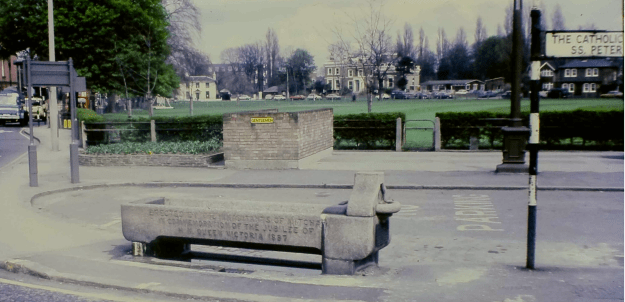
Clip of 1975 photo taken by Bill Rudd, and reproduced here by kind permission of the Merton Historical Society

The gas lamp post shown between the toilets in this photo was added to the local list by Merton Council on 12th July, 2017, as a result of a campaign by Mitcham Cricket Green Community & Heritage.

The need for a public convenience at this spot was debated in 1923.

From the minutes of the Mitcham Urban District council
Volume IX April 1923 to March 1924
Pages 291 to 292

Report of Sub-Committee appointed to consider the question of the provision of Public Conveniences.
Meeting held Monday, October 15th, 1923.

Present : Mr. R. F. Langley (Chairman), Messrs. H. J. Davis, J. Fitch and W. H. Parslow.

The Sub-Committee considered the matter referred to them by the Public Health Committee, and beg to submit the following suggestions :-

1. The need for public conveniences in certain parts of Mitcham is becoming more and more apparent every year, and with the constant increase in the number of visitors brought into the district by the omnibus and tramway services it is essential that the matter should be taken in hand at a very early date.

2. The Sub-Committee consider that the most pressing needs are for public conveniences (for both sexes) upon the Fair Green and the Lower Green.

3. The site upon the Fair Green has already been determined by the Council, and the plans of the Surveyor have been the matter is now before the Ministry of Health.

4. The provision of a convenience on the Lower Green is, therefore, in the opinion of the Sub-Committee, the most pressing need at the present time. every day a large number of persons are brought to this spot owing to its being the terminus of a well patronised bus service.

5. The Sub-Committee suggest that the most suitable site for a convenience is upon the triangular piece of ground, now planted as a shrubbery, between the ” Cricketers ” Inn and Messrs. Barclays Bank ; and the Committee further suggest that a convenience constructed upon this site could be of an external design which would be in no way a disfigurement to the Green.

6. The Sub-Committee look upon the provision of a convenience in the vicinity of the omnibus terminus as an essential.

From the minutes of the Mitcham Urban District council, volume XIV, 1928 to 1929, page 124:

32. PUBLIC CONVENIENCE, Lower Green. – It was Resolved, That the Council be recommended to instruct the Surveyor to report as to suitable sites for a public convenience on or adjacent to the Cricket Green.

The council had also considered removing the water trough, but held off until they could get agreement on widening the London Road.

In considering the sites for the toilets, the council considered next to the Cricketers pub, and the island opposite Barclays Bank. Page 201 of the above minutes says:

An overground convenience … would destroy the amenity of this corner of the Cricket Green

The problem with an underground convenice though was the cost, as Riley Schofield concluded:

I would like to point out to the Committee that underground conveniences are a very costly proposition. The site will have to be wholly excavated and carted to tip. The walls must be constructed as retaining walls, and also covered on the outside with asphalte to render the structure waterproof. The roof will have to be constructed of
reinforced concrete and provided with prismatic pavement lights, or, as an alternative, the structure could project 2 feet or so above the ground and be lighted by means of lantern lights. Steps will have to be provided, and these are costly and wasteful of space. Ventilation is also an expensive item. It may be necessary to raise the sewage by
mechanical means, necessitating a constant charge for the supply of water.

The decision to go with an underground convenience, behind the water trough, was made and reported on pages 276 to 277, although the Surveyor was asked to provide estimates for a partially underground as well wholly underground. Page 451 shows that his estimates were close, £2,100 for partially vs £2,500 for wholly underground, and he recommended the latter. Page 457 shows that the council agreed with his recommendation.

In volume XV, 1929 to 1930, page 104, the council asked the Ministry of Health for a loan of £3,500 to build the underground public convenience. Adjusted for inflation, this is equivalent to around £200,000 in 2017 values. Page 207 shows that the Ministry approved the loan and so the Surveyor was instructed to put it out to tenders. Page 311 reports that 11 firms had submitted tenders for the job, and that the Horley firm of Mr J. CREWDSON had been accepted, for the amount of £2,672. The Horley Local History Society has more on this builder, who also has a road there named after him.

No further details are available in council minutes as to when the convenience was completed.

From the minutes of the Mitcham Urban District council
Volume XVI, 1930 to 1931
Page 178

9. PUBLIC CONVENIENCE The Surveyor reported that he would find it necessary to engage the services of a full time attendant at the public convenience on the Lower Green, and that the annual cost thereof would amount to £352, this being a sum somewhat in excess of the original estimate. Resolved, That the Surveyor be authorised to make the necessary appointment.


Minutes of meetings held by the Mitcham Urban District Council are available on request from the Merton Heritage and Local Studies Centre at Morden Library.
New Close

Built in 1936/7, a council housing estate originally of 95 houses and 3 flats.

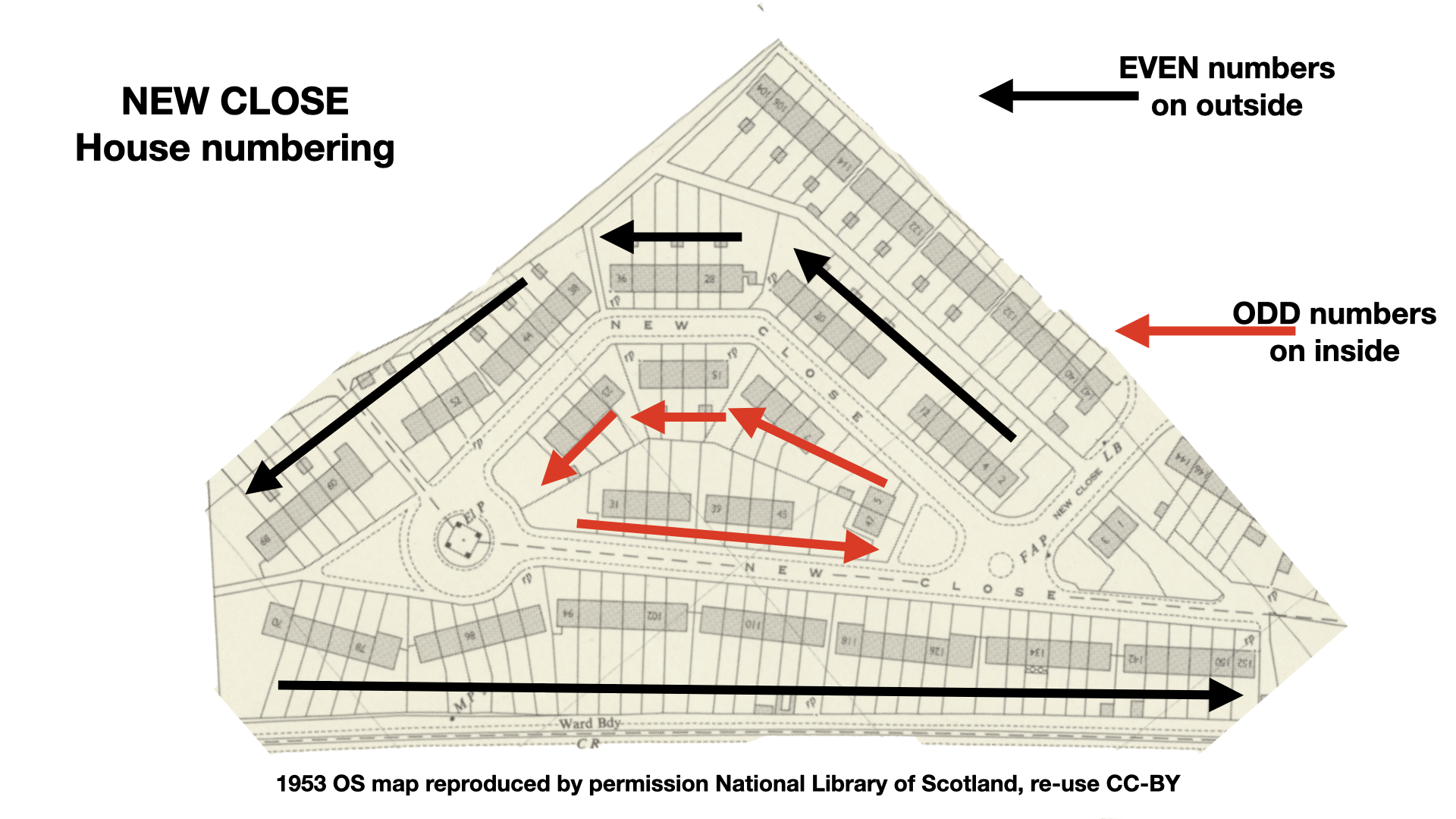
The road is off the west side of Phipps Bridge Road, between numbers 142 and 144. It is a cul-de-sac and is shaped like a flattened oval. Two houses on the left are numbers 1 and 3, then the even numbers, from 2 to 152, continue around the outer side of the oval anticlockwise towards a block of flats at the tramstop end. The houses numbered odd are in the inside of the oval, numbered from 5 to 47, also anticlockwise. See illustration below:

New Close house numbering.

The map above shows that the estate had its own fire alarm post (FAP), next to number 2.

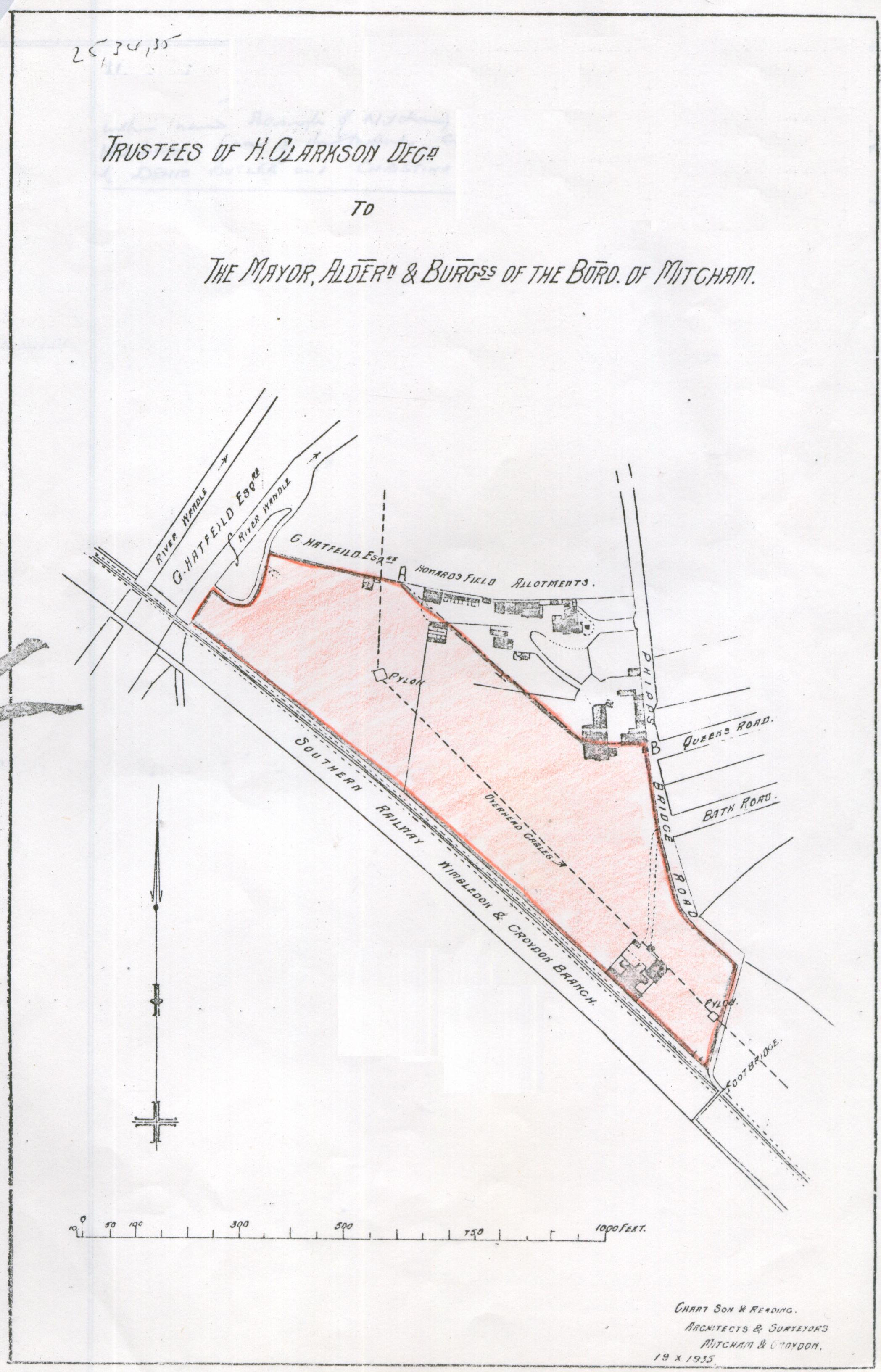
The land was bought for £14,475 from Messrs Clarkson by Mitcham Borough Council for rehousing people made homeless by the Explosion, and for their slum clearance programme.

1935 New Close Clarksons Land sale to Mitcham

1935 Map of land bought by the Council

From the Mitcham News & Mercury, 29th May, 1936:

“Laying out of housing estate”

Reporting on the lay-out plan of New Close Housing Estate, the Borough Engineer, Mr Riley Schofield, said it allowed the erection of 135 houses. The density on the land purchased, viz. 9.70 acres plus one half of the width of Phipp’s Bridge road, and one half of the railway, a total of 11.149 acres worked out at 12.1 houses per acre.

A portion of the estate accommodating 36 houses might not be proceeded with, leaving 99 houses for immediate development.

It was proposed to erect a disinfection house, to be isolated in the south-east corner of the property.

The size of the houses provided for a living-room, scullery, W.C., and bathroom and larder on the ground floor and three bedrooms on the first floor and for the provision of a shed at the rear of each house. A proportion of the houses to have more than three bedrooms.

The Council approved the plan.

Housing Committee, Thursday, October 10th, 1935

LAND, PHIPPS BRIDGE.

-Messrs. Chart, Son and Reading reported that they had been in communication, on behalf of the Council, with Messrs. Clarkson for the acquisition of 9 1/2 acres in Phipps Bridge Road, and that the terms upon which Messrs. Clarkson were prepared to sell were, that the total sum to be paid for the land should be £14,475, and that of this sum £12,047 should be paid upon possession being given of 8 acres 0 roods, 5 perches, and that the balance of the purchase money should be paid on vacant possession being given of the remainder of the land either on the death of Mrs. Clarkson or earlier if Mrs. Clarkson ceases to occupy New Close House. The Town Clerk reported that these conditions had been referred to the District Valuer for his observations, and a report had been received from the District Valuer stating that he was prepared to support an application for a loan at this figure.

Resolved. That the Council be recommended to purchase the site at the price quoted, and that application be made to the Minister of Health to sanction a loan of £14,600 for this purpose.

Source: Proceedings of the Council and committees, Mitcham Borough Council, Volume 1 1934-35 pages 980-1

Finance and General Purposes Committee
Tuesday, 21st July 1936

8. Nameing of New Street
– That in lieu of “New Close” suggested in the report of the Housing Committee, the name of “Jarrow Road” be substituted.

Source: Proceedings of the Council and committees, Mitcham Borough Council, Volume 2 1935-36 page 841

Highways, New Buildings, Lighting and Public Works Committee
Thursday, October 14, 1937

New Close Estate.
-It was Resolved, That his worship the Mayor be asked to hand over officially the New Close Housing Estate to the Housing Committee on Saturday, October 23.

Source: Proceedings of the Council and committees, Mitcham Borough Council, Volume 3 1936-37 page 1065


November 12, 1937

New Close Housing Estate

– The Borough Engineer reported that he had received a quotation from the Wandsworth Gas. Co. for the carcassing required for 95 houses and 3 flats for gas services, amounting to £176 12s., and that he had also received an offer from the company to supply 98 slightly used reconditioned gas cookers at the reduced price of £5 each.

Resolved, That the quotation and offer submitted by the Wandsworth Gas Co. be accepted and the order placed accordingly.

Source: Proceedings of the Council and committees, Mitcham Borough Council, Volume 3 1936-37


From the minutes of Housing Committee
11th December 1947
page 151

PIGEONS

The tenant of 36, New Close, has erected a 15-ft. long pigeon loft without first having first obtained the Council’s permission. I shall be glad of the Committee’s instructions.

I am, Ladies and Gentlemen,
Your obedient servant,
B. THRUPP
Housing Manager

Resolved – That the tenant be instructed to remove forthwith the pigeon loft which has been erected without permission.


News Articles via the British Newspaper Archive

Streatham News – Friday 12 September 1958

Stole scrap metal A 68-year-old labourer, said to have lived nearly all his life in the Mitcham area and to have previously been of good character, was fined £10 at Wallington when he admitted stealing 63 lb. of scrap lead and copper cables, worth £2 from his employers, London Electricity Board at Mitcham. He was William Robert Brice, New Close, Mitcham.Det.-sergt. Sabin said that Brice, who had been employed by the board since 1951, should have taken the scrap parts of the cables to a depot at Sandy Lane, Mitcham. But when he went to Brice’s home he found 63 lb. of the cable in a shed. Brice told the court: “I just made a folly. I am very sorry. I have lost a good job over it.”

Streatham News – Friday 14 April 1950

Fewer Tenants Owe Rent Arrears Highest On Post-War Estates

A statement of the rents owing on Mitcham Council’s housing estates show that arrears have decreased on almost every estate since last year. Arrears are still highest on the post-war estates, where 299 of the 1,743 tenants owed a total of £567 7s. at March 1 this year. In March 1949 the amount was £733, owed by 392 tenants. On the pre-war estates 243 tenants owe a total of £357 as compared with 299 tenants owing £520 last year. The greatest number of tenants in arrears are those in requisitioned properties. Ninety of them owe a total of £153, but last year 122 owed £311. Arrears on the Pollards Hill Estate are also heavy: those on the Arion bungalows showing a slight increase on last year. The total owing now is £78 compared with £63 then, but arrears on the houses have dropped from £192 to £158. On the pre-war estates tenants most heavily in arrears are those at Bordergate, Swain’s Farm and New Close.


The name ‘New Close’ can be traced back to the 17th century. Deeds published in the Harvard Law Library mention a lease from that Richard Garth for ‘New Close’.

Lease, 1633, January 19. 8 Charles I. 1 Item : parchment ; 42 x 58 cm.

SUMMARY:

Lease between Richard Garth, esq., of Morden (Surrey) and Dame Dorothy Capell of Morden of a new brick house in Morden, with all out houses, barns, etc., with 1 adjoining close called “the Marsh Close,” containing 5 acres, another called “New Close,” containing 5 1/2 acres, another called “Great Parkelandes,” containing 13 acres, another called “Little Parkelandes,” containing 8 acres, another called “Grube Close,” containing 3 acres, and another called “Water Dens,” as now it is enclosed, containing 8 1/2 acres; except and always reserved all woods, timbers, and trees now standing, etc., with all hunting, for 21 years (if she live so long) from last Michaelmas, at the annual rent of £30 5s. Signed: Dorothy Capell.

WITNESSES: Edward Straynge, James Grantham, William Mathewe.

NAMES: I. Garth, Richard. R. Capell, Dorothy, Dame. III. Straing, Edward. IV. Grantham, James. V. Mathew, William.

SUBJECTS: I. Deeds—England—Surrey. 2. Deeds—England—Morden. 3. Surrey (England)—Charters, grants, privileges. 4. Morden (England)—Charters, grata, privileges.

Source: Harvard Law Library, though this text is no longer online
Retrieved: 2007
This text can also be seen online as part of a Google Books search.


Minutes of meetings held by the Mitcham Borough Council are available on request from the Merton Heritage and Local Studies Centre at Morden Library.