From the Mitcham & Tooting Mercury, 10th August, 1917, page 2:
THE FLOODS AT MITCHAM AND COLLIERS WOOD.
The aftermath of the floods at Mitcham, Tooting Junction and Colliers Wood is what was expected.
Those who remember the great storm of the early months of 1914, when Tooting Broadway, Mitcham Road and other parts of the borough suffered considerably from the flood,
are certainly justified in their expressions of disgust at the means available to prevent these floods.At Seely-road, the tenants are up in arms, and are reported to have refused to pay their rent this week, owing to the damage done to their household goods through having 2ft.
to 4ft. of water in the ground floor rooms; feeling that action will enable their landlord to make a claim in bulk upon the proper authorities for compensation.After the last storm, the tenants were assured that it would not be possible for the scenes of 1914 to reoccur, as proper pumping machinery was installed to meet future contingencies. Apparently, the great force of water lost week overcame the capacity of the pumping machinery and, getting the upper hand, the water flowed in all directions and did considerable damage.
The wood pavement in High street Colliers Wood, was torn up by the force of the water, and the Rural District Council’s men have been busy this week in relaying the road way; whilst, in all directions the gardens give evidence of extensive floods, and the open doors, of the cottages and houses affected show bare flooring which is gradually drying, now the water has subsided.
The river Wandle is a pretty old fashioned stream, passing through some of the sylvan beauty of Surrey (in ordinary times); but on the occasion of floods it becomes a strong torrent, and once it overflows banks, the surrounding property is soon presenting the appearance of a vast lake. Some explanation of the failure of the pumping machinery
awaited.
The river Graveney formed the north boundary, along with the railway line the south, of a golf course, as shown in this 1895 OS map:
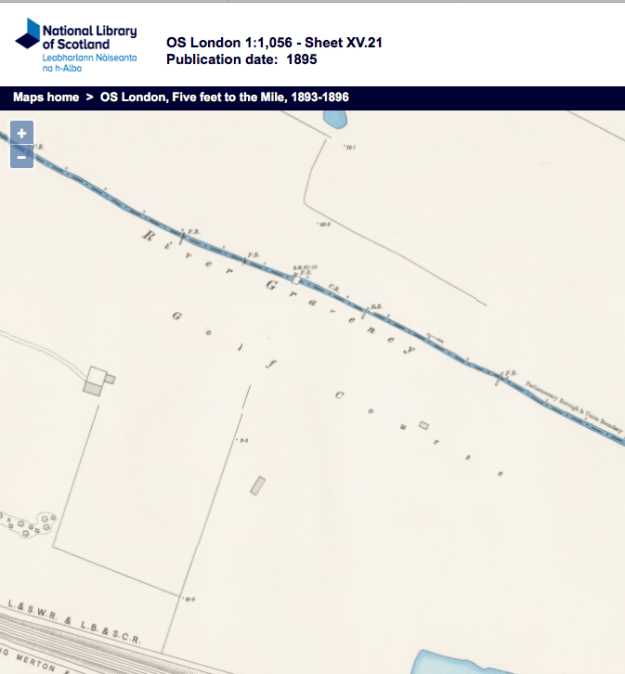
1895 OS map
The housing estate built on this land was dubbed the Links Estate, being a reference to the golf links. By 1911, as this OS map shows, a number of roads with houses had been built. The river Graveney also formed the boundary between the London County Council and the Mitcham Urban District Council, which is why the letter below from Mr Popple of Links Road was forwarded on to the Mitcham council.
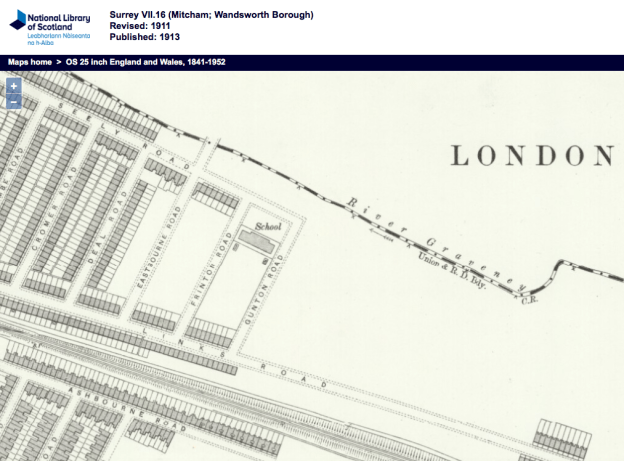
1911 OS map
From the Mitcham Urban District Council minutes,
Volume 3, pages 109-112, Public Health and Burial Committee meeting of 11th September, 1917
FLOODING : LINKS ESTATE –
The Clerk reported that on August 1st there was a very abnormal rainfall, which resulted in the flooding of many houses on the Links Estate, in consequence of which he had received 31 complaints from owners and occupiers, together with claims to be compensated of varying amounts, a list of which he presented to the Committee ; that these had been duly acknowledged by him, pointing out that the flooding of their properties was due to the overflowing of the River Graveney, caused by the quantity of water discharged from the relief Sewers of the London County Council and the incapacity of the river; at the same time repudiating any liability of this Council for any damage arising therefrom.
The Clerk drew attention to a report made to him as Surveyor to the late Rural District Council recorded in Vol. XVIII., p. 485, of that Council’s Minutes, in which the danger of this flooding was anticipated and the action of the Rural Council in consequence thereof.
The Clerk also reported that he had forwarded copies of the complaints and claims to the Chief Engineer of the London County Council and had written him on the subject; further, that he had, with Mr. Drewett as Chairman of the Joint Sewerage Board
had an interview with Mr. G. W. Humphreys, the Chief Engineer, and had obtained from him a promise that he would take into consideration the practicability of adopting some temporary means preventing future floodings from the Graveney until some permanent work can be carried out, and that my letters and the complaints and claims should be laid before his Committee.It was Resolved, That the Clerk’s report be entered in the minutes of this Committee.
The following letter was read from the Local Government Board asking for the observation of the Council on a complaint of Mr. Popple, of Links Road, as to the flooding.
It was Resolved, That the action taken by the Clerk be approved and that the Local Government Board be made acquainted with the facts, and that they be requested to urge upon the London County Council the necessity for providing for the adequate capacity
of the River Graveney to discharge the volume of water brought into it.Local Government Board,
Whitehall, S.W., 1,
15th August, 1917Sir, –
I am directed by the Local Government Board to forward to the Mitcham Urban District Council the enolosed copy of a letter which has been addressed to the Board by Mr. H. Popple, 96, Links Road, Tooting, S.W.17, and I am to request that the Board may be furnished with the observations of the Council upon the subject of this communication.
I am Sir,
Your obedient Servant,
F. J. Willis,
Assistant Secretary.96, Links Road,
Tooting, S.W. 17.
4th August, 1917.The President of the Local Government Board,—
I beg to bring to your notice the shocking conditions existing on the Links Estate, Tooting, London, S.W., Parish of Mitcham.
This estate is composed of a large number of 5-roomed houses tenanted by respectable working people. A very large percentage of the male population is away serving with the Colours.
Whenever a heavy downpour of rain is experienced on this estate the roads become flooded, the water in many cases surging up through the drains. In some instances the flooding only occurs in the roadway, and even in this case an offensive sediment remains which creates
disease. In other cases the whole of the neighbourhood is turned into a huge lake, varying from inches to 3 or 4 feet deep. This latter has happened twice during the past week, and three times within a month. About a month ago a petition was sent to the local Borough Council, Mitcham, but nothing has been done in the matter except talking. Talking does not assist in such matters, and I am, therefore, appealing to you in the interests of health. Such conditions are disastrous in many ways; the damp conditions prevailing and the
offensive sediment deposited by such floods being a huge source of danger to the community. There is a very large Council School on the estate, and the children passing to and fro after such floods must inhale the germs created by the dried offensive sediment. Again, a small child slipping out unnoticed from one of the houses, might easily be drowned.The damage caused is also very great, as the majority of the male population being away the women left are unable to lift the heavier furniture, and it is generally recognised that a piano or such article standing in about a foot of water is not going to improve. Further, the male population left have devoted their spare time to cultivating
vegetables in accordance with the desire to produce as much food as possible, and it is heartbreaking to see such labour wasted by the vegetables boing washed away by the flood.I am placing the case in your hands, confident that you will see that proper redress will be given if such lies within your power.
I might add that I lived six years in the neighbourhood before any suggestion of this kind occurred, the first flooding taking place on June 14th, 1914. I believe the cause to be primarily as follow:-
About 1912, the L.C.C. were granted power by Act of Parliament to lay a 4ft. storm-sewer to carry off the London storm water and discharge it into the River Wandle. This sewer does not discharge into the river Graveny at Colliers Wood. This being but a brook, such a volume of water being discharged into it is already heavily taxed, holds up the water with which it is already charged, causing it to overflow and thus turn our estate into a gigantic lake. Thus it happens that many thrifty men who have purchased property in this neighbourhood and are away serving their country are having their little all ruined in order that the L.C.C. or whoever is responsible, might save a few pounds.
I should be pleased if you yourself or a reliable inspector would visit my house and the surrounding neighbourhood and note the state existing.
There are hundreds who could fully endorse my letter, and I therefore ask you in my name and in the name of the others who are not here to ask for themselves to see that the matter receives proper and immediate attention.
I am, Sir,
Yours faithfully,
(Signed)
H. POPPLE.Mr. Councillor Laing reported that on the occasion of the flooding referred to Mr. Cusden loaned his horse and van for conveying persons to and fro through the flood.
It was Resolved, That a letter of thanks be sent to Mr. Cusden.
It was moved by Mr Drewett and seconded by Mr Bland, and Resolved, That the Council be recommended to give special consideration to the serious conditions created by heavy rainfall and
Report from the Town Clerk, Robert Masters Chart, from the Mitcham Urban District Council minutes,
Volume 3, pages 133-4, meeting of 25th September, 1917
FLOODING : LINKS ESTATE.—
The Clerk reported that he had replied to the letter of the Local Government Board of August 10th, in accordance with the instructions of the Finance and General Purposes Committee, as follows :—
Sept. 12, 1917.
Sir,
In reply to your letter of the 16th August, enclosing a letter addressed to the Local Government Board by Mr. H. Potter, drawing the attention of the Board to the Flooding of houses on the Links Estate, Tooting Junction, in this Urban District, which letter was laid before the Public Health Committee of tho Council yesterday, I am directed to
state as follows:—1. The River Graveney at the locus-in-quo forms the boundary between this District and the County of London. The London County Council contend that this portion of the river is under their jurisdiction as being scheduled as a Sewer in the Metropolis Management Act of 1855, although this Council do not admit the contention. The outfall of this river is into the River Wandle at Mitcham, and is the natural outfall for this area.
2. The London County Council have from time to time constructed overflows from their Southern Area Sewers into the River Graveney, the last of these being constructed in or about 1913, and is 4ft. in diameter. The late Rural District of Croydon at that time pointed out to the London County Council the probability of flooding of, and damage to, property that would ensue unless proper provision was made for increasing the capacity of the river to accommodate the volume of water that would be discharged when, in times of storms, these sewer overflows were brought into action.
3. The view expressed by the late Croydon Rural District Council in 1913 have been realise on two or three occasions, notably on June 29th, and again on August 1st of this year. On the former occasion the Medical Officer of Health and Sanitary Inspector reported to this Council that although considerable inconvenience and some damage was caused to the occupiers, no nuisance injurious to health was occasioned.
4. Numerous complaints have been received from owners and occupiers, and some claims for compensation, to all of whom a reply has been given that, whilst this Council regrets the occasion, they repudiate any liability for damage or responsibility for the flooding, having provided an efficient service of soil sewers and surface water sewers for the drainage of the Links Estate; at the same time, they have forwarded copies of the complaints and claims to the L.C.C. engineer, and a deputation from this Council have interviewed the Chief Engineer and urged upon him the necessity of providing a more effective outfall for the River Graveney.
5. Having regard to the fact that the present unsatisfactory condition has been brought about by the L.C.C. in order to relieve the Southern portion of their district from flooding to the prejudice of this Council’s District, this Urban Council trust that the Local Government Board will urge the L.C.C. to take immediate steps to provide an adequate outfall for the River Graveney.
Yours obediently,
Robert M. Chart
From the Mitcham Urban District Council minutes,
Volume 3, pages 165-6, Council meeting of 23rd October, 1917
FLOODING OF LINKS ESTATE
The following letter was read from the Chief Engineer of the London County Council:-
LONDON COUNTY COUNCIL,
Engineer’s Dept.,
County Hall,
Spring Gardens, S.W., 1.
9th Oct. 1917dear Sir,
RIVER GRAVENEY
As promised on the occasion of your call here on the 7th ult., I have considered the question of carrying out temporary works for the prevention of the overflowing of the River Graveney at the Links Estate. After inspection of the river and the adjacent land which had been flooded in recent storms, I am afraid that the work in a nature of a temporary expedient would prove to be ineffective to cope with such an influx of water as has been at times experienced this summer.
I am, however, about to place the whole matter before the Main Drainage Committee of my Council.
Yours faithfully,
G. HUMPHRIES,
Chief Engineer.
Maps are reproduced with the permission of the National Library of Scotland.
Minutes of meetings held by the Mitcham Urban District Council are available on request from the Merton Heritage and Local Studies Centre at Morden Library.
 Mitcham History Notes