This was a series of articles in the Croydon Times of 1932.
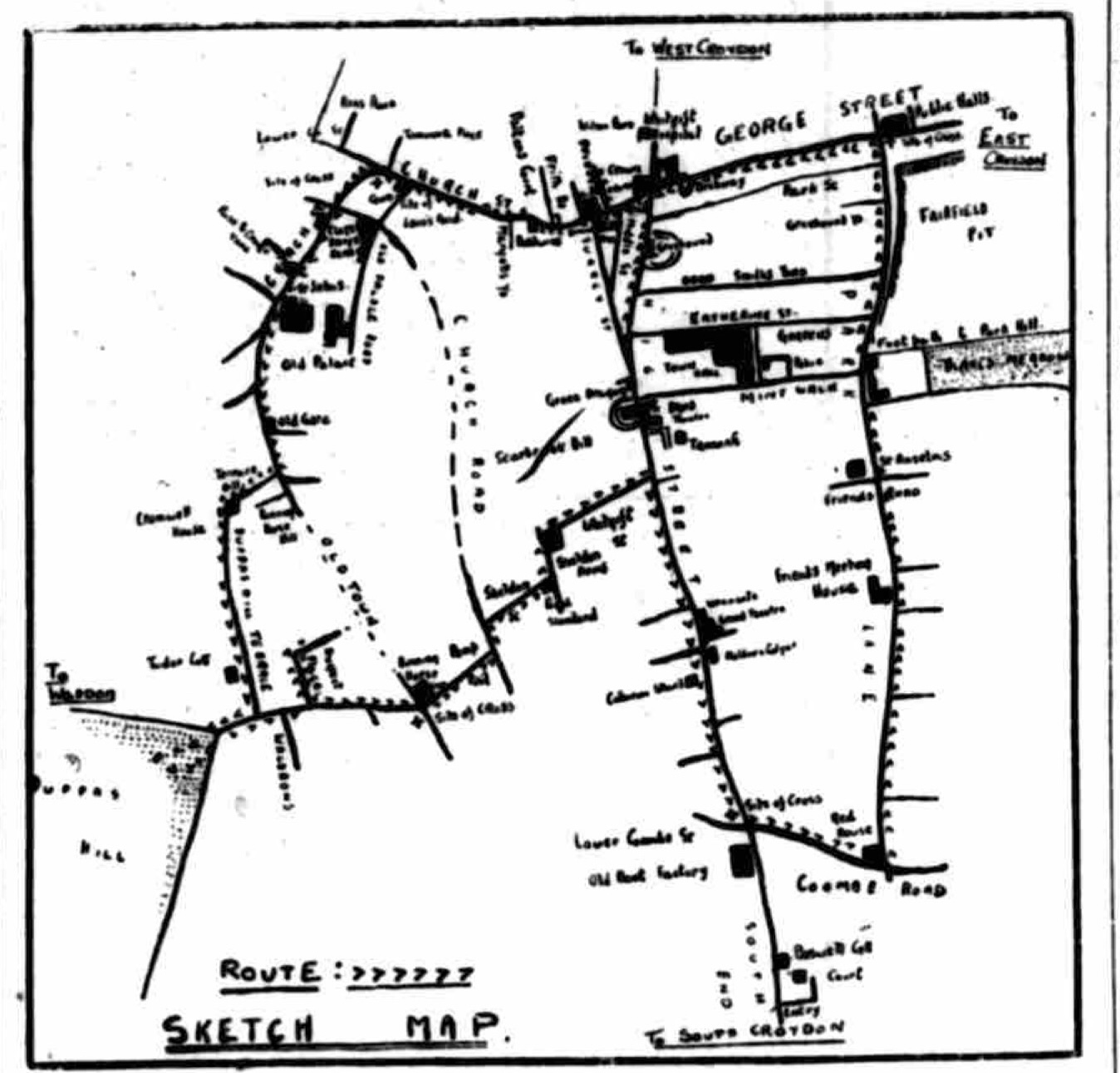
Image © Successor rightsholder unknown. Please contact us via support@britishnewspaperarchive.co.uk if you wish to claim rights to this title.
1
Old World Scenes in New Croydon
Here is set out the story of a few hours’ pilgrimage to old scenes in modern Croydon, and which, to visitors and many residents, may add something of interest to life.
By RONALD BANNERMAN, F.S.A.Scot.
START if you like from the centre of the town, and if you prefer the establishments of mine host, set out from the Greyhound, descendant of that house which knew a long line from an earlier King George to General Fairfax, and Mr. Justice Hawkins to Lord George Sanger; or choose the Green Dragon, remembered by Addison and visited by Dickens, now flaunting its attractive dragon on a white background.
(Image: A hand-drawn sketch map showing various streets in Croydon, including George Street, Church Road, and Old Town, with a dotted line indicating the route)
SKETCH MAP. ROUTE : >>>>>>
Leave then the chosen post and walk Londonwards, on the west side of the road, to North-end. There, on the corner of the cross-roads at Crown-hill (formerly twin with Bell-hill, and now blocked by Hope’s shop), and on the opposite side of the road, stands the Elizabethan Whitgift’s Hospital, where entrance should be sought
(Image: A view of a narrow, dark passageway leading between buildings)
BELL HILL
through the gateway into the quadrangle. If Sir Warden is about he will be pleased to allow you a peep at the perfect little chapel within, and, should the occasion be opportune, at others of its treasures.
When you bid farewell, glance half-right at the rebuilt barn, three centuries old, of Wilson’s Cafe, a good example of the drawing power of ancientry; and then in front of you at the unattractive modern porcelain-fronted Crown, which, I think, quite unsuccessfully and glassily attempts to stare out as the presence of an improved “le crowne and meadow” which formerly held site there in the fifteenth century, and where, in 1610, Richard Curtis, of the inn, died of plague.
BELOW HILL
Your route should now make for the Old Church by way of Crown-hill, to the top of which the parish tower quite pleasingly beckons. On nearing the bottom of the hill notice on the left Middle-street and Bell-hill, fragments by name of mediaeval Croydon; then Surrey-street, sturdy old way with long pedigree, fine as Butcher-row, but rubber-collary as “Surray-strate,” where the last of the overhanging roofs dam for a brief space the gigantic modernity of Grant’s new store, and give a momentary hint of past market-town Croydon and the red roofs of Ruskin’s choice.
At the corner, realise Victory Inn, and a few yards away the Britannia, and the picture is as quickly lost. And yet the latter possessed, once upon a time, the proud and rare name of Black Lyon—and I have heard there are still a few fine old pots within bearing the rich old name—for that name was derived from the coat-of-arms of Queen Phillipa of Hainault, Consort of Edward III., who granted Archbishop Stratford a Saturday market at Croydon, a market which still exists before the gaze of a chastened and disguised Black Lion.
ECHO OF FAMOUS ARTISTS
On the other side of Crown-hill, and opposite Middle-street (poor substitute for Middle “Row”), is the Hippodrome picture theatre, an early “talkie” which was formerly the rather famous little Theatre Royal, known in its early building to Edmund Keen, Paganini, Grimaldi, and other famous artistes, and later by Henry Irving in his young days.
Why it should be disguised under the name of a circus can be explained only by a full-blooded Croydonian, for assuredly it seems to be the fate of any building or street of historic interest in this old place to be re-named or obliterated entirely.
I am often reminded of the remarks of Donald Maxwell in his “Unknown Surrey,” where he recollects the suggestion of a well-meaning town councillor at Guildford when speaking of its famous castle. This dutiful and busy “improver”
(Image: A narrow, cobbled yard or alleyway flanked by old brick buildings)
PRIDDY’S YARD, CROWN HILL
desired the clearing away of the old stone and brick on the hill to make way for a new and attractive bandstand, to be painted green.
PRIDDY’S YARD
To get back to the theatre—notice, however, the quaint survival of Priddy’s Yard, and, because it doesn’t matter much now, the carefully notice-boarded “public way” —and if you will take the trouble to use your public rights and enter it, remember that its quaintness can be regained to a small degree only by reaching the end and viewing from that point a strange and almost unrecognisable Church-street.
The mystery of Priddy need not tantalise. In the good and full old days Mr. Richard Priddy was a corn dealer, and at this spot he lived and died.
2
Old World Scenes in New Croydon
Here is the second article descriptive of a few hours’ pilgrimage to old scenes in modern Croydon. The route followed was shown in a line drawing published in our issue last week.
By RONALD BANNERMAN, F.S.A.Scot.
CHURCH STREET
CHURCH-STREET still retains in its roofs and eaves, and by its windings, some suggestion of the old country town; and on the left, after leaving Surrey-street, you will see something of the bygone in the little country cottage butcher’s shop of Baldwin, where see above the front door, wrought in twisted iron as bar to the fanlight, the name of JONES; in 1861 the
(Image: Ornate twisted ironwork spelling “JONES” in a fanlight window)
directory shows No. 20, Mary Jones, Butcher. The street has since then been renumbered.
Back at Surrey-street corner, look across the road and there is Frith-road, a modern and convenient cut-through, while on the corner the Home Stores treads heavily on the grave of an ancient and departed house, previously occupied as a shop by Boggust; and again, before you leave the corner, at the Victory and the Britannia (Black Lion); the former has a grand sign, which to me always seems to have missed its mark—it should have been a trim, timber Victory in black and white, not the fairyland ship sailing in a place no one would dare consider as fairyland. However, take your look at it, for it is, I understand, on the redundant list.
DALTON’S COURT
Continue on that side along Church-street and you will soon reach Dalton’s Court, almost terrified and shrinking before the onslaught of new bricks, with its former country gardens shrunken and left to their fate.
Cross over again to Baldwin’s cottage shop already mentioned, and you may care to know that the entry between Borthwick’s wholesale department and Hewitt’s was at one time Margett’s Yard. And here, as you have again met the butchers, believe that this sturdy brotherhood, having lost Butcher’s-row, have found their bustle in Church-street, for early morning will find this quarter as busy in good fellowship and carcases as ever was Butcher-row. Times have passed by the slaughter-house, and present here now the orderly rows of the refrigerator and store.
THE PALACE
On the right-hand side you can pick out a former opening between Sainsbury’s and Boots. 1861 shows two cottages—Smith, Richard, and Adams, Joseph—Ebbutt’s-court, an old Croydon name, unfortunately erased. You are now approaching Old Palace-road, discovered to you by the “Gun,” known in old days by its picture sign and music-hall, where some four-score years ago people used to congregate in the road outside to hear the music played or sung within.
This road was the ancient entrance avenue to the Palace, where at the gates, long gone, the good Archbishop Herring had distributed there three times a week the ancient alms, the Dole.
And, at this moment, without proceeding down Old Palace-road, imagine the left side bordered by a clean and sparkling pond; for there was Laud’s Pond, first badly contaminated by the old Gas Works in Surrey-street, and then neglected until necessity pushed it underground.
On the right, still in Old Palace-road, see the road crossing, the finest viewpoint of the Palace and Church completely blinded by an atrocious block of school buildings in yellow faced with red. It may be that finances called the tune to this erection, but at the time of building, land was available in the vicinity at a price not excessive.
“HANDCROSS”
However, to proceed on your walk along Church-street, half right and across the road there is the small entry named Tamworth-place, a slovenly blotting out of “Handcross Alley, leading to Tamworth Place and Road, and also North End.”
The ancient Handcross stood near the junction, in front of you, of Church-street and Lower Church-street, and with the
(Image: A hazy street view showing storefronts and signs for pubs/inns)
VICTORY AND BRITANNIA
loss of this alley-name, if you will except the stupid corruption “Handcroft,” Handcross, like all the Town Crosses themselves, has entirely disappeared from Croydon.
You might care to ruminate on the erasure of the last Handcross; the same path ran out at the “Railway Arms” into North-end, but to mark a chapel, which as such has since gone with the hedgerows of the alley, it was re-named, and is yet styled Church-path; while another branch entered North-end by Young’s, with its name to be expunged—having to Croydon some history—when it was re-opened as Drummond-road, so termed after a chairman of the local Board.
3
This week’s article—the third—descriptive of a pilgrimage to old scenes in modern Croydon, gives interesting information concerning Hand Cross, the Old Church and Palace, and Old Town to Duppas.
By RONALD BANNERMAN, F.S.A.Scot.
HAND CROSS
HAVING reached the site of the ancient Hand Cross, with sad looking Ann’s Place over the road on the right, formerly favoured by the icecream vendors, you will notice in front of you an island of modern shops of pleasant design, an island which conceals from your view the site of the little Almshouses, and Ellys Davy’s Almshouses now demolished and removed; and what was a junction of the old Iron Railway, which ran from Wandsworth to Croydon and thence to Merstham by way of Church-road, which you are about to cross.
The junction was made by a side line which left the main route in order to reach West Croydon Basin. Passing Church-road, notice on the opposite side a typical Croydon improvement. There stand the rebuilt Ellys Davy’s Almshouses founded in 1447—I am not referring to the rebuilding, but to the “improved” modern spelling which Ellys never dreamed about—with the inscription referring to Elis David. It might be of some interest to record that the inscription on his tomb reads, Elye Davy.
“ROSE AND CROWN”
Proceed then to the “Rose and Crown,” and if you don’t approve of such places, enter only the yard, which is a fine example as yet untouched of the old Croydon public-yard containing dwelling houses. The inn itself is well known if
(Image: A view down a narrow, cobbled yard with buildings on either side)
“ROSE AND CROWN YARD,”
only from its inclusion in old engravings of the Church (I dare wager that neither the brewer, nor the hostess knew this); Dr. Hughson’s illustration shows the blank inn-sign, while the pleasing engraving in Brayley and Britton hints at the inn but shows a delightful figure of a burly carter emptying a pint tankard with great gusto, while holding up his cart in the middle of the road.
To me it has always seemed a pity that the brewers have, generally speaking, failed to appreciate the trade value as well as the aesthetic value of picture sign-boards; hence in this case possibly, the blank of Hughson’s illustration and the omission from the Brayley picture; however, rather the mundane and harmless print than the hackneyed rusty-red and gold of anything connected with a crown, when depicted by a mass sign painter.
OLD CHURCH AND PALACE
As you reach the Old Church, notice the quaint old gravestones pressing
(Image: Old houses bordering a street corner next to railings)
ANN’S PLACE, CHURCH STREET
against the trespassing railings, and at the same time recognise that, except for the tower, the old structure, parts of which dated from Saxon times, was destroyed by fire in 1867. Where the road is, opposite the Tower door, named St. John’s Grove, was formerly a mill pond and a stream from the headwaters of which in about 1850 there was a dipping place to supply barrel carts with drinking water for Chelsham, Farleigh, and Sanderstead districts. A copy of the only engraving I know—and a very quaint and ugly one at that—used to hang in Whitgift School old library at North End. Along the road from Old Town also flowed the stream which branched off in that road at Bog Island, now Union-street quarter, and again behind the Old Palace to Laud’s Pond, and in front of the church on the other side.
A visit to the church with its famous tombs, including those of Whitgift, Sheldon, and others, should be made, and at the same time talk nicely to the verger, who lives across the road, to allow entry into the churchyard to view the outer walls of the Palace, for from this viewpoint there is gained the definite atmosphere of the ancient Archiepiscopal Palace which saw kings and queens as well as archbishops, which you may in your mind re-create for yourselves.
TO “AN HONEST MAN”
Of some interest in the churchyard, is the tomb of the old Croydon Blakes. On the death in recent years of Miss Blake, permission was given for the burial of this old lady who had seen the growing pains of market town Croydon. On leaving the church by the tower door walk to the left and in the island of gravestones on the right seek out that erected to “an honest man.” This was erected to the memory of a Quartermaster of the old Royal Wagon Train, which had its headquarters at the Barracks in Mitcham-road. The inscription is now quoted as a good humoured army joke of the only Quartermaster in H.M. Army Supplies Department who died “honest.”
The old vicarage formerly stood in the churchyard, and its site you may take as in line and opposite to the drinking trough in the road by the railings. Bordering the churchyard, and at the corner of Howley-road, is an old gateway, at one
(Image: An old arched stone gateway or entrance)
OLD GATE, CHURCH STREET
time approached by a footbridge over the stream before mentioned. Here again it is a pity vandals were permitted to destroy the cherubs and fabric generally. Fortunately, unlike the old archway which once spanned Old Palace-road, it has not been destroyed to please those who like to make Croydon a real up-to-date London suburb.
OLD TOWN TO DUPPAS
Old Town, the road, is straight in front of you, but in order not to miss an open space and a seat, cross over and make your way up the steep path formerly known as Dark Hill and now called Terrace Hill to Duppas Hill Terrace. The old wall on the right bordered the grounds of Duppas House, or Duppas Hurst House, where in 1670 Doctor Hardy, Dean of Rochester, died. The mansion is long destroyed, although a last scrap of the grounds survives on the slope up the hill bordered by trees.
At the top of the hill on the left is Cromwell House, formerly “Ye Olde Runninge Horse,” the board of which was recalled to Miss M. Major, of Croydon, by one of a carol singing party, who had been born at the inn. At the bottom of the hill and in Old Town, you should know that a fragment parallel with Terrace Hill, still named Running Horse Hill, yet remains, although it is, I understand, on the list of roads doomed under the Town Planning or Clearance scheme.
To be continued
A later one was demolished a few years ago, and gave the name Waddon Close to the street on its site.
4
In this, the fourth article descriptive of a few hours’ pilgrimage to old scenes in modern Croydon, the writer gives us some idea of the many structural changes now taking place in the borough
By RONALD BANNERMAN, F.S.A.Scot.
DUPPAS HILL AND TERRACE
YOU will wish for the seat when you reach the top of Dark Hill, or as it is now called, Terrace Hill, and enter the Terrace. Duppas Hill Terrace is old Croydon, and has, happily, remained so owing to difficulty of access to unwanted traffic, and if, as is mooted, some gallant improver achieves the driving through of a useless road, the charm of this little oasis will at once drain away.
The Terrace is of an age as to appear in the earliest known plan of Croydon, that by Monsieur Jean Baptiste Say, done in 1785. Of the weatherboard cottages on the left is a note that, like Whitgift’s old school in George-street, they gave service as temporary granaries for the storing of corn during an emergency period of the Napoleonic scare. On the right you will spy Tudor Cottage, and behind it an ancient bowling green and other flat ground formerly extended open, to the present Duppas Hill, to form an old tournament ground.
After leaving the Terrace, a moment’s walk to the right will bring you to Duppas Hill and the promised seat. There are other things notable about Duppas Hill. Here, the year before the Spanish Armada hove in sight, Lord Howard of Effingham,
(Image: A narrow residential street with buildings on both sides)
PROSPECT PLACE, DUPPAS HILL
Lieutenant of the County, and afterwards Lord High Admiral, who later died at Haling, required a muster of all the able-bodied men of Surrey.
THE DUKE AND THE EARL
Here the Duke of Wellington with Lord Raglan watched Sir Francis Head’s skill with the lasso and Josh Bignall’s horsemanship; and here Earl Roberts presented Colours to the 4th Battalion of the Queen’s Royal Regiment, while at the foot of the hill the band and drums of the 2nd Battalion, stationed at Dover, performed on their historic first visit to Croydon.
In July of 1731 you may care to know that Surrey County played Kent County at “crickett,” and beat the hoppers with an eleven entirely made up of Surrey Woods. To-day cricket is played there, and as an added attraction is the continual buzzing of aeroplanes to draw the eye to their gymnastics.
The open plain stretching towards Beggars Bush, now genteelly called Russell Hill, has disappeared within the last few months, and in its place you will see the red roofs of the new Waddon housing estate.
RETURN TO HIGH STREET
Return might be made by the same route as far as the Terrace, a matter of a few yards. Here leave that road on the left and pass the circular lodge of the Waldrons, a district tenanted in the reign of Henry VIII. by Sir Nicholas Carew, “a bank of conies,” formerly enclosed within the estate of Haling by a park fence.
On the other side of the road look out for Prospect Place, and spend a minute within it, for it has hidden houses and used to hold the Bell Inn, and a right of way into Old Town known to few but its inhabitants. Then on returning and reaching the cross-roads, notice the pleasing inn sign with unsophisticated grandson to the one previously mentioned, whose father, before the stream was entombed, used to overhang the waters. Near the corner stood another of the old Town Crosses of Croydon, and in the vicinity of the inn was held a small fair.
Pump Pail, the road now in front of you, gives you an idea of Old Croydon. Take a look, for it is marked for destruction. A few years ago, and in less crowded times, the pride of its inhabitants made it compare more nearly with Duppas Hill Terrace. As you cross the road to Sheldon-street you again cross the route of the gone Iron Railroad, for this is Church-road passed by Ellys Davy’s Almshouses.
“THE SHELDON ARMS”
Sheldon-street has at its east end the “Royal Standard,” which I think I am right in saying saw festivities in connection with the marriage of one of the Surrey cricket Gearys and a visit from Andy Sandham; but to find the “Sheldon Arms,” where the famous Tom Lockyer, of Surrey, died in his chair, you must again
(Image: A pub sign hanging above a street)
“RUNNING HORSE,” OLD TOWN
pass another road-crossing into Whitgift-street. The “Sheldon Arms” is easily picked out by its excellent picture sign representing the arms of the archbishop—by the way, all the good signs seem to be at houses of the successors to Nicholas Hatcher—and in passing it might be stated that the “Whitgift Arms” is in Scarbrook-road, running parallel to Whitgift-street, and which is seen on the left when leaving Sheldon Street for Whitgift-street.
It is in Scarbrook-road you see the new pillared Baths Hall, erected at a spot where in earlier days the scar-brook springs spread a clear pond over the road, and where on fair holidays Wombwell’s elephants used to be brought for their morning drink and bath. A moment now, along Whitgift-street will bring you back into High-street, and as a matter of changing Croydon, notice on your right in Whitgift-street the absorption of the Protestant Martyrs’ Memorial Hall, by Harold Williams, Halliday & Partners, as sale rooms.
GOING SOUTH
On reaching High-street you will notice to the left, as you probably did on leaving the “Green Dragon,” the squat giant of the Davis Theatre, which has overwhelmed the site of Spotted Dog Yard, but has opened as a welcome street the former Roberts Yard, to disclose to gaze the pretty little boarded cottage of Tennant’s Nursery. Like the re-building operations at the “Blue Anchor,” which revealed quaint cottages, this is an irritation to the modernist and a pleasure to such as have pride in the old and autonomous town of Croydon, which is in danger of becoming a branch establishment of the multiple and metropolitan fraternity.
However, your way is to the south and right, where you will notice house-breaking in full swing. Do not be taken off your guard and fail to detect the small gateway of the Central Bowling Club, next to Trengrove, the antique shop. When you do find it go away down the passage and ask for a glance at the emerald setting in a hive of industry. There also you will find a hut made from stone sleepers of the old Iron Railroad.
(Image: A dark view down an alleyway or passageway)
A REMINDER OF THE OLD SURREY IRON RAILROAD
Proceeding along High-street you will easily distinguish the Grand Theatre on the left, the foundation stone of which was laid by Sir Beerbohm Tree. This house has seen many famous actors and actresses, from Sir Henry Irving and Sarah Bernhardt to Charlie Chaplin, a programme showing his name in character as a page-boy in a Sherlock Holmes play being still on the wall inside.
On the north side of the theatre is Wrencote, a fine house, the design of which is attributed to Wren, and next again on the north side is the new extension of Lee & Kitley, another red-bricked house disguised as a shop. At this house the poet Cowper used to visit his friends the Unwins.

