Road and block of flats off northern side of Colliers Wood High Street and built in 1938/9 by Mercer Taylor & Co. At this time the Mitcham borough boundary included this road. Royal Mail postcode lookup shows 16 flats, all with the postcode SW19 2BL.
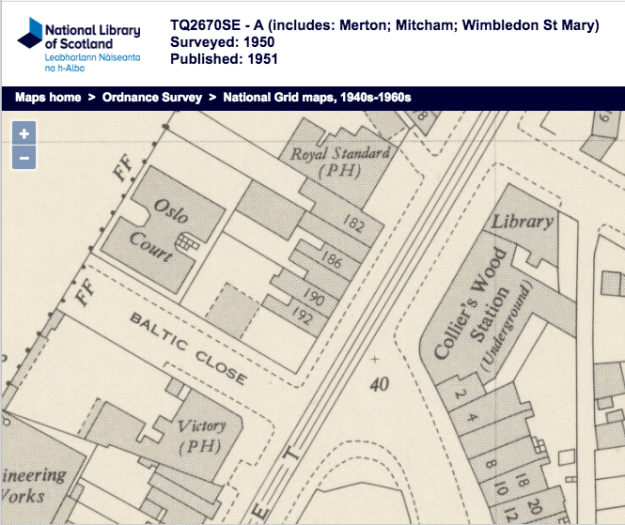
1950 OS map
The developer wrote to Mitcham Borough Council and suggested that since this road was next to the Victory pub, then the name of the road could be Trafalgar Close or Victory Close. The council disagreed, pointing out there were already similar named roads in the SW19 postal district. The council suggested Baltic Close, and the developer agreed, who suggested that the block of flats be named Oslo Court.
Source: Minutes of the Mitcham Borough Council, 1938-39 volume 5, pages 12 and 127.
Note that the Victory pub has since been renamed a couple of times, and the current (as of Feb 2018) name is the Charles Holden, who was an architect who designed the nearby Colliers Wood underground station.
Maps are reproduced with the permission of the National Library of Scotland.
Minutes of meetings held by the Mitcham Borough Council are available on request from the Merton Heritage and Local Studies Centre at Morden Library.
 Mitcham History Notes