Category Archives: Cricket Green Conservation Area

Rigid rules of the almshouses in old days

Clip from Merton Memories photo, reference Mit_​Almshouses_​1-2, copyright London Borough of Merton. This early drawing shows the original enclosing wall.

From the Mitcham News & Mercury, 13th May, 1960, page 3.

TWELVE middle-aged women, protected from the cold winds by woollen capes that reached their ankles, wended their way to Mitcham Parish Church in 1829.

Parishioners who saw the women demurely stepping out each Sunday, knew by their dress that they lived at the newly-erected almshouses at the Cricket Green, Mitcham.

For in 1829 the Tate’s Almshouses were constructed to provide “a residence free from rent, taxes and outgoings for 12 poor women who shall be respectively widows or unmarried women … members of the Church of England and who have a legal settlement in the parish.”

TRUST FUND

For generations the Tate families had been benefactors in the parish and in this early part of the 19th century decided it was time to build houses for the poor and set up a trust fund.

The building, familiar to residents today, was built to designs by a Mr. Buckler on the site of a former house belonging to the Tates who lived nearby. When completed a board of trustees was set up to choose applicants for admission to the house and to organise the administrative side.

These well meaning gentlemen included the Rev. James Henry Mapleton, Vicar of Mitcham, who acted as clerk to the trustees; George Matthew Hoare, of Morden Lodge; Sir John William Lubbock, of Norfolk, and William Simpson, squire in Carshalton.

Each of these ebullient figures invested some money in the project as did the foundress, Mary Tate who gave £5,000.

EXPENSE

The almshouses, whose exterior has altered little, are built in the style prevalent in the latter part of the 16th century and were erected “at considerable expense.”

For the poor of the parish there was considerable competition to be allocated a room or small flatlet in the almshouses and when, at last, they were successful in gaining admission, there were some fairly rigid rules to be observed.

A copy of the rules was presented by Worthing Public Library to Mitcham Library in the early 1930s.

One of the main stipulations was that the “almswomen” were to be 50 years old and upwards and were not to have received poor relief in the five previous years. They were to be selected by Mary Tate during her life and subsequently by the trustees.

The women forfeited their weekly allowance of three shillings if they remained outside their home for more than 24 hours without official leave.

They were expected to “behave civilly and orderly and to live orderly and religious lives,” attending the church each week and receiving the sacraments four times each year.

The gates, inset in the high brick wall round the building, were locked at 11 p.m. and an hour earlier during the winter months.

No strangers were allowed into their homes without special permission and on receiving the weekly allowance, the women were “enjoined to discharge all debts contracted in the last week.”

They were also not allowed to keep dogs or alter their apartments without permission.

From this early record, it would seem that the establishment was run on rather austere lines with the matron keeping a book with the names of the women and reporting “for infraction of the rules ” to the trustees.

The women also benefited from “Smith’s charity.” Smith was an eccentric retired London jeweller who travelled Surrey on foot accompanied by his old dog. He was dubbed “ Dog-smith ” and was reputed to leave sums of money where villages received him well.

Some of the correspondence between William Simpson and Mary Tate, who moved to a country house at Loughborough, shows how the women were chosen to live at the almshouses.

SAME COURSE

In February, 1837, he wrote. . . ” our course at the last vacancy was to give notice of it at church and invite each candidate to send in her grounds of admission to the trustees … if it is your pleasure we should follow the same course on the present occasion, will you do me the honour to communicate with me.”

Then again he wrote to Sir Lubbock asking if he considered it suitable to ask applicants to go to the almshouses 44 when particulars of each case be laid before Miss Tate for her decision on the next vacancy.”

But now a proportion of the old rules have been changed and a recently completed modernisation scheme has resulted in a transformation within the building.

The residents — still all women who have lived in the locality for not less than five years—have had their two-room flatlets redecorated in pleasant light colours. Electric light has been installed, inside toilets, baths and new gas stoves in some of the apartments.

There is a new roof and drainage system and other renovations completed by a Mitcham firm to make the homes more comfortable.

The women, who now pay a small nominal rent, are chosen by a seven-man committee of trustees. Following former custom, Rev. John Thorold, Vicar of Mitcham, is the ex-officio trustee.

The memory of the Tate family is carried on, however, for there are several tablets and plaques in the parish church commemorating various members of the family.

Among them is a white marble monument erected to George Tate, “a gentleman of aimiable and accomplished manners,” father of the foundress, who died at the age of 77 in May, 1822.
Cumberland House

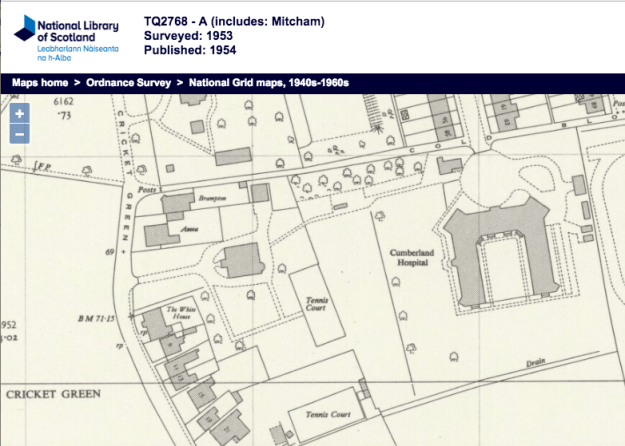
Cumberland Hospital was paid for by Isaac Wilson, and built on land he owned, at the rear of his house The Birches. Its entrance was at the end of Whitford Gardens at Cold Blows.

Opened in 1939, it was demolished in 1992. Its perimeter wall along Cold Blows remains.

1953 OS map

From the Mitcham News & Mercury, 21st July, 1939, page 1.

LEFT THE GOLD KEY AT HOME

But Sir Isaac’s Splendid Gift is Duly Inaugurated

CUMBERLAND HOUSE OPENED

An amusing hitch occurred at the formal opening of Cumberland House, Mitcham, on Friday afternoon. Sir Isaac Wilson, as the munificent donor of the place, was about to present the key to Sir Richard Meller, M.P., with which to unlock the door, when he discovered that he had left it at home.

A messenger was dispatched post-haste, and in ten minutes’ time he arrived with the gold key.

The ceremony then proceeded smoothly. It was a semi-private affair, arranged by the Surrey County Council officials. Among the guests present were Sir Isaac and Lady Wilson, Sir Richard and Lady Meller, the Mayor and Mayoress of Mitcham (Ald. and Mrs. Field), Mr. R. M. Chart, the 89-years-old Charter Mayor of Mitcham, Mr. Stephen Chart, the vicar of Mitcham (the Rev. C. A. Finch) and Mrs. Finch, Col. W. F. Johnson, Mr. Christopher Chart, Dr and Mrs. A. T. Till, Ald. E. H. Rickards (Croydon), County Councillor Mrs. C. Randall, Mr. and Mrs. G. S. Alderman, Mr. H. H. Dance, staff, officials, and inmates of the House.

COSTS £60,000.

The building was erected at the cost approximately of £60,000 by Sir Isaac Wilson, on land belonging to him, and adjoining his own residence at The Birches, almost overlooking the famous Mitcham Cricket Green. The foundation stone was laid on March 1, 1937, by Sir Kingsley Wood, then Minister of Health. The place was originally to be used as a home for poor disabled persons, and it was vested in trustees for that purpose. Subsequently, however Sir Isaac and Lady Wilson, with the approval of their co-trustees, offered the building as a gift to the Surrey County Council for use as a convalescent home in connection with the Council’s hospitals. The munificent and public-spirited offer was gratefully accepted in May, 1938. Under the scheme, Sir Isaac and Lady Wilson are life members of the committee of management, with seven other members appointed by the County authority. The hospital has been furnished and equipped by the Council, who have also appointed the necessary staff. The first patient was admitted on March 29 last. The hospital has accommodation for 110 patients and 24 staff. The patients are mainly transferred from hospitals as requiring from two to eight weeks’ further treatment in order to firmly reestablish their health.

UP-TO-DATE.

On the ground floor there are the administrative offices, kitchens, a dispensary, and two units. The first floor comprises two ward units, an electrical treatment room, the doctor’s flat, and dining-rooms for the nursing and domestic staff. The second floor contains bed- and other rooms for the matron, assistant matron, and 22 members of the nursing and domestic staffs, including two staff common rooms. The lay-out of the Home is magnificent, with sunshine balconies, and spacious grounds for recreation.

Sir Isaac paid tribute to the architects, Messrs. Chart, Son and Reading; the builder, Mr. C. Higginson; his confidential friends, Mr. R. M. Chart, and his son, Mr. Stephen Chart (Town Clerk of Mitcham), Sir Richard Meller, and the Rev. C. A. Finch, chaplain of the home. He declared that every one of these gentlemen had helped him by good advice during the building of the Home. He went on to say that the Surrey County Councii were now trying to do the very best they could with the building, and “I shall be fully recompensed to know that the institution will be carried an efficiently in the future for the benefit and use of convalescent cases,” he added.

DEPUTISING FOR MINISTER OF HEALTH.

Sir Richard Meller humorously suggested that a record of the ceremony should be “the safe arrival of the key.” He greatly appreciated the honour and privilege conferred upon him, he said. He was really deputising for the Minister of Health, who was unable to attend. “This is a succession of noble acts of benefaction by Sir Isaac Wilson,” commented Sir Richard. The building of Wilson Hospital, and the Garden Village, are other worthy examples of his generosity. There is nothing which adds to human happiness so much as the enjoyment of good health, and Sir Isaac and Lady Wislon have been so charity-minded as to build these institutions to try to confer the greatest blessing on mankind by providing them with means of achieveing the greatest human happiness.”

In handing over the Home to County authority, Sir Richard thought the donors had paid tribute to the efficient administration of that body. It came at an opportune moment for the County Council in providing them with the necessary accommodation to relieve their present hospitals, and particularly as an outlet for the large institution being built on St Helier Estate. Sir Richard gave the assurance that the intentions of the trustees would be carried out as far as possible.

“The opening of this home, concluded Sir Richard, “confers a very valuable asset upon the County, and it should be duly recorded among the great historic events of Mitcham.”

“By taking over this building, the County Authority have enabled Sir Isaac to confirm two benefits on community, provision of an institution for the sick, relief for the ratepayers. It is a second example of the dual benefit that Sir Isaac has conferred upon the ratepaying community through Wilson hospital and now Cumberland Home. “Where I am ye shall dwell,” seems to have animated the donor, for he has built both institutions close to his own private residence, equivalent to saying what is good enough for me I hope is good enough for you. In your name as residents of Mitcham, and on behalf of the County of Surrey, I express to Sir Isaac and Lady Wilson our whole-hearted gratitude for their generosity and kindness. Before their eyes they will have the satisfaction and knowledge that those who came here sick went away rejoicing in good health.” (Cheers).

The company then proceeded to the main entrance of the budiling, and Sir Richard unlocked the door with a gold key, declaring the Home open for the succour of mankind.”

Photos on Merton Memories:
Laying of the Foundation Stone
Foundation Stone
1958 : Chest hospital building


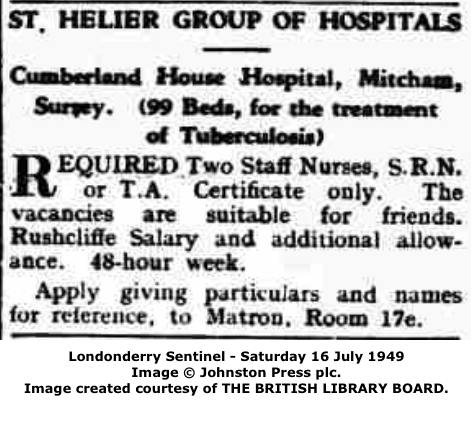
The hospital, originally under the Surrey County Council, became part of the NHS in 1947. This ad for nurses in 1949 shows it was part of the St Helier hospital group:

16th July 1949

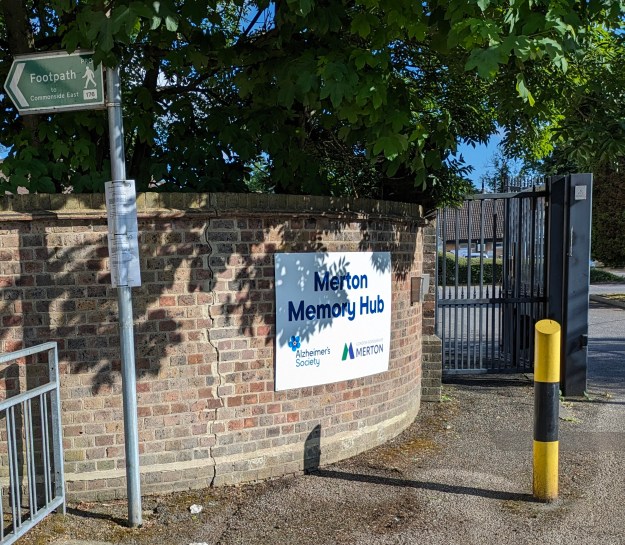
In 1979, the Sutton, Merton and Wandsworth Area Health Authority announced it was to close. The buildings were demolished in 1992. Redevelopment of the site by the health authority has included day care centres, and is the site of the Merton Memory Hub.

Photo taken May 2024

For more information about the hospital, see the website Lost Hospitals of London.


Maps are reproduced with the permission of the National Library of Scotland.