Road off east side of Streatham Road, north of Lock’s Lane and south of Graham Avenue.
Built in the late 19th century on land previously occupied by The Willows, described by Eric Montague in his book Mitcham Histories : 2 North Mitcham, page 74, as having extensive stabling, farmery, meadows and gardens. The roads Graham Avenue, Elmfield Avenue and Fernlea Road were also built in this land. The address “Graham Road, Willows Estate” was used in this ad from 1900:
Mitcham (best part). – Pretty and conveniently arranged 6 – roomed houses; bath (h. and c.); good garden; within 10 minutes’ walk of Tooting Junction Station; good service of trains to Ludgate-hill and London-bridge; rent £24 per annum, or price (freehold) £350; £300 could remain on mortgage, repayable by easy instalments, which would amount to the same thing as paying rent.
Apply to Nott, Cartwright, and Etches, 13, The Parade, Tooting; 1, Bank Buildings, Balham; or to 39, Graham-road, Willows Estate, Mitcham.
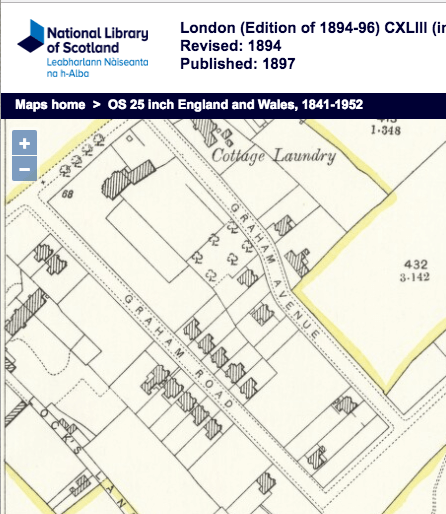
1894 OS Map
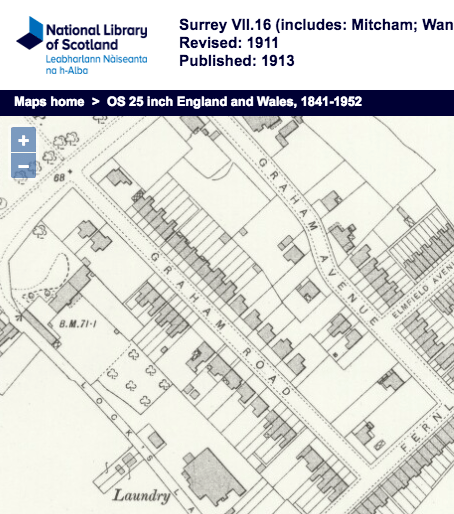
1911 OS Map
In 1902, the road was made up, and charges to owners was based on the length of the frontage of their properties. This list is from the minutes of the Croydon Rural District Council:
Volume 8
1902 to 1903
Mitcham Parochial
19th June 1902
page 200
The ‘number on plan’ isn’t a house number. The plan referred to isn’t available.
| No. on plan | Property | Owner | Frontage |
|---|---|---|---|
| 1 | House | Sydney Moses | 18 ft. |
| 2 | Three houses | Charles Bell | 54 ft. |
| 3 | Three houses | Nott, Cartwright & Etches | 54 ft. |
| 4 | Two houses | Charles Bell | 36 ft. |
| 5 | House | Arthur Mansfield | 18 ft. |
| 6 | House | Charles Bell | 18 ft. |
| 7 | House | Charles Wheeler | 18 ft. |
| 8 | House | Alfred Edger | 22 ft. |
| 9 | House | Miss Annie Fawcett | 18 ft. |
| 10 | House | John Edwin Branch | 18 ft. |
| 11 | Three houses | Charles Bell | 54 ft. |
| 12 | House | Charles Remington | 18 ft. |
| 13 | House | Edward Duncan | 18 ft. |
| 14 | Two houses | Edward Charles | 36 ft. |
| 15 | Eight houses | Edward Cheeseman | 134 ft. 6 ins. |
| 16 | Seven houses | James Willers | 121 ft. 6 ins. |
| 17 | House and land | T.L. Laver | 34 ft. |
| 18 | Land | J. Mounter | 24 ft. |
| 19 | Land | Trustees of Lansbury | 296 ft. |
| 20 | House and land | F.L. Mizen | 150 ft. |
| 21 | Land | H.A. Chappell | 188 ft. |
The contract for making up the road went to tender, as listed in the council minutes of 18th September 1902, page 394:
Graham Road Tenders
The Council opened and considered the undermentioned tenders received for the making up, forming, kerbing, and metalling of Graham Road, Mitcham:-
Stockwell & Co., Bromley ……… £812 14s.
Adams, T., Wood Green, London …. £621
Free & Sons, Maidenhead ………. £540
Iles, E., Mitcham ……………. £495
Wheeler, W.H., Southwark, S.E. … £441 13s.Resolved, That the tender of Mr. E. Iles, of Mitcham, be accepted, and that the necessary bond be entered into in accordance of conduct.
From the minutes of the Croydon Rural District Council
Volume IX 1903 – 1904
7th May 1903
page 71
No. 2481, Bennington, J.A., 3 houses, Graham Road, Mitcham
Minutes of meetings held by the Croydon Rural District Council are available on request from the Merton Heritage and Local Studies Centre at Morden Library.
The street directories of 1891 and 1915 list the occupants in the order encountered when walking from Figgs Marsh to Fernlea Road. The house names are in brackets.
1915
SOUTH SIDE
from Figg’s marsh
2 William James Dickisson (Trent House)
William Frederick Laing, auctioneer & estate agent (Trezamble)
James Dalton (Rose Bank)
George R. Waters (Sydmouth)
Andrew George Jones (Jessima)
James Knight (1 Graham villas)
Philip Musk (Rothesay)
John Davey (3 Graham villas)
Alfred Charles Firth (Dulmeney)
Samuel Weldon Myles (The Cottage)
Arthur E. Cooper (Lyndhurst)
12 Rev. Sydney Jackson [chaplain to Holborn Union workhouse & schools] (White Heather)
James Glover (Selby lodge)
Rowland Macbeth (Homeleigh)
Charles Stratton (Mayfair)
James Alfred Bennington (Eversley)
Edward E. Kelly glove cleaner (Melrose)
Alfred Thomas Green (Brambletye)
Thomas Harper (Stalheim)
Harry Wilson (Merok)
Henry Keen (Sundial)
Thomas Brandon (Viva villa)
NORTH SIDE
Alex. Cordier (Rosenheath)
Charles Jordan (Linacre)
Mrs Bishop (Bellefontaine)
Alexander Notman (Essen)
George H. Day (Aldwark)
Jesse Ray (Kimberley)
James Arthur Martin (Ivydeane)
Arthur Lewis Peake (Belmont)
Herbert Geogre Littleton (Claremont)
Joseph Geaney (Inisfail)
Frederick V. Whicher (Sherwood)
John Howard Feesey (Elmwood villa)
Walter Hudson Douglas (Roselea)
John Lewis Rooke (Thorstone)
Mrs Scales (St. Arvans)
William Luker (The Glen)
26 Richard James Glyde (Glenmore)
27 William Vickers (Crohamhurst)
28 William Driver (The Nest)
Edward Gurr (Sunnymeade)
Arthur Edward Hayne (St. Cross)
Mitcham Conservative & Unionist Association (Arthur Edward Hayne sec.) (St. Cross)
Henry Ailes Chappell (Oxwycke)
…. here is Fernlea Road ….
1891
NORTH SIDE
Miss Wilson (Montrose)
E. Hitchings (Trezamble)
H.S. Coldicott (The Cottage)
William Baker (Lyndhurst)
W.H. Wood (Oakleigh)
V. Roberts (Selby lodge)
Philip Marshal (Homeleigh)
John Forge (Brambletye)
SOUTH SIDE
50 Joseph Harbord
Dr. W.V. Kemshead (Avondale)
26 Hamilton Lawrence
First World War combatants 2nd Lt. Arthur Gordon Jackson, and his brother Lt Henry Stewart Jackson lived at White Heather, in Graham Road.
Minutes of meetings held by the Croydon Rural District Council are available on request from the Merton Heritage and Local Studies Centre at Morden Library.

