Category Archives: Industry

1827 auction of Patent Steam Laundry at Phipps Bridge

clip from Merton Memories reference Mit_Work_Industry_2-3

From the Sun (London) – Wednesday 08 August 1827, via the British Newspaper Archive

The Patent Steam Washing Company’s Valuable and Extensive Premises, at Phipps-bridge, Mitcham, Surrey, with Two Steam Engines, and all the Capital Machinery.

TO BE SOLD BY AUCTION,
By WINSTANLEY and SONS,

At the Mart, on TUESDAY, AUGUST 14, at Twelve, in One Lot, by Order of the Assignees, and with consent of the Mortgagees.

THE Valuable and Extensive PREMISES, comprising a newly-erected Building about two hundred and fourteen feet long and sixty-one feet wide, situate adjoining that well-known and fine stream the River Wandle. Together with Two Steam Engines, one of ten-horse and the other six-horse power ; seven large washing wheels, an Hydraulic Press of immense power, with ironing and calendering apparatus, and all other suitable fittings and machinery for the various departments, and forming one of the most complete establishments of the kind in the Kingdom, and the whole is easily applicable for a Brewery, Calico Printing, and many other descriptions of manufacture.

Also, very extensive Stabling, Coach or Waggon-houses, Yards, &c. The above Premises are holden by Lease for Ninety-nine Years, at £31 10s. per annum.

Likewise a New Brick Erection fitted up as a Dyehouse, containing several large Coppers, with Leaden Cisterns and other apparatus of the most approved constructions, and upon a very excellent scale, held for thirty years, at £9 per annum.

And a Field of Meadow Land, about Fifteen Acres, well calculated for a Drying or Bleaching Ground, with a Timber Building about 110 feet long and 21 wide, fitted up as a canteen, and supplied with suitable cooking apparatus and appendages.

To be viewed by Tickets only, which with particulars l may be had of Mr. de Mole, solicitor, at Merchant Tailors’ , Hall ; of Messrs.. Rankin and Rickards, solicitors, Basinghall-street ;of Messrs. Gregson and Fonnergau, Angel Court, Throgmorton-street ; and of Winstanley and Sons, Paternoster-row ; particulars may also be had at the Buck’s Head, Mitcham ; Greyhound, and King’s Arms, Croydon ; the King’s Arms, Carshalton ; Spread Eagle, Epsom ; Griffin, and Castle, Kingston ; of Thomas Winstanley and Son, at Liverpool and at Manchester ; and at the Inns at Glasgow.

From the Sun (London) – Wednesday 08 August 1827, via the British Newspaper Archive.

The ‘Field of Meadow Land, about 15 acres’, is likely to be the area shown on this 1894 OS map on the west side of the river Wandle with the horizontal lines. Using the National Library of Scotland’s area measurement tool, this area is 0.06 square kilometres, or 14 acres. Currently this area is the site of Wimbledon Studios on Windsor Avenue.
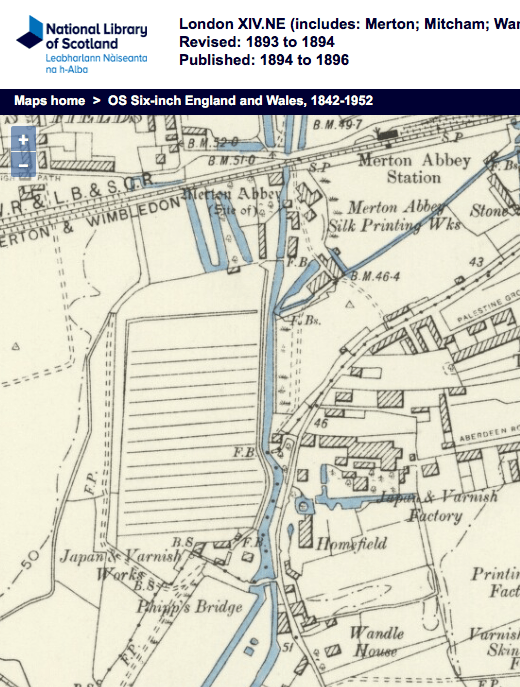
1893 OS map

1945 : Kempat Ltd fined for overcharging for bras

From the Mitcham News & Mercury, 19th January 1945, page 1.

£3,435 in Fines
for Overcharging
for Brassieres

Fines amounting to £3,435 were imposed at Mitcham Court, on Monday, when Kempat, Ltd., James’s Estate, Western-road, Mitcham, a firm manufacturing women’s underclothes, and three directors of the firm, were summonsed for overcharging on 15 sales of brassieres involving a sum of £14 5s. 5 1/2d. The case, which opened last week, and involved 47 summonses, took over five hours to hear.

Describing the case as “flagrant,” the Chairman of the Bench (Ald. S.L. Gaston) said the Bench accepted the firm’s plea of guilty, and the firm would be fined £200 on each of the 15 summonses. The Bench found the case against the three directors proved, and Mr Vivian Fitch-Kemp, managing director, All Saints-road, Sutton, would be fined £20 on each of the 15 summonses against him; Major Walter Maxwell Henderson-Scott, Burley Beacon, Burley, Hampshire, £10 on each of nine summonses; and Mrs Ruby Olive Knobel, Gibsons Hill, Norbury, £5 on each of nine summonses. Fifty guineas costs were given against the firm.

At the opening hearing last week it was stated that the proceedings were brought by the Board of Trade under an order limiting profits to 7.5 per cent, on the manufacturers’ costs of production. It was alleged that the firm’s accounts at one time showed a profit of 63 per cent.

Major Henderson-Scott told the Bench that he was a qualified mining engineer, and director of a group of companies engaged in mining industries, which in 1939 acquired shares in Kempat, Ltd.. He had no technical knowledge of the brassiere trade, and took no part in the costing of the company’s goods. When in March, 1944, he saw the accounts for the year ending November, 1943, he had no idea that the firm was overcharging. He did not realise that the figure 34.6 per cent had any bearing on the margin of profut allowed on utility goods. He held no shares in the company apart from his qualifying shares as a director.

Questioned by prosecuting counsel, he said he had been director of companies for about 22 years. He had looked after his own part of the business, and denied that he had any intention of “screwing money out of the public.”

Mrs Knobel, who, it was stated at the previous hearing, had become director simply for the convenience of signing cheques, told the Bench she was no longer a director since Mr Fitch-Kemp’s return. During her directorship she continued to receive her salary of £5 15s., but had nothing extra. She had sent the production figures to Mr Fitch-Kemp nat intervals, but had not understood the costings, nor could she read a balance sheet. The turn-over figures from 1940 to 1942 had dropped from £37,000 to £24,000. Asked for the figures for 1943, she admitted they had risen to £29,000. She was accustomed to send the bank balance to Mr Fitch-Kemp.

The Chairman asked if Mrs Knobel hadhad prepared a monthly financial statement; had she not some knowledge of figures and of balance sheets. “There is evidence of some knowldge of figures. There is little use of her pleading ignorance when she is in a position to prepare statements of this kind,” he said.

Mrs Knobel said she knew the prices the company was charging and that retailers added a percentage, but she insisted that she did not know the firm was overcharging.

At this point defending counsel submitted that proof of the regulations should be before the court. The prosecuting counsel replying that the suggestion was “fantastic,” said that in five years of this kind of work he had never met the point before. The documents were produced.

For the defence it was said that although much had been said about culpable and gross neglect, there was no suggestion of fraud. The firm had carried on under difficulties. When Mr Fitch-Kemp went into the R.A.F. managing directors were difficult to get, and were not as plentiful as gooseberries on bushes. If the company had had the proper staff, they would have made the discovery that the costs were wrong.

Adjusted for inflation, £3,435 in 1945 is equivalent to £150,000 in 2019.