Tag Archives: James Estate

Change-Wares Ltd.

Wire works company at various locations, based on news items and ads, see below.

1943 : James Estate, Bond Road, Mitcham.
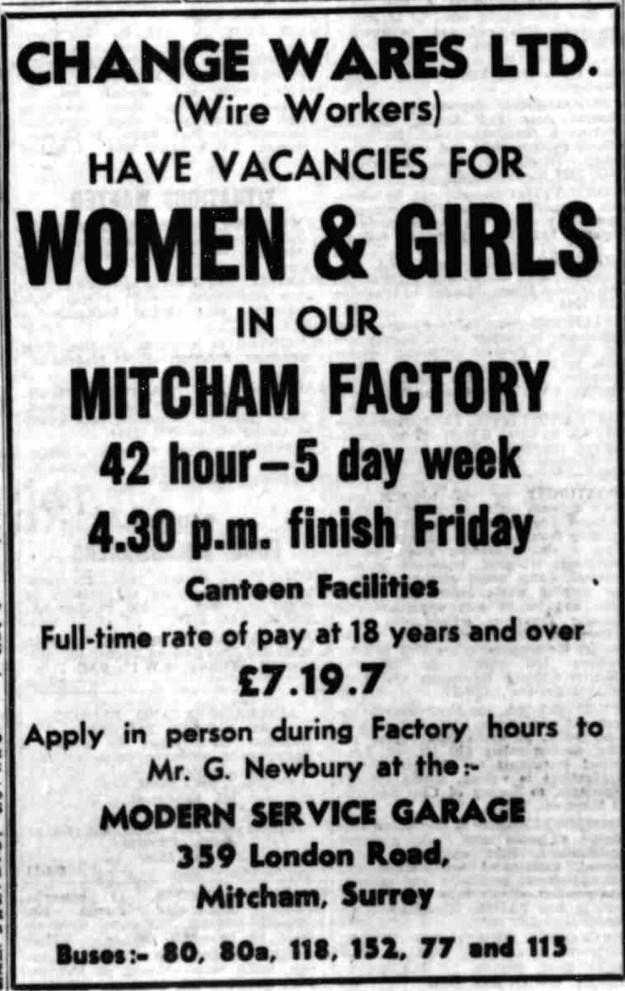
1963 : 359 London Road, Mitcham.
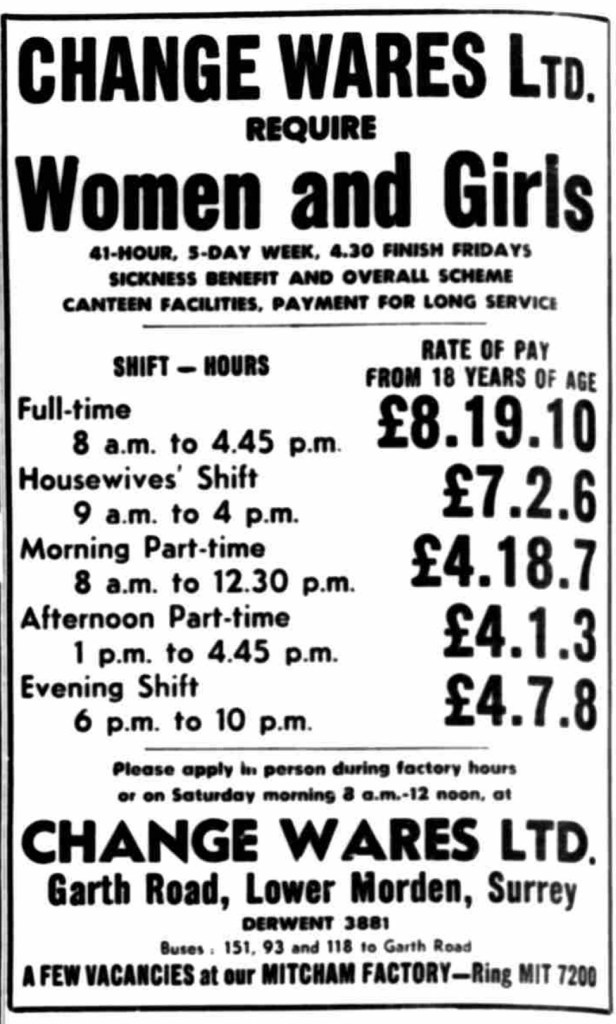
1965 : Garth Road, Morden.

Liquidated in 1983.

Mitcham Advertiser – Thursday 27 May 1943

LIGHTS IN THE NIGHT

Change-Wares, Ltd., James Estate, Western Road, Mitcham, were fined £1 at Mitcham Police Court on Monday for a black-out offence on April 1. P.-c. Cooper said he saw a light shining from seven large windows and a skylight at the works at 9.5 pm. He was unable to gain admission till he found the caretaker. Mr. Thompson a director, told the Bench that he left the works at about 6.30 p.m, and trusted to a responsible employee to see to any lights, Apparently the man inadvertently switched a light on instead of off.
Streatham News – Friday 27 September 1963
Image © Successor rightsholder unknown.
Streatham News – Friday 25 June 1965
Image © Successor rightsholder unknown.

Norwood News – Friday 20 August 1965

CHANGEWARES LTD. GARTH ROAD, LOWER MORDEN, SURREY We have the following departments in our Garth Road Wire and Sheet Metal Working factories:
MAIN OFFICES
DRAWING OFFICE
TOOL ROOM and DEVELOPMENT DEPT.
WIRE STRAIGHTENING and CUTTING
RESISTANCE WELDING SHOPS
PRESS SHOP
NICKEL and CHROME
PLATING
PAINT DIPPING and SPRAYING
POLYTHENE COATING
STORES and DISPATCH
MAINTENANCE DEPT.

Shropshire Star – Tuesday 17 November 1970

New issue Charterhouse Japhet keeps the new issue pot bubbling with plans shortly to offer for sale 40 per cent. of the capital of Change Wares Ltd. The company, with its subsidiary, Chrome Mesh Equipment, manufactures wire components for domestic appliances

Insolvency notice in the London Gazette
Publication date 28 December 1983
Supplement : 49579
Page : 17102

Name of Company—CHANGE WARES MANUFACTUR-
ING Limited. Address of Registered Office—Garth Road,
Lower Morden, Surrey. Nature of Business—TIN, WOOD
and WIREWORKERS. Court—HIGH COURT OF JUS
TICE. No. of Matter—004223 of 1983. Creditors—Date, 10th
January 1984; Hour, 11 a.m.; Place, Room G20, Atlantic
House, Holborn Viaduct, London EC1N 2HD. Contributories
—Date, 10th January 1984; Hour, 11.30 a.m.; Place—Room
G20, Atlantic House, Holborn Viaduct, London EC1N 2HD.

1945 : Kempat Ltd fined for overcharging for bras

From the Mitcham News & Mercury, 19th January 1945, page 1.

£3,435 in Fines
for Overcharging
for Brassieres

Fines amounting to £3,435 were imposed at Mitcham Court, on Monday, when Kempat, Ltd., James’s Estate, Western-road, Mitcham, a firm manufacturing women’s underclothes, and three directors of the firm, were summonsed for overcharging on 15 sales of brassieres involving a sum of £14 5s. 5 1/2d. The case, which opened last week, and involved 47 summonses, took over five hours to hear.

Describing the case as “flagrant,” the Chairman of the Bench (Ald. S.L. Gaston) said the Bench accepted the firm’s plea of guilty, and the firm would be fined £200 on each of the 15 summonses. The Bench found the case against the three directors proved, and Mr Vivian Fitch-Kemp, managing director, All Saints-road, Sutton, would be fined £20 on each of the 15 summonses against him; Major Walter Maxwell Henderson-Scott, Burley Beacon, Burley, Hampshire, £10 on each of nine summonses; and Mrs Ruby Olive Knobel, Gibsons Hill, Norbury, £5 on each of nine summonses. Fifty guineas costs were given against the firm.

At the opening hearing last week it was stated that the proceedings were brought by the Board of Trade under an order limiting profits to 7.5 per cent, on the manufacturers’ costs of production. It was alleged that the firm’s accounts at one time showed a profit of 63 per cent.

Major Henderson-Scott told the Bench that he was a qualified mining engineer, and director of a group of companies engaged in mining industries, which in 1939 acquired shares in Kempat, Ltd.. He had no technical knowledge of the brassiere trade, and took no part in the costing of the company’s goods. When in March, 1944, he saw the accounts for the year ending November, 1943, he had no idea that the firm was overcharging. He did not realise that the figure 34.6 per cent had any bearing on the margin of profut allowed on utility goods. He held no shares in the company apart from his qualifying shares as a director.

Questioned by prosecuting counsel, he said he had been director of companies for about 22 years. He had looked after his own part of the business, and denied that he had any intention of “screwing money out of the public.”

Mrs Knobel, who, it was stated at the previous hearing, had become director simply for the convenience of signing cheques, told the Bench she was no longer a director since Mr Fitch-Kemp’s return. During her directorship she continued to receive her salary of £5 15s., but had nothing extra. She had sent the production figures to Mr Fitch-Kemp nat intervals, but had not understood the costings, nor could she read a balance sheet. The turn-over figures from 1940 to 1942 had dropped from £37,000 to £24,000. Asked for the figures for 1943, she admitted they had risen to £29,000. She was accustomed to send the bank balance to Mr Fitch-Kemp.

The Chairman asked if Mrs Knobel hadhad prepared a monthly financial statement; had she not some knowledge of figures and of balance sheets. “There is evidence of some knowldge of figures. There is little use of her pleading ignorance when she is in a position to prepare statements of this kind,” he said.

Mrs Knobel said she knew the prices the company was charging and that retailers added a percentage, but she insisted that she did not know the firm was overcharging.

At this point defending counsel submitted that proof of the regulations should be before the court. The prosecuting counsel replying that the suggestion was “fantastic,” said that in five years of this kind of work he had never met the point before. The documents were produced.

For the defence it was said that although much had been said about culpable and gross neglect, there was no suggestion of fraud. The firm had carried on under difficulties. When Mr Fitch-Kemp went into the R.A.F. managing directors were difficult to get, and were not as plentiful as gooseberries on bushes. If the company had had the proper staff, they would have made the discovery that the costs were wrong.

Adjusted for inflation, £3,435 in 1945 is equivalent to £150,000 in 2019.