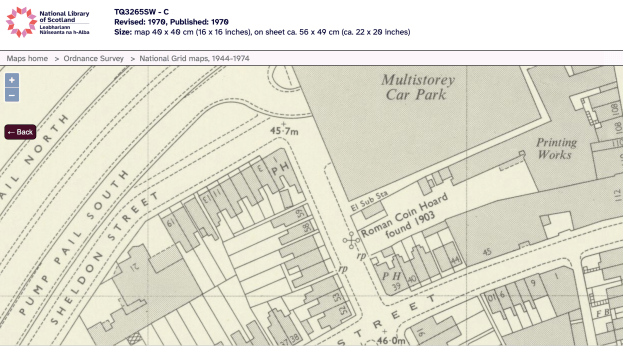
In 1903 a Roman Coin Hoard was found in Croydon.
REMARKABLE DISCOVERY IN WANDLE ROAD.
A HOARD OF OLD ROMAN COINS.
On Monday, Corporation workmen employed in digging a drain trench in Wandle-road made a remarkable discovery. One of the men felt his pick strike upon something hard and on looking closer saw that the implement had come into contact with and smashed an earthenware jar. Further investigation showed that at the spot two antique pots or jars, evidently of Roman manufacture, had been buried, and seeing that they were only two feet below the surface, it seems remarkable that they should have remained hid for so many centuries. Unfortunately both utensils were smashed, but experts have been able to “reconstruct” them, and to prove that they are jars of a conventional Roman pattern.
This collision between pick and pot was only the beginning of discoveries. Peering into the hole the workmen saw a large quantity of metal discs, covered thickly with verdigris. A handful of the discs were examined, and it was then seen that they were coins of some kind—evidently of a remote period. The Town Hall authorities were at once communicated with, and the remainder of the coins were got out in the presence of an official and conveyed to Katharine-street, together with the remnants of the pots. There some of the coins were cleaned with acid and it was then seen that they were pieces of copper coinage. The vast majority consisted of coins of a size not quite so large as a half-penny. They are by no means perfect as to shape, but have been preserved to a quite astonishing degree. When cleaned, indeed, the coins look as though they had just been minted—excepting, of course, that advances have been made in the art of minting since they were struck.
Under the direction of Mr. S. Jacobs (Acting Town Clerk) the green encrusted coins were counted—a by no means enviable job—and it was found that they numbered over 3,600. They remain at the Town Hall pending a decision as to what is to be done with them.
The collection of coins, which had undoubtedly been placed in the pots over 1,500 years ago, includes about thirty different varieties, all bronze, but the small coin alluded to is in a majority of nearly a hundred to one. They are stated by an expert to be coinage of the reign of the Roman Emperor Constantius, who died in A.D. 361. On the obverse of the coin—known as a sesterce, and equivalent to a little over a penny—is a remarkably fine profile likeness of the emperor, a gentleman of classic features and commanding mien and the lettering is as follows:—”D.N. Constantius. P.F., A.V.G.” On the reverse is this inscription:—”Fil. Temp. Reparatio,” this being an abbreviation of the Latin Filium temporum reparatio, which may be rendered roughly into English as “O happy times of restoration.” In the centre is depicted a Roman oared galley containing two figures, one representing the Emperor, and the other, who is steering, Victory.
The Emperor Constantius was one of the three sons of the great Constantine, founder of Constantinople. Upon the death of their father the brothers became the rulers of different parts of the Empire, one becoming King of the then Roman Colony of Britain. Constantine, who ruled over a great part of Europe, seems to have been of a greedy disposition. He coveted his brother’s kingdom of Britain, forced a quarrel upon him, crossed the sea and conquered and slew him, and, as was the free and easy usage of those times, reigned in his stead.
One can, of course, only speculate as to how the large hoard of coins of a relatively small value came to be buried in a place that in the course of many centuries, has become a thoroughfare in a great and populous town. Had the original owner had the gift of prescience, perhaps, he would have selected a more secluded place for the bestowal of his treasure, or, as the case may have been, plunder. At all events he could hardly have foreseen that Mother Earth would have been so safe a bank and that his money was kept in security, although earning no interest, until the year 1903, then no doubt, a very remote date in his view. The intrinsic value of the coins, as we have said, is trifling, but the remarkable find is full of interest to archaeologists, numismatics, and others whose delight is to delve into the past or to treasure memorials of vanished peoples and civilizations. We understand that arrangements will be made to give the public an opportunity of inspecting the unearthed treasure of some Roman colonist or British worthy of the fourth century.