Category Archives: Roads

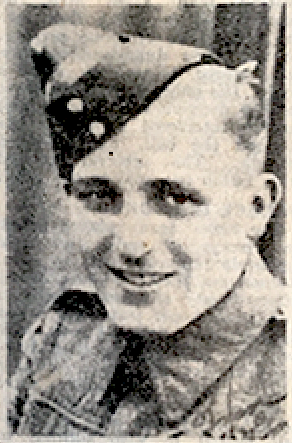
Private Fred Lee

From the Mitcham News & Mercury, 13th October 1944, page 1

South London Too Quiet

Pte. Lee from Arnhem

Narrow Escape in Wood

Wants to Return to the Front

Pte. Fred Lee, man of Arnhem, only son of Mr and Mrs F.J. Lee, Dinton Road, Colliers Wood, made his first airplane landing when he arrived in this country from Holland.

He has been airborne scores of times, but each time his descent was made by parachute. First it opened over English fields, then over enemy territory in Italy; on D-Day it flowered over Normandy, and a few weeks later was among the first to open over Holland for the attack at Arnhem. So the journey home held a new experience for Skyman Lee, who is now spending seven days leave at home. Airborne operations and leaping into space from a racing airplane is all in the day’s work to Pte. Lee, who is now spending denying that, says he is only one of many carrying out a job he has been trying to do.

His one desire to return to the front for more fighting, for he finds life in South London too quiet. Too quiet in all ways but one. There are too many visitors to his house, too many people who wish to call him hero. Much of his life has been spent in avoiding them. On Sunday he went to early Mass to avoid the crowds. He does not wear his uniform, and one day, wearing a dressing gown, himself told a caller that Pte. Lee was not at home!

THREE DAYS IN THAT TRENCH

Last week the “News” told how Pte. Lee’s photograph, taken in a slit trench at Arnhem, had appeared in almost every national newspaper. Pte. Lee spent three days without a break in a trench, but was, he told a friend fairly comfortable, for when our planes dropped supplies by parachute he was able to secure three canisters with their parachutes. These he used to cover in the trench so that he and his companions managed to keep fairly dry.

He collected enough water in containers to have a shave each of the three days.

GERMANS SLOW AND BADLY CLOTHED

Many of the German soldiers fighting against them were badly clothed, and, unlike our own men, who are trained to think quickly and act on their own initiative, the Germans were slow to act when separated from their leaders. As usual, they played foul, and used hospital grounds, which were supposed to be neutral.

Pte. Lee had a narrow escape when he came on a group of Germans in a wood. Seeing their figures creeping through the trees towards him, he stepped, quick as lightning behind a tree, and shot at them. One of them fell, but the others, instead of taking cover, looked around to see where the bullets were coming from. The poor spirit of some of the men was indicated by the behaviour of a bunch of 300 prisoners who were guarded by a handful of our men with a few Sten guns, most of which were out of order.

Pte. Lee was in a Dutch house, where he found quantities of luxury foods and wines. A German officer had been living there. The paratroopers had a good meal, and to the question of the Dutch who lived in the house, as to when Dempsey’s men were to arrive, they replied “Tomorrow.”

WANT TO HAVE ANOTHER CRACK

“We kept hoping that reliefs would succeed in getting through to us.

Now all we want is to get back to have another crack at those Germans,” he said.

For more on Fred Lee, see his entry on the ParaData website.

Note that, at the time, Dinton Road, Colliers Wood, was part of the Borough of Mitcham.

Lance Corporal George Philpott

from the Mitcham News & Mercury, 6th October, 1944, page 1:

Lance-Corporal George Philpott, Riverside Drive, London Road, Mitcham, a tailor’s cutter and trimmer at Gieve’s, Piccadilly, before the war, now wields a blacksmith’s hammer at Suez, and has Egyptian strikers, whose only language is Arabic, at his anvil.

In peace-time he was a keen motor and polo cyclist, and hoped to get a job as despatch rider when he joined the Army, but they sent him to Longmore to train as a blacksmith. Later, he worked at Wilmot, Newport and London. While working at the Albert and King George V docks London, he claims to have had a wonderful time, because he was so near home, and able to visit his father and brothers frequently.

Of his job Lance-Corporal Philpott says: ”It’s interesting work, and I quite like a change, but I shall go back to my own trade after the war. Only, maybe, If I get absent-minded, I might begin to cut clothes with a hammer and chisel.

DANGER AT THE DOCKS

“We came to the Middle East in May, 1942,” he said,” and I was posted straight to Suez, where we are now. When the push was on a detachment of us went to Mersa Matruh and Tobruk, to work on the docks there. We repaired cranes and installations destroyed by the Germans before they left. There were air attacks when we were at Tobruk and at Benghazi. Most of the troops were quartered outside the town, but we got the full benefit, because we had to stay right on the docks, and whenever a ship came in, the attacks were redoubled.”

Lance-Corporal Philpott is in charge of the blacksmith’s shop for his present Company, and has Egyptian strikers at his anvils. Language is something of a difficulty but he has picked up enough Arabic to make himself understood, and he can give measurements in Arabic. Work is hard and the climate difficult, being very hot, indeed, in summer; but pressure is less than it was when the Allies were invading Sicily. Then the Company worked long hours, and nobody got any off-day during the week.

“My Army experience has been interesting,” he says. “I have seen things I shall never forget. I do not regret my Army service for a moment.”

BROTHER THERE, TOO.

His brother, Frank, is also in the Middle East. He too was a keen motorcyclist, and was more fortunate than his brother, for he became a despatch rider. Their younger brother, Ronald is a member of Mitcham Army Cadet Corps.

KEEN CYCLIST

L-Cpl Philpott, a member of Tooting Cycling Club, was one of the club’s top scorers. He played in their bicycle Polo team and holds several medallions awarded for his part when the club won competitions. His brother, like his father, is a keen racing cyclist, and won several prizes on the road; he held the 25-mile record of the Tooting Cycling Club in 1931, his time being 1 hour 3 minutes 53 seconds.

The 1939 Register shows the occupants of 62 Riverside Drive:

James I Philpott, born 19/02/1881, Newsagent’s Warehouseman
Florence A Philpott, born 28/02/1884, housewife
George Philpott, born 31/01/1910, Uniform – Tailor’s Trimmer
Esther F Philpott, born 28/07/1911, Packer – Confectionery
Grace Philpott, born 17/06/1912, Packer – Confectionery
Gladys Philpott, born 13/07/1915, Chain Store Supervisor

Source: The National Archives; Kew, London, England; 1939 Register; Reference: RG 101/1372H

A relative on the Facebook group Mitcham History wrote “As he and his brother Frank volunteered for service, they both thought that their skills in civilain life would be put to use. Instead they were both posted to North Africa. George was trained as a blacksmith, somewhat different to a military tailor! He was posted to the London Docks to repair cranes, then was shipped out with them.”