Category Archives: Shops

Sapper Harold H. Taylor

From the Mitcham News & Mercury, 29th September, 1944

Sapper Killed in France

Mitcham Newsagent for Fourteen Years

Sapper Harold H. Taylor (aged 41), of the Royal Engineers, who for fourteen years was a newsagent in London-road, Mitcham, was killed in action in France on September 10. His wife, who is living in Graham-road, received a letter from her husband written two days before his death.

Sapper Tayor joined the Army two years ago, and went to France about ten days after D-Day. He brought his family from Woodford to Mitcham fourteen years ago. There are four children.

His will gives his residence as 103 London Road, presumably above the newsagents shop.

Harold Henry TAYLOR of 103 London-road Mitcham Surrey died 10 September 1944 on war service. Administration Llandudno 30 January to Violet Grace May Taylor widow. Effects £173 16s. 9d.

Source: Ancestry.com. England & Wales, National Probate Calendar (Index of Wills and Administrations), 1858-1995

The 1939 Register shows four occupants at this address:
Harold H. Taylor, born 4th April 1903, newsagent shop keeper
Violet G.M. Taylor, born 29th May, 1903, housewife (surname changed to Spall 13th September 1948)
Violet G. Taylor, born 3rd April 1927, at school
Henry P. Taylor, born 8th April 1937, under school age
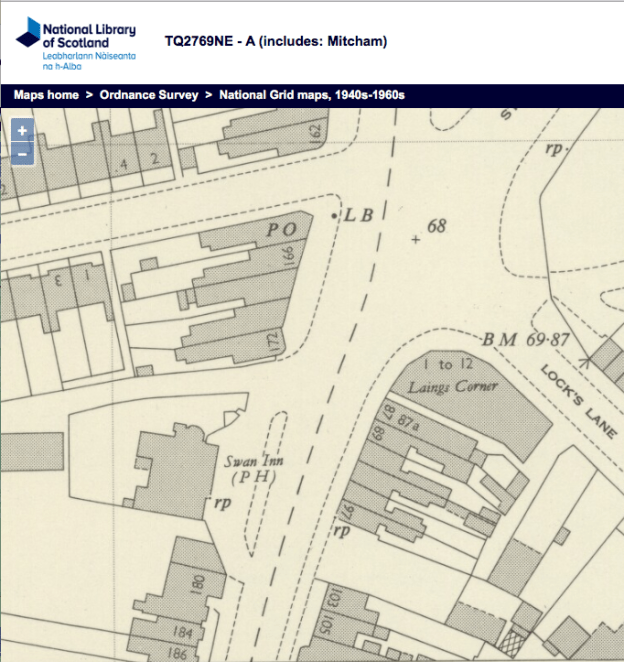
1953 OS map

1973 Image courtesy of Collage – The London Picture Library

This clip from 1973 shows the newsagents at 103 on the left, the bicycle shop is no. 105, and the pub on the right, the Gardeners Arms, is no. 107.

It was a newsagent until possibly the 1980s. In 2019 the building still exists, but is part of the solicitors Pruveneers LLP, at 103-105 London Road.

From the Commonwealth War Grave Commission

Sapper
TAYLOR, HAROLD HENRY

Service Number 14243886

Died 10/09/1944

Aged 41

Royal Engineers

Son of Henry Thomas Taylor and Mary Jane Taylor; husband of Violet Grace May Taylor, of Forest Gate, Essex.


Maps are reproduced with the permission of the National Library of Scotland.

J.H. Peters, Optician

c. 1962 clip from Merton Memories photo reference Mit_Streets_P_Will_77-2

Addresses taken from phone books:

1959 : 4A Western Road, MIT 7114
1966 : 4 Western Road, 01-648 7114
1981 : 6 Fair Green Parade, 01-648 7114.

J.H. Peters was James Henry Peters, the marathon runner known as Jim Peters.

From the Liverpool Echo – Wednesday 13 January 1999

Marathon hero Peters dies

MARATHON legend Jim Peters, who caught the imagination of the public at the 1954 Empire Games in Canada when he staggered around the last lap, has died aged 80.

Peters entered the Vancouver stadium around three miles ahead of the next competitor but dehydration had taken its toll and as the crowd rose to acclaim him he faltered and began to stagger.

He fell six times and his anguished English team-mates at trackside could not help for fear that he would be disqualified if he received any assistance.

They were finally able to go to his aid when it was clear he was not going to cross the finishing line of the race eventually won by Scotland’s Joe McGhee.

But his courageous efforts over the final few yards made an unforgettable sight which was etched in the minds of millions by Movietone News.

He ran a world’s best time in the marathon each year from 1952 to 1954 but he was more celebrated in that glorious defeat than in his victories during the fifties.

Peters quit athletics after the Games – “It cost me my killer instinct” he said – but the image of his heroic bid for a gold medal 45 years ago still lives on.

David Bedford, the international race director of the London Marathon, said: “Jim was a class runner when marathon running, unlike today, was unfahsionable.

Plimsoles

“He trained harder than most – often 100 miles a week – and believed in the work ethic with his thousands of miles run in plimsoles.

“My first memories of him were from newspaper pictures showing him collapsing when in sight of the finish.”

Bedford, the former 10,000 metres world record holder, added: “Few athletes push themselves to such exhaustion as Jim did at those Games. He was unique.”