Category Archives: WW2

Carshalton Road

Road that is the start of the A237 and runs south from the junction with Commonside West, Cedars Avenue and Croydon Road, heading towards Carshalton.

On the west side there is a junction with Cranmer Road and Willow Lane, and on the right just after this is the entrance road to Mitcham Junction railway station and the Mitcham Golf Club. The road goes over the railway and tram lines on a bridge that was rebuilt and widened in the mid 1950s. On the west side of the road and part of the southern slope of the bridge is an access road leading to Aspen Gardens. Further south from here, and set back from the western side of the road is a line of houses that were originally called Rumbold Villas and Tramway Terrace. They are separated by two roads Drake Road and Arney’s Lane. At Beddington Corner is the Goat pub on the corner with Goat Road.

After Beddington Corner, the road is now called London Road and the A237 continues to the A23 at Coulsdon.
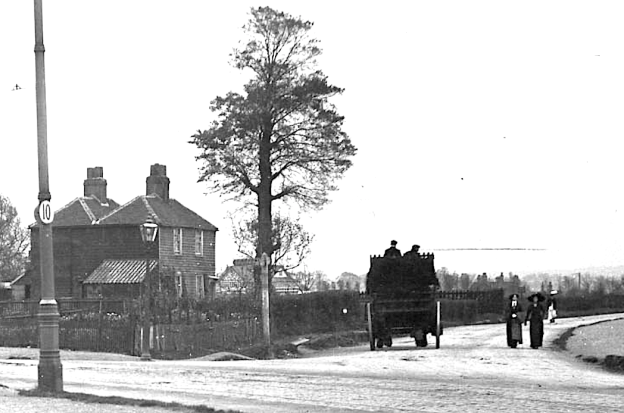
Carshalton Road at junction with Croydon Road. The house was one of the Blue Houses. From a Percy Mayhew postcard, from Merton Memories, photo reference Mit_19_1-19

The guide post (marked G.P.) that is on the south side of the tram line in this 1910 OS map is the one seen in the photo.
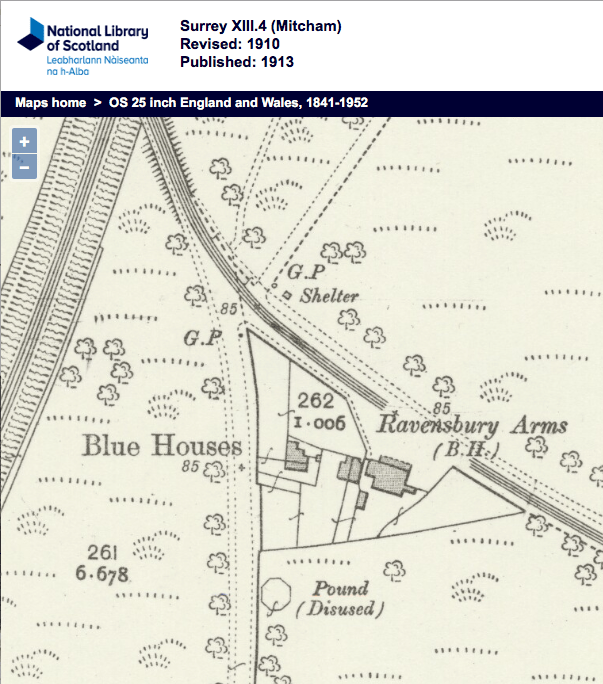
1910 OS map

The junction with Croydon Road was changed to a roundabout in 1955.

From the Mitcham News & Mercury, 24th February 1955

ROUNDABOUT

Work is to start soon on making a traffic roundabout at the busy junction of Croydon Road with Carshalton Road, on Mitcham Common.

The Transport Minister has approved a grant of up to £4,427 towards the cost of the roundabout. Coun. D.J. Hempstead, Highways Committee chairman, said last week that it was hoped that work would be speedily undertaken.

The bridge over the railway line was widened at the same time, the work having been started in 1939 but was interrupted by the war.

On the east side of Carshalton Road, south of the railway station, was a WW2 anti-aircraft gun site. It was cleared in the early 1960s.
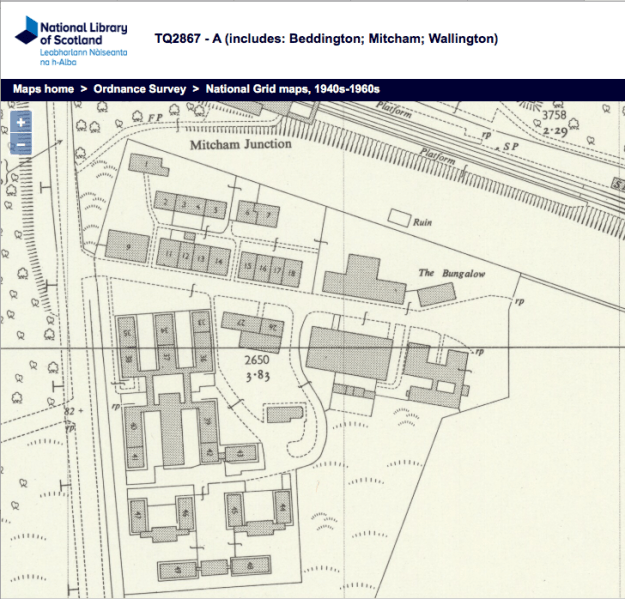
1955 OS map showing the Gun Site.

From the Mitcham News & Mercury, 13th July 1962:

At last – Gunsite is to go

One of Mitcham’s biggest eyesores, the Gun Site, Carshalton Road, Mitcham Common, is at last to be cleared at a cost of about £13,000.

Work on clearing the site is expected to start in about two months time.

The Ministry have approved a tender of £10,800 submitted to them from the Conservators and have further agreed to bear the cost of replacing trees on the site.

WELCOMED

A further cost of £2,000 fees will be included in the work.

This news is welcomed not only by the Conservators but by Mitcham Council and the public.

The Gun Site is one of the few remaining war relics in Mitcham and local people have been pressing for years to clear it.

The conservators hope to replace it with a grass landscape with trees.

WW2 Civilian Casualties

20th October 1940

16 Carshalton Road
Winifred Mabel LARBY, aged 35


Maps are reproduced with the permission of the National Library of Scotland.

Sergeant Thomas Oakley Burgess D.F.M.

Thomas Oakley Burgess was born in the last quarter of 1919, and in the 1939 Register his parents, Thomas Henry and Bertha Emily Burgess, lived at 73 Church Road, Mitcham.

As Leading Aircraftsman, Thomas Oakley Burgess, service number 551290, he served with 12 Squadron R.A.F., and was awarded the Distinguished Flying Medal in 1940.

BURGESS, Thomas Oakley. 551290 Leading Aircraftman, No. 12 Sqn. (Imediate)
L. G. 21/6/1940. Wireless Operator/Air Gunner. Air2/4097.

On 19th May 1940, L.A.C. Burgess was Wireless Operator/Air Gunner in Battle L.5536 of which
Pilot Officer J.J. McElligott was pilot and 580646 Sergeant B.C. Long was Observer. The aim on this mission was to bomb troops de-bussed in the area Mont Cormet – Neuf Chatel – Chateau Porcein – Ecly – Germaincourt – Fraillcourt. At 11.10 hours, the pilot had just dropped his bombs on the village of St. Fergeaux and was turning for home when the Battle was attacked by six Me.109’s about four miles South West of Ighel. They were engaged by the rear gunner and the Air Observer opened fire on three of them with the third gun as they passed underneath the Battle. The Me.109’s made further attacks and the rear gunner continued to engage them. By this time, the pilot had been severely wounded in the right shoulder and arm and the port tank was on fire, but he managed to bring the aircraft down about six miles South West of Juniville, an area occupied by the French. L.A.C. Burgess, who was admitted to hospital with shrapnel wounds, told Sergeant Long, the Air Observer, that he was sure he had shot down one Me.109. The crew were cared for by Lieutenant Cambourne of the 7th Demi Brigade, Cuirassee. Sergeant Long was interviewed late by a French Colonel at Neuf Lize who told him that it was certain that one Me.109 had been brought down and that he thought a second had crashed some distance away. This evidence has been confirmed through the French Mission. The pilot of the aircraft died of the wounds received in this action but the Air Observer was unhurt. It is considered that L.A.C.
Burgess showed a great courage in sticking to his gun, though probably already wounded, and
skill in disposing of one, and possibly two, of the enemy in the face of such superior odds.

2nd June, 1940.

Gloucester Citizen – Friday 21 June 1940

THREE AIRMEN OF TWENTY WIN D.F.M.

The exploits of three 20-years-old airmen who have been awarded the D.F.M. were described in an official announcement last night.

The men are Corporal James Anthony Drummond. of Salisbury; Leading Aircraftman Thomas Oakley Burgess, of Mitcham, Surrey; and Aircraftman 2nd Class Edward Joseph Evans, who was born at Ironside, Salop.

Corporal Drummond engaged a large formation Messerschmitt 109’s, shot down one and damaged others. Leading Aircraftman Burgess and Aircraftman Evans, both of whom are wireless operator-air gunners, also fought superior forces of Messerschmitts. Each brought down one and damaged others.

Burgess received shrapnel wounds. All three are described as having shown great courage and skill.

Squadron Leader Cyril Elton Kay, O.B.E., Royal New Zealand Air Force, has been awarded the D.F.C., was announced last night.

Squadron Leader Kay, in extremely difficult conditions and in face of heavy opposition, bombed and machine-gunned important targets in the forests south of Bourlers and Abileux in a night raid this month.

The announcement speaks of his daring, determination and outstanding ability.

As Sergeant he was a Wireless Operator and Air Gunner with 12 Squadron when he died on 7th July 1941, aged 21. His Wellington aircraft type II, number W5360, was shot down and crashed at Kervel-en-Guilers, France. All of the crew died.

Norwood News – Friday 26 September 1941

Mitcham D.F.M. Reported Killed

Sergt T. D. Burgess, R.A.F., Church-road, Mitcham, who was awarded the D.F.M. for bravery and who was decorated by the King in March, is now reported killed.

Note that his middle initial is given as ‘D’ instead of ‘O’.

Commonwealth War Grave Commission casualty record.