Tag Archives: 1878

Skinners Arms, Beddington Corner

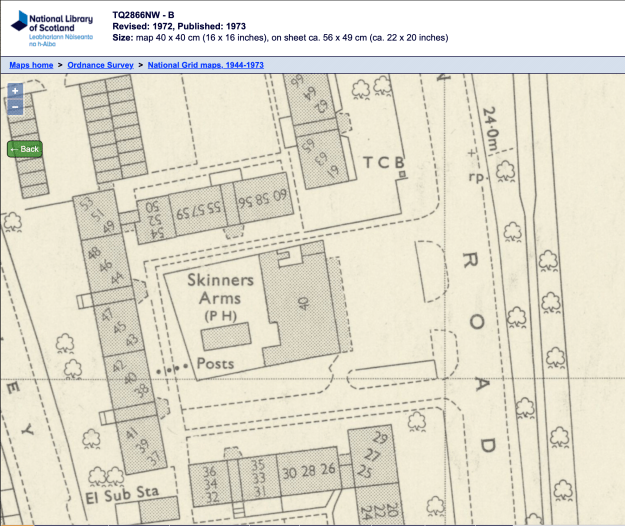
Pub that was at 40 London Road, Mitcham Junction, Sutton CR4 4JB, as shown on this 1972 OS map.

1972 OS map reproduced by permission of the National Library of Scotland, re-use CC-BY (NLS)

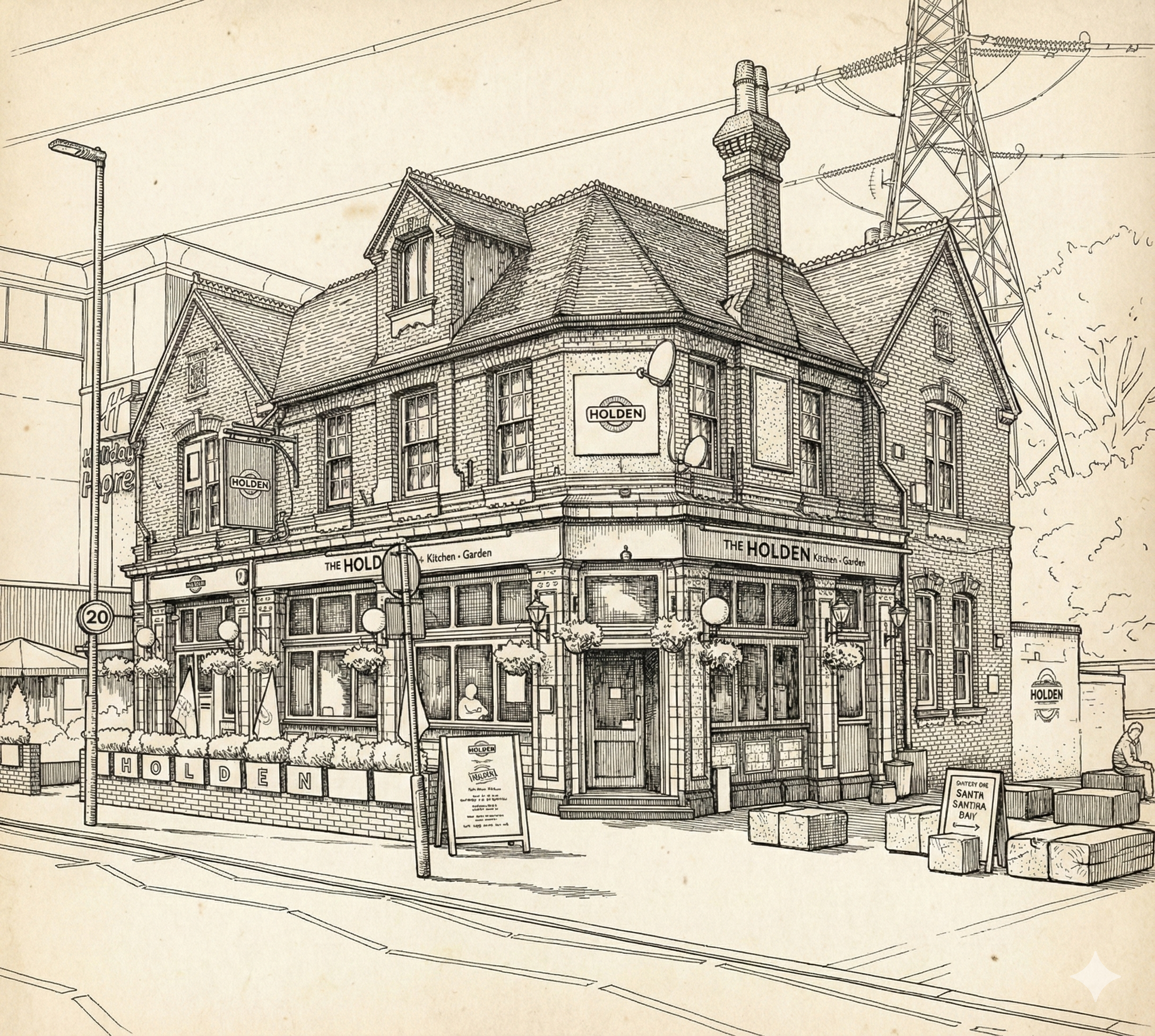
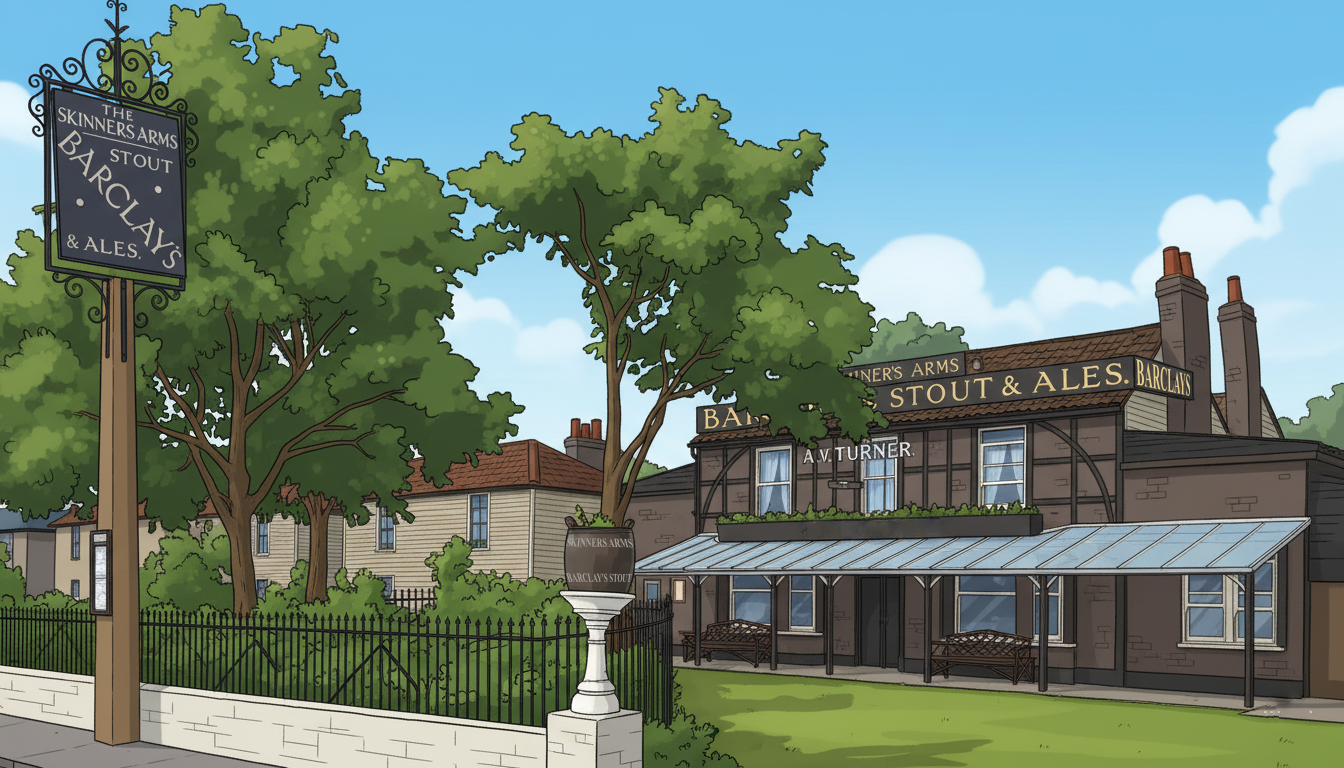
1930s photo rendered as a cartoon to show detail

It was demolished and a block of flats built in its place, called Victoria Court. See planning application C2004/53307 on the Sutton council website.

Click a link below:

Possible origin of pub name
1835
1839
Mrs Vince
1925
Mr Albert Vernon Turner
Continental-style Beer Garden
Generosity
Menagerie
Licensees

Possible origin of pub name

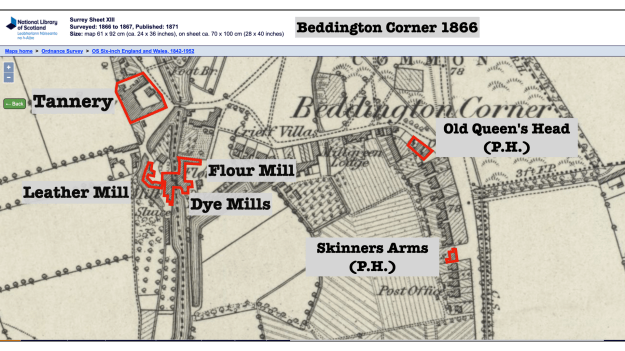
The name likely comes from the leather trade, where a skinner was the person who sourced the skins of the animal, (also called a hide,) and cured them ready for tanning. This 1866 map shows the location of the Skinners Arms and the leather mill, tannery, flour mill and dye mill on the nearby river Wandle.

1866 OS map reproduced by permission of the National Library of Scotland, reuse CC-BY (NLS)

1835

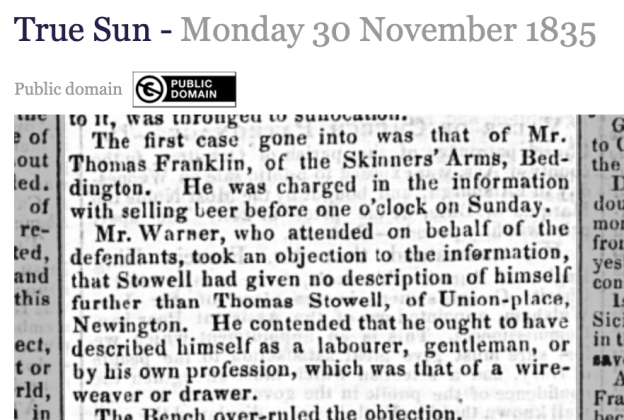
The earliest newspaper article is from 1835, which refers to Thomas Franklin having been charged with serving beer before 1pm on Sundays.

1839

Andrew McRae, beer retailer of the Skinners’ Arms, and a leather dresser, was listed as a bankrupt in 1839, as shown in this extract from theLondon Gazette, Publication date:5 November 1839 Issue:19786 Page:2106

Andrew McRae, formerly of the Skinners’ Arms, Beddington-corner, near Carshallton, Retailer of Beer, and Leather-Dresser, and late of Grange-walk, next of Swan-mead, both, in Bermondsey., afterwards of Beddington-corner aforesaid, next of Wanersh, near Guildford, next of Page’s-walk, and late-of Wright’s-buildings, Grande-road, Bermondsey, all in Surrey, Leather-Dresser.

Mrs Vince

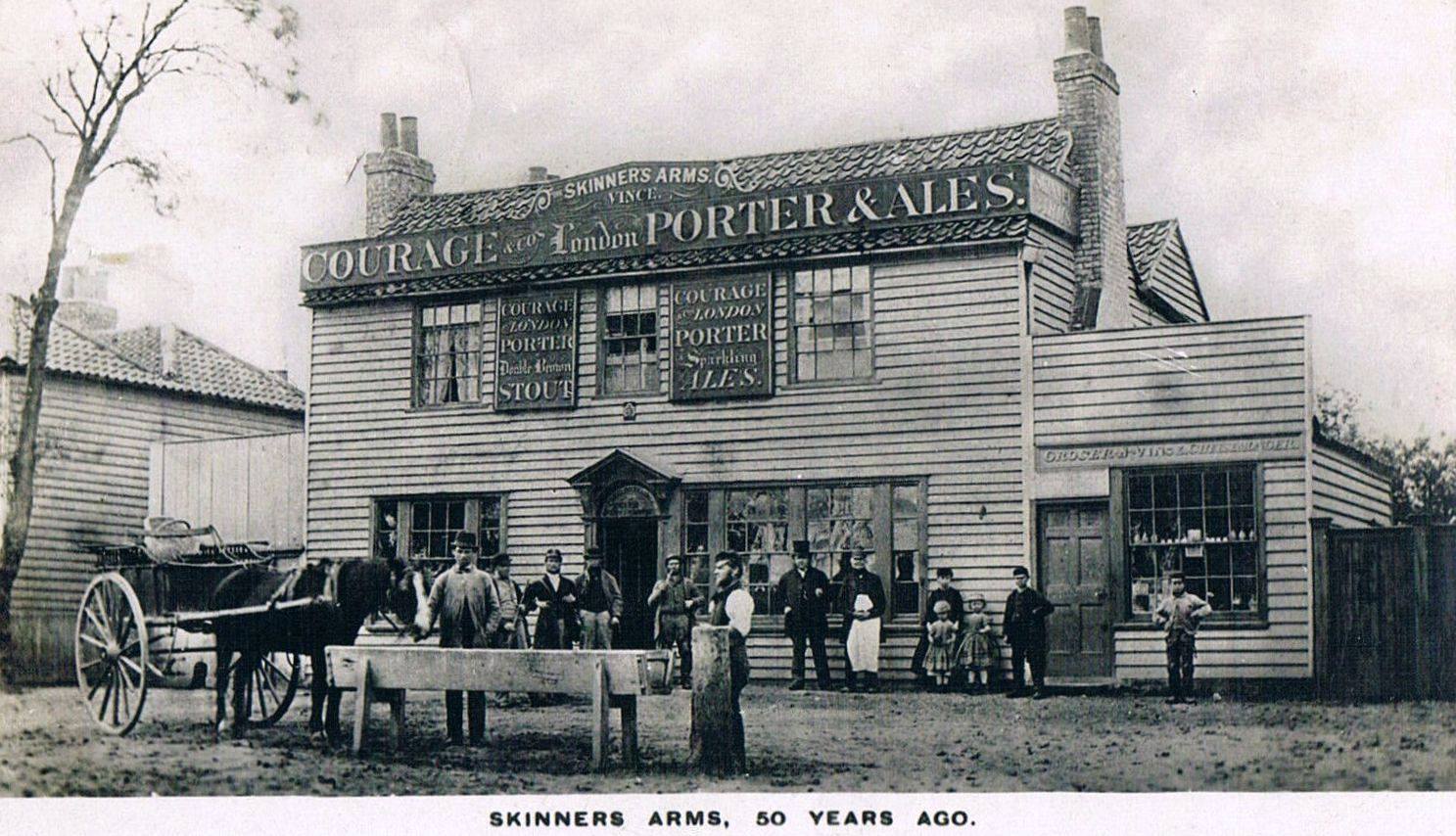
Photo from 1928 claiming to be 50 years previous to that, hence possibly 1878.

Sydenham Times – Tuesday 12 January 1869

William Storks, a boy, was charged with stealing a live thrush from a cage, from the Skinners’ Arms, Beddington Corner, the property of Charlotte Vince, on the ?th inst.

Elisabeth Vince, daughter of prosecutrix, who is landlady of the Skinners’ Arms, Beddington Corner, said yesterday a thrush was in a cage belonging to her mother in the taproom. Hearing the bird flutter, she went into the room, and there saw the boy on the form near the bird. On going into the taproom again, she fouud that the bird was gone. The lad had left the house, and was brought back. A constable was fetched, who searched the prisoner, and found the bird upon him. He was given into custody.

The boy, in answer to the Chairman, said he was 12 years of age. He had no work. His brother worked for Mr. Horton, cowkeeper, of Brockley-lane, Forest-hill, and kept him when he had no employment. He had been engaged by Mr. Timpson, dust contractor, of Sydenham, for two years, but left on Saturday last, as he had no work for him to do. If he was discharged and could not get work, he intended to go back to his brother, who would keep him.

Mrs. Vince expressed her willingness to withdraw the charge.

The Chairman said that as such was tho case, the prisoner would be discharged, who must thank Mrs. Vince for her leniency, because if it had not been for her, he probably would have been sent to reformatory for four years.

This article from 1869 refers to Mrs Vince as the landlady, and in the 1871 census she is listed as a 55-year old widow, and beer house keeper. The name VINCE is seen in the 1878 photo above. Her daughter, also called Charlotte, was 23 years old.

The 1892 Licensed Victuallers Report shows that the pub was owned by the licensee, Charlotte Vince.

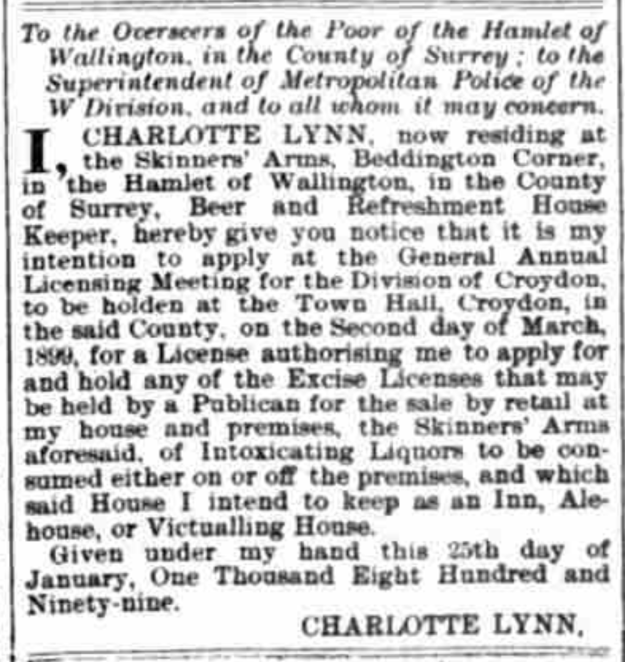
Croydon Advertiser and East Surrey Reporter – Saturday 04 February 1899

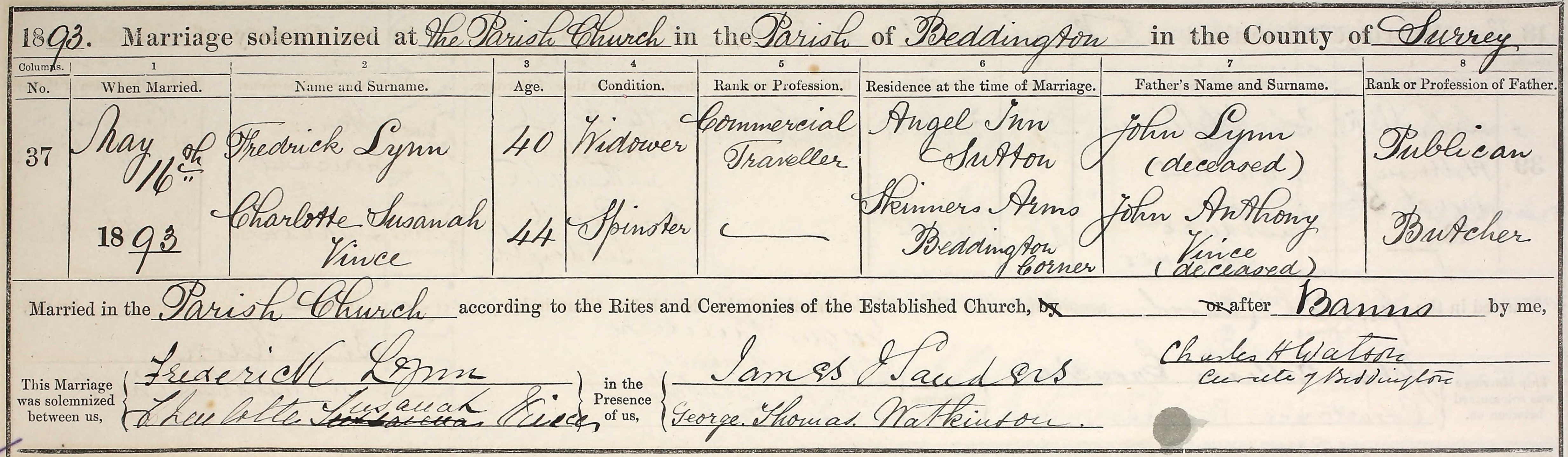
Mrs Vince died aged 67 in 1883 and her 44-year old spinster daughter Charlotte Susannah Vince married Frederick Lynn, of the Angel Inn, in 1893.

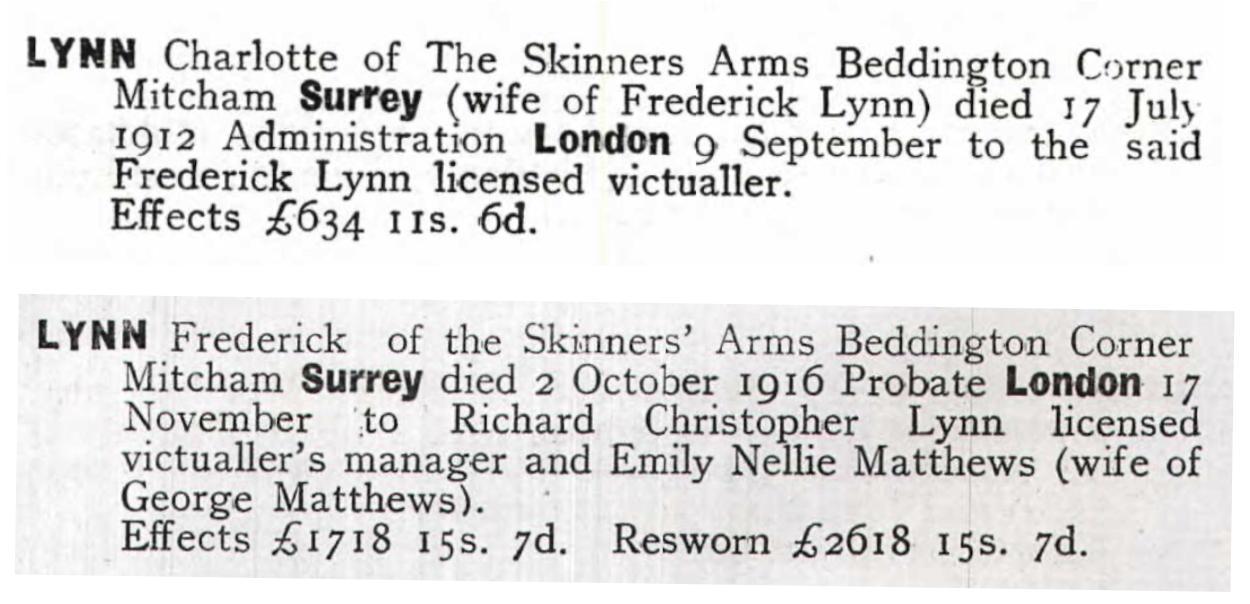
Mrs Charlotte Lynn died in 1912, and left £634 11s. to Frederick Lynn, licensed victualler.

Frederick Lynn died 1916, and left £2618 15s. 7d. to his son Richard Christopher Lynn and Emily Nellie Matthews.

1925

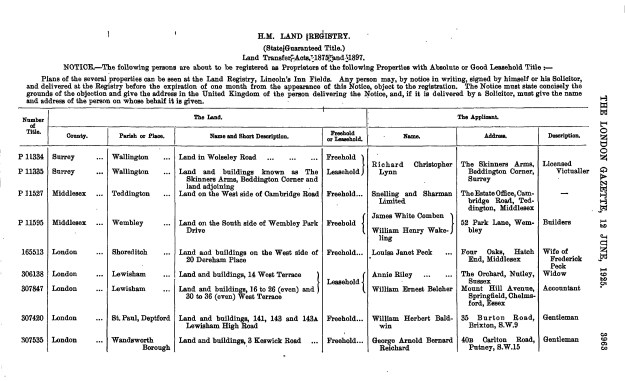
In 1925, Richard Lynn registered the land of the pub at the land Registry.

The London Gazette
Publication date:12 June 1925Issue:33056Page:3963

Mr. Albert Vernon Turner

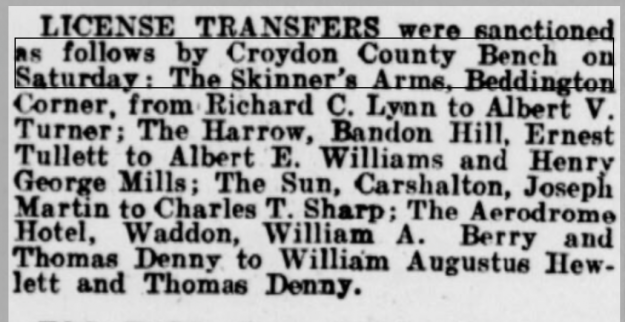
At the Croydon County Bench on Saturday 31st October 1925, the license for the Skinner’s Arms, Beddington Corner, was transferred from Richard C. Lynn to Albert V. Turner, according to the Mitcham Advertiser – Thursday 5th November 1925.

Image © Successor rightsholder unknown

18th September 1926.

Licensee’s donation to the vicar.

A comment in the All Saints Church magazine concerning a local public house has brought the vicar designate, the Reverend James Bevan, a cheque from the landlord, Mr. A.V. Turner, for half a guinea, accompanied by the following letter.

“Dear Sir, I thank you very much for the advertisement that you have given the Skinner’s Arms in your September magazine.
I have much pleasure in enclosing a donation of half a guinea to be given to a local charity.
Yours faithfully, A.V. Turner.”

The article referred to is as follows:

I have been given to understand that a local tavern has set out to make a ‘brighter’ Corner. I have knocked about somewhat in rough and smooth quarters but I have never struck the boozer yet that is capable of brightening any place. I have seen their effects in squalid surroundings, ruined lives, mentally and physically. If the young followers of this place imagine for a moment that a pub makes for brighter living they are making the mistake of their lives. May I throw out a bit of advice? The only safe side of a public house is the outside. At the same time the new landlord of the Skinner’s Arms has thrown out a challenge to all churchmen and churchwomen. Are you going to take it up or will the parson have to take it up alone? No churchman can hide behind the excuse, it’s not my job. It is my job and your job to make an earnest attempt to stop young fellows from making a rotten start in life.

Continental-style Beer Garden

From the Croydon Times – Saturday 23 July 1932

BEER GARDENS FOR ENGLAND
Successful Experiment at The Skinner’s Arms

This country is still a long way behind most of the Continental countries with their cafes and beer gardens. To the accompaniment of music, and amidst attractive surroundings, a man can take his family to any German or Austrian beer garden. There is no sense of shame and, also, be it noted, there is no excessive drinking.

It is therefore interesting to find that this form of recreation being introduced into our country, and Mr A.V. Turner, of the Skinners Arms, Mitcham Junction, is to be congratulated on his enterprise in opening his beer and tea garden.

The gardens, beautifully laid out with lawns and flowers and lit at night by coloured electric lights, provide a most pleasing venue for a friendly gathering, and there is plenty of shelter should the weather be wet. Luncheons and teas are served all day during the summer.

Judging by the success which is attending Mr Turner’s experiment these replicas of the famed Continental beer gardens should become most popular over here.

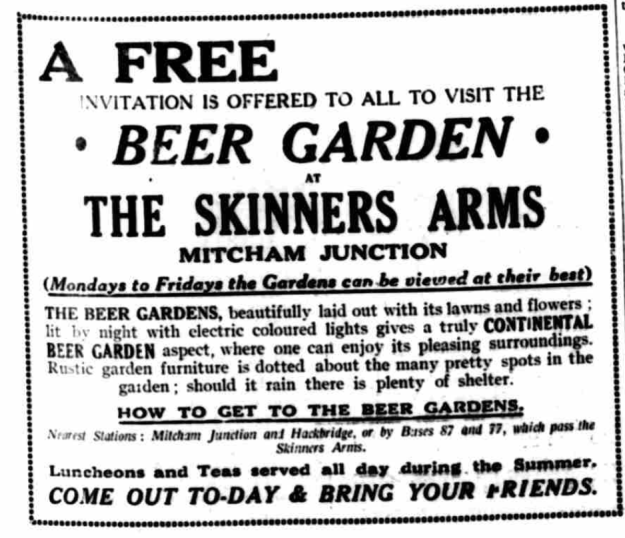
The earliest ad for the beer garden found on the newspaper archives online was from 25th June 1932 in the Croydon Times.

25th June 1932 Croydon Times – rights holder unknown

A FREE INVITATION IS OFFERED TO ALL TO VISIT THE BEER GARDEN AT THE SKINNERS ARMS
(A. V. TURNER, Proprietor)
MITCHAM JUNCTION

(Mondays to Fridays the Gardens can be viewed at their best)

THE BEER GARDENS, beautifully laid out with its lawns and flowers; lit by night with electric coloured lights gives a truly CONTINENTAL
BEER GARDEN aspect, where one can enjoy its pleasing surroundings. Rustic garden furniture is dotted about the many pretty spots in the
garden should it rain there is plenty of shelter.

HOW TO GET TO THE BEER GARDENS.
Nearest Stations: Mitcham Junction and Hackbridge, or by Buses 87 and 77, which pass the Skinners Arms.
Luncheons and Teas served all day during the Summer.

COME OUT TO-DAY & BRING YOUR FRIENDS.

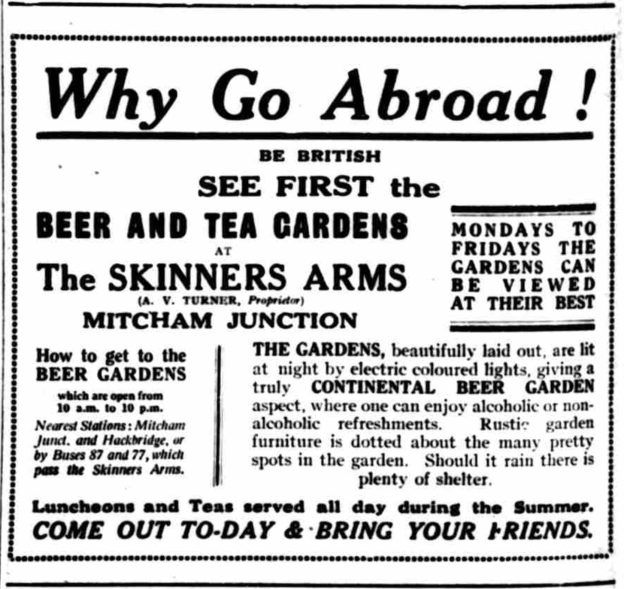
Why go abroad! ad for the beer and tea gardens.

Croydon Times – Wednesday 27 July 1932

Why Go Abroad!

Subheading:

BE BRITISH
SEE FIRST at the

Main Body:

BEER AND TEA GARDENS
AT
The SKINNERS ARMS
(A. V. TURNER, Proprietor)
MITCHAM JUNCTION
MONDAYS TO FRIDAYS THE GARDENS CAN BE VIEWED AT THEIR BEST
How to get to the BEER GARDENS
which are open from 10 a.m. to 10 p.m.
Nearest Stations: Mitcham Junct. and Hackbridge, or by Buses 87 and 77, which pass the Skinners Arms.
THE GARDENS, beautifully laid out, are lit at night by electric coloured lights, giving a truly CONTINENTAL BEER GARDEN aspect, where one can enjoy alcoholic or non-alcoholic refreshments. Rustic garden furniture is dotted about the many pretty spots in the garden. Should it rain there is plenty of shelter.

Closing:

Luncheons and Teas served all day during the Summer.
COME OUT TO-DAY & BRING YOUR FRIENDS.

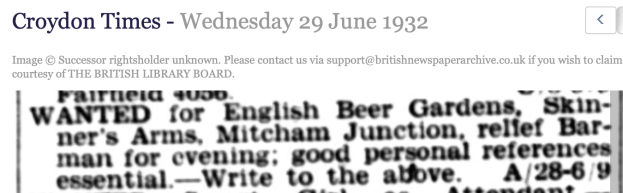
Job ad:

Croydon Times – Wednesday 29 June 1932

Generosity

Mr A.V. Turner made contributions to local hospitals, such as the Carshalton memorial Hospital and the Croydon General. In 1933, the Skinner’s Arms raised £14 4s. 3d., the most among local pubs, for the Explosion Relief Fund.

1939

Menagerie

From the Croydon Times – Wednesday 19 July 1939 via British Newspaper Archive
LION CUB JOINS LICENSEE’S MENAGERIE

BEAR AND MONKEYS ARE OTHER PETS

HUNDREDS OF BIRDS

If you were asked “Where is the nearest zoo?”, you would probably attempt to assess the comparative distances to Regents and Chessington. Yet there is a menagerie nearer than either North London or West Surrey.

This colony of animals has been developed by Mr A.V. Turner, licensee of the Skinners Arms, London Road, Beddington Corner. There are monkeys, foxes, a bear and hundreds of birds ranging from red eared bull-bulls to orange truples.

And now Mr Turner has added a lion cub to his collection. This native of Abyssinia has not yet been accorded the respect from the other menagerie inhabitants he is entitled to expect as King of the Animals, (or should one, in view of his age and size, term him Prince of Animals?) Mary, the black Himalayan bear who was formerly owned by an Addiscombe man, has shown particular resentment and hostility to the newcomer.

HUNDREDS OF VISITORS

The menagerie is situated in the grounds at the rear of the hotel and hundreds of visitors are attracted there every evening. Mr Turner’s interest in animals and birds was enhanced by a stay of several years in East Africa and this private zoo has been his very unusual hobby. Inspection of the animals is entirely free and is not conditioned by patronage of the hotel.

The grounds are very extensive for an inn with lawns and well laid out beds of geraniums and other flowers. All round the garden are cages for animals and birds.

There are iron seats painted green to accommodate no fewer than 350 people and in addition to a sweet shop in the grounds, nuts and raisins can be obtained for offering to the menagerie inhabitants from slot machines.

The menagerie is a model of cleanliness and tidiness and it is Mr Turner’s ambition to continue enlarging it and making it still more representative.

WON IN COMPETITION

The lion cub was originally won in a ticket competition at a fete in aid of Surbiton Hospital. It was given for the purpose by Mr R. S. Goddard, proprietor of Chessington Zoo where it was born.

When Mr and Mrs Turner showed me round the menagerie, writes our representative, I was somewhat apprehensively admiring the obvious strength and sharpness of the cub’s teeth when I heard an urgent voice calling, “Father” and “Mother” behind me. My first impression was that it was a lost and wandering child. I was wrong, for Mr Turner indicated “Mac,” a large macaw, when at the venerable age of 90 performs a sprightly dance to a humming accompaniment by Mr Turner.

MONKEYS HELP THEMSELVES

“Mac” is a handsome bird of green and gold with a tail 18 inches long and a surprisingly wide wingspan. It is believed to be the finest specimen of its kind in the country, while its manners are impeccable. On being awarded titbits for singing any old rags, bottle or boxes, or bones, it never fails to express its thanks by the brief but appreciative ”Ta.”

The monkeys include sooty mangabeys who are as tame as they are intelligent. Children derive great enjoyment from inserting pennies in the slot machines and watching the greedy but grateful mangabeys extract packets of nuts. There is an entertaining Java monkey and two foxes, one of which is only six weeks old. The other was presented to Mr Turner by Dr Elizabeth Sloane Chesser of Carshalton. It is as tame and as docile as a dog.

“Mac,” by the way, has rivals in garrulity in a sulphur-crested white cockatoo who, on being given more time in response to his appeal, cocky once a drink promptly breaks out into an Irish jig. He is encouraged by “Joe,” a jackdaw, whose pet phrase is, “Go on, Go on.”

SOME OF THE BIRDS

The remarkable collection of British and foreign birds are a delight to the eye. There are hundreds of them, of all colours and kinds, including a very representative gathering of finches. Here are a few of the lesser known birds. Peking robins, colonial budgerigars, weaving finches, Pope cardinals, Java sparrows, red crested cardinals, red-eared bullwalls, black and scarlet tanagers, orange truples, red virginians, cardinals, buttercup budgerigars. The birds range in size from smaller than the wren to as large as the vulture.

Mr and Mrs Turner (she shares her husband’s interest in this absorbing hobby) ask us to make it clear to intending visitors that dogs cannot be allowed in the grounds.

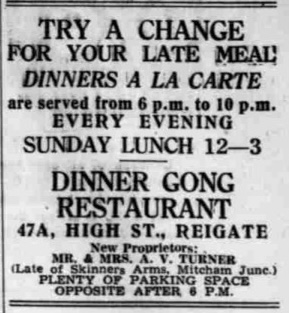
In 1947, Mr A.V. Turner left the Skinner’s Arms and opened a restaurant in Reigate. This ad from 1950 shows the proprietors as Mr and Mrs A.V. Turner (Late of the Skinners’ Arms, Mitcham).

Surrey Mirror – Friday 04 August 1950

Mr. A.V. Turner died in 1954.

Croydon Times – Friday 12 March 1954

MR. ALBERT TURNER OF “THE VICTORY”

FORMERLY a prominent member of Croydon and District Licensed Victuallers’ Protection Society, Mr Albert Vernon Turner, of the “Victory” public house, Gillett-road, Thornton Heath, died in Mayday Hospital on Friday following a brief illness. He was 65 years of age. Mr. Turner was for 21 years licensee of the “Skinner’s Arms” at Mitcham Junction, where he ran a small zoo for many years. He left the licensed trade in February, 1947, to open a restaurant at Reigate, but returned to Croydon and took the licence of the “Victory” 14 months ago. For five years In the early 1930s he was chairman of the Croydon L.V. Society. He leaves a widow and two grown-up children. Mrs. Turner. who is now secretary of the Officers Club, at Woodcote-road, Wallington, was formerly well known in this district as a teacher of dancing. The funeral took place on Wednesday at South London Crematorium.

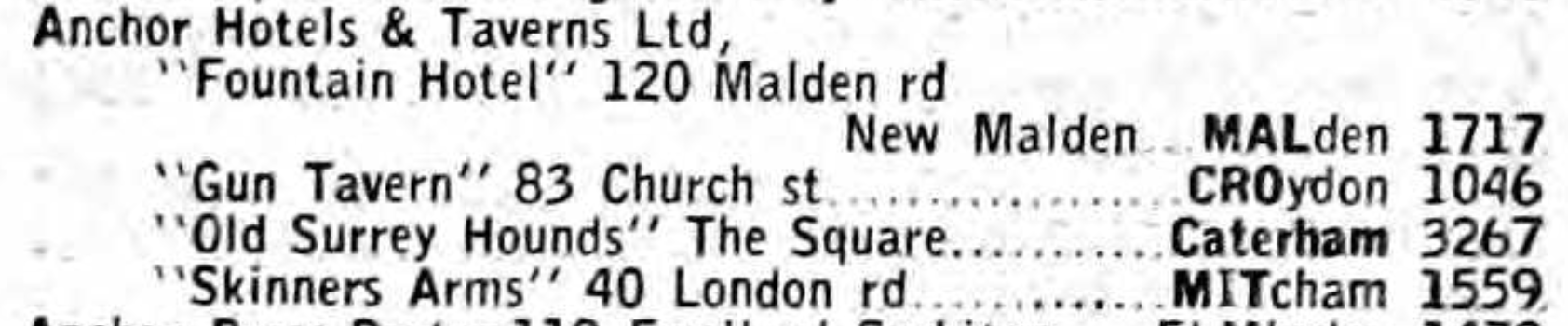
The 1961 phone book entry shows that it was part of the Anchor Hotel & Taverns group, which was part of the brewer Courage.

1961 phone book

Licensees

Information is from the Google Map Pubs of Sutton and surrounding areas, directories and electoral registers from Ancestry.

1835 – Thomas Franklin
1869 – Charlotte Vince
1892 – Charlotte Vince
1897 – Charlotte Lynn
1899 – Frederick Lynn
1911 – Frederick Lynn
1918 – Frederick Lynn
1925 – Richard C. Lynn
1926 – 1947 Albert Vernon Turner

From comments on Facebook

1964 John & Olive Burke took over from Mrs Best
1967 John & Olive Burke moved to the Woolpack in Banstead
1978 to 1990 Roger & Moira Davenport

George Parker Bidder QC obituary

The following obituary is from the
Wallington & Carshalton Herald – Saturday 08 February 1896, via the British Newspaper archive.

Listen here: .

Death of Mr. G.P. Bidder, Q.C.

Public references.

The inhabitants of Mission were profoundly moved on Saturday morning when they learnt
that perhaps the most distinguished inhabitant of the famous village, Mr. George Parker Bidder, Q.C. of Ravensbury Park, had passed away suddenly during the night at his town residence, Queen Anne’s Mansions. The primary cause of death was the formation of a clot of blood at the heart supposed to have been occasioned by some internal injury resulting from an accident in the streets of Manchester. He had been conducting an important arbitration case at the Assize Court in that city on the 9th of last month, and was going back to his hotel when he was knocked down and run over by a horse and van. The injuries received were not regarded as of such a character as to prevent his resuming the case on the following day, but at the close of the proceedings he was so exhausted as to necessitate his immediate return to London. On the 17th January he made his last public appearance in Mitcham at the inquiry with reference to the entrance to the proposed Lower Mitcham schools. He travelled to Mitcham
specially for that purpose, although he was then wearing surgical bandages.
After a few days rest he again resumed his professional work when he conducted the case
on behalf of the trustees of the Tower Hill schools in their claim against the London
and Blackwell Railway Company. These proceedings terminated on Saturday the 25th ult. and almost
immediately afterwards the effects of the injuries of the accident began to manifest
themselves more seriously. By order of his medical advisor he was compelled to go to
bed at the beginning of last week, and though to all appearances he was progressing rapidly
towards recovery, and the physician in attendance had given him permission to dictate instructions earlier this week concerning an important case, a sudden relapse occurred in the early hours of Saturday morning, and before his medical advisor could be summoned the eminent counsel had passed away. His death was very pathetic, but quite peaceful. His devoted wife was reading to him as he felt somewhat restless during the night when Mr Bidder suddenly complained of a pain which he thought must be due to indigestion. Mrs Bidder hastily summoned the nurse and turned to give him a little stimulant when to her consternation she found that her husband had turned quite pale. A doctor was in the mansions and he was called and arrived in two or three minutes only to tell the watchers that he was dying. Mr Bidder, apparently hearing that, put out his arm and embracing his wife he died with his head on the shoulder of her who had so ably seconded the efforts of her honoured husband. On the news being telegraphed at Ravensbury Park it soon became known in the village the bell at the parish church was tolled and many of the tradesmen at once put shutters to their shop windows, and such marks of respect have been pretty general
until after the funeral. Much sympathy has been expressed throughout the week with Mrs
Bidder and the family. Miss Bidder, Mrs Devenish, Miss Minnie Bidder, Miss Ina Bidder, now in
Calcutta, Messrs George, Harold and Morris Bidder. The concert which was to have been
held at the Vestry Hall on Wednesday in aid of the new church has been postponed out of
respect for the deceased.

Mr George Parker Bidder was the eldest son of the celebrated engineer who bore the same name and who was known in the early part of the century as the calculating boy. The future lawyer was born in August 1836 and educated at King’s College School and at the Universities of Edinburgh and Cambridge and his close and persistent study at the latter university secured for him marked academical distinction, he being 7th Wrangler in the mathematical tripos in 1838. Called to the bar in 1860 his thorough grasp of questions requiring special knowledge and skill soon placed him in the front rank of his profession and before parliamentary committee he was frequently engaged as council.
He took silk in 1874 and shortly afterwards became a bencher of his inn, Lincoln’s Inn.
He was recently elected master of the library and was next in rotation for the offices of
Treasurer in 1897. For several years he had been one of the leading council at the parliamentary bar and his name had been prominent in all the struggles between the water companies and the London City County Council. In nearly all the important opposed bills he acted either on behalf of the promoters or for some of the opponents and in particular represented the interests of the Midland Railway, the London Brighton and South Coast Railway Company, the Mersey Docks and Harbour Board, the Butte Docks Company, the North British Railway Company and a large number of water companies. The extraordinary calculating powers of the father were inherited in a large degree by the son who, it is said, could mentally multiply fifteen figures by fifteen figures and perform with apparent ease many similar feats. He has also been very successful as a cryptographer and published some years ago in one of the monthly magazines what is perhaps the only attempt at scientific method of analysis of ciphers. Mr Bidder was chairman of the Danish Gas Company, the Cannock Chase Colliery Company and the Sydney Harbour Colleries Company as well as being a director of the Rock Life Assurance Company and the West Lancashire Railway Company. In 1878 the deceased permanently took up his residence at Ravensbury Park of which he was the owner, yet having been acquired by his father the late Mr GP Bidder, CE. Mr Bidder’s residence in Mitcham was distinguished by an active and zealous interest in local affairs and the service he has rendered to the locality has been of almost incalculable advantage. Many years ago when the Brighton Railway Company promoted a bill in parliament for the purposes of obtaining powers to enable it to take a considerable part of Mitcham Common, Mr Bidder gave his services as counsel to the inhabitants
gratuitously to resist the application and worked so well for the cause that he had taken
up that the application was refused. After that, in conjunction with other gentlemen,
he spent a large sum of money in defending the rights of the Commoners against the attempted enclosure of common land at Bennington Corner in the well-known action of Bidder and Bridges, but in that case unsuccessfully. He was also prominent in other agitations connected with the Common and when the scheme for placing it under a Conservancy Board was propounded, was one of its strongest supporters. After public inquiry and in the face of much interested opposition, the Board of Agriculture approved of the formation of a Conservancy Board and Mr Bidder was unanimously elected the first chairman, a position he was peculiarly qualified to fill. With characteristic energy and zest he entered into a scheme for improving the Common and though his efforts have not always met with the appreciation they deserved at the hands of the people of Mitcham, no one who can remember what the Common was a dozen years ago and compare it
with its present state will deny that the work of the conservators has been attended with good
results. He, in conjunction with Mr A. H. Smee MRCS and others, successfully resisted attempts
to get the sanction of Parliament to schemes for extracting water from the Wandle by means
of waterworks and amongst his other appearances, in protection of the interests of the parish, may be mentioned his opposition to the scheme to place a huge cemetery just on the borders of the parish at Rosehill Sutton, which would have involved a constant stream of funerals through the parish and the strenuous opposition he manifested to the proposals of the Carshalton local board to obtain a site for their sewage out for works in Mitcham parish.
We’ve obviously obtained a lease of Mitcham Green in order that it might be preserved and regulated for purposes of recreation and the public advantage which has accrued can only be estimated by those who live in Mitcham. It has enabled cricketers of all classes to enjoy the national pastimes without less or hindrance. The policy which was pursued there was extended so soon as the larger area of the Commons could be dealt with. For many years Mr Bidder filled the office of church warden at the parish church of Mitchell and it was during this period that the beautiful east window, said to be the most beautiful in the country, towards the cost of which he distributed largely, was put up. Mr Bidder was also a trustee of Tate’s Alm Houses and at one time represented the parish upon the late Croydon Rural Sanitary Authority. He was a Master of Arts, fellow of the Royal Astronomical Society and an associate member of the Institute of Civil Engineers and an associate of the Institute of Surveyors. Mr Bidder has for many years held the commission of peace for the county and on the formation of the county council at once offered his services to his neighbours to represent them on that body. One paragraph in his address in 1888 is worth quoting now. He said one matter of local interest would at the proper time have my special attention vis the securing to our district more adequate representation having regard to its population and importance. You are perhaps aware at the recent meeting of the magistrates that quarter sessions I did my best to obtain the rectification of what appears to me to be the injustice which at present we suffer under from having only one representative allotted to us. I should strive before the next election to obtain a reappointment of representatives which would place us on a more equal footing with other parts of the county. Mr Bidder was elected by a majority of 150 over another old resident now for some years dead and that he did not forget his promise in that the records of the council will testify. Indeed this question of the unjust representation of suburban Surrey on the council was one of the points upon which he felt very strongly and more than once he referred to it and sought but in vain to persuade his colleagues to consent to a rearrangement. When the question of the future meeting place of the council came to be discussed he was perhaps the strongest advocate of the council chamber remaining in London. Holding as experience has since proved that there will be more difficulty in getting all the members to attend committee and council meetings if they were held in the country than there would be if held close to the terminal of the great railway companies and so easily getatable from all parts of the county. At the second election of the council in 1892 Mr Bidder was opposed by Mr George Parker, a socialist. The inhabitants showed their
appreciation of the difference between the merits of the two men by giving Mr Parker three votes and returning their old member with a majority of over 600. At the last election in 1895 Mr Bidder was returned unopposed. On the formation of the parish councils the deceased manifested much interest in the movement and besides attending public meetings where the matter was discussed became a candidate for a seat on the first council and being elected was asked by his colleagues to accept the position of chairman which he did and by his legal knowledge helped him to help to steer them safely and quickly through the difficulties inseparable from the establishment of a new body such as that. Prior to 1892 Mr Bidder had been regarded as a strong liberal but like many other good men he could not accept the home rule programme and at the time and at the general election of 1892 with other liberal unions in the division issued a circular calling upon his neighbours to support the conservative candidate Mr Bonsor and so to defeat the schemes of those who were anxious to bring about the separation of Great Britain and Ireland.