Tag Archives: 1913

Queens Road

One of the roads of ‘Rocky’. It ran from Phipps Bridge Road eastwards to Belgrave Road.

The Explosion of 1933 led to rehousing of a number of families from this area, to other parts of Mitcham. Although the houses in Queens Road were not badly damaged, it was identified as a Clearance Area in 1936.
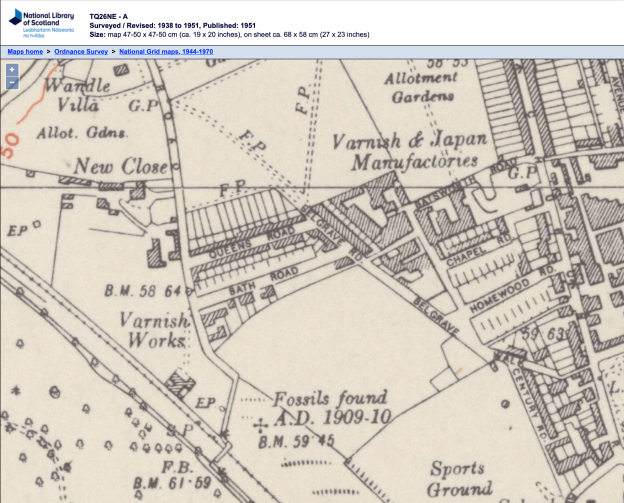
1938 OS map, courtesy of the National Library of Scotland. Re-use CC-BY.

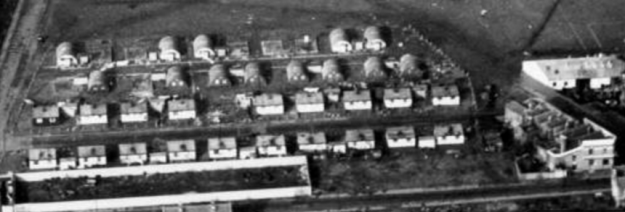
After the second world war, ‘hutments’ and prefab bungalows were built for temporary housing. These were cleared in the early 1960s for the Phipps Bridge Housing estate, and the name Queens Road was kept.
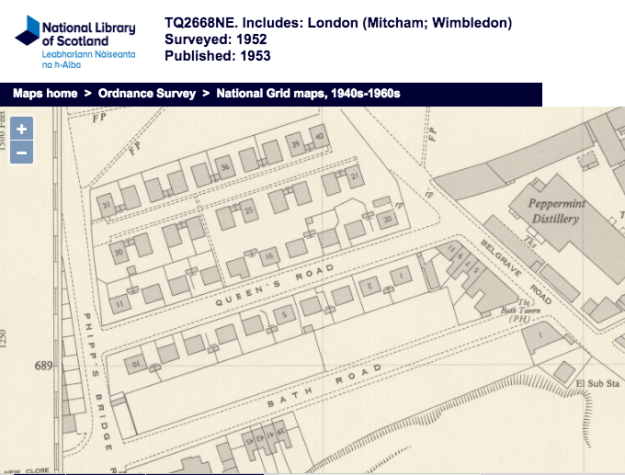
1952 OS map
1952 OS map

1954 aerial view of Queens Road and its temporary housing - this clip is from Merton Memories photo 49269 and is copyright London Borough of Merton.

1954 aerial view of Queens Road and its temporary housing – this clip is from Merton Memories photo 49269 and is copyright London Borough of Merton.
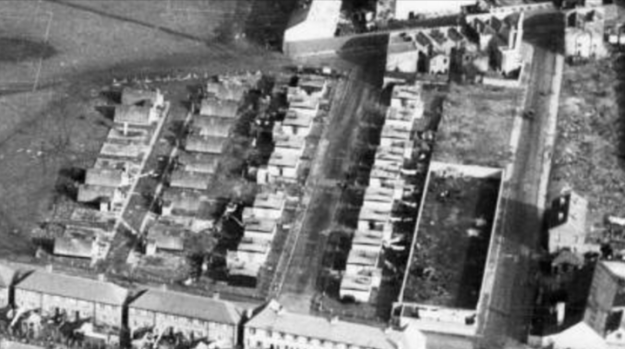
1954 aerial view of Queens Road and its temporary housing, looking east. This is a clip from Merton Memories photo 49278, and is copyright London Borough of Merton.

1954 aerial view of Queens Road and its temporary housing, looking east. This is a clip from Merton Memories photo 49278, and is copyright London Borough of Merton.


This receipt for coal in 1950 was for number 35 Queens Road which was at that time a Nissen Hut. It was for 10 hundredweights (half a ton) of HHA, which possibly meant Heavy Haulage Anthracite. The total cost was £2 7s. 8d., which in 2020 values is around £85.
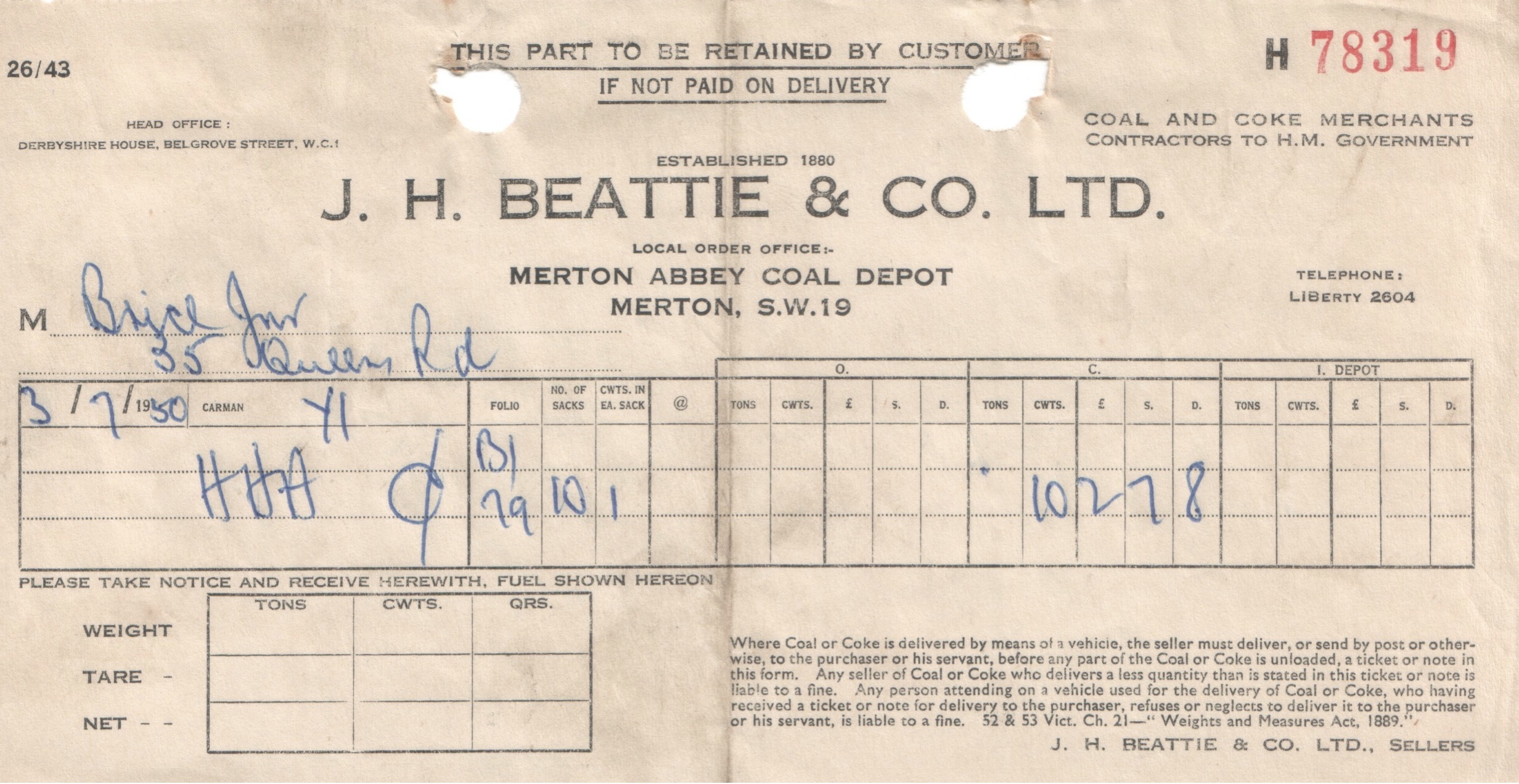
3rd July 1950 coal receipt


World War 1 Connections
Lance Corporal Arthur James Block

Private Edgar Block

Rifleman W Glover

Private J James

Driver E Marney

Driver J Newson

Private Hubert George Truelove

Sapper William Walklett

From the Surrey Recruitment Registers:

W BOTTWELL of 22 Queens Road, aged 18 Years 1 Months, Carman. Joined on 11 May 1917 to the Royal Field Artillery.

S T S DALE of 38 Queens Road, aged 19 Years, Fitter. Conscripted on 17 April 1917 to the East Kent Regiment (3rd Batn).

W DAVIS of 7 Queens Road, aged 24 Years 7 Months, Carman. Volunteered with the Derby Scheme on 12 December 1915 to the Royal Fusiliers (35th Batn).

L DIXIE of 1 Queens Road, aged 19 Years, Labourer. Volunteered on 01 November 1915 to the Royal Fusiliers.

B FENNELEY of 8a Albany Terrace Queens Road, aged 37 Years 7 Months, Jeweller. Volunteered with the Derby Scheme on 11 December 1915 to the Artillery School (5th).

M GLOVER of 11 Queens Road, aged 29 Years 5 Months, Painter. Volunteered on 25 October 1915 to the Army Ordinance Corps.

W G HERRINGTON of 19 Queens Road, aged 22 Years 6 Months, Stoker. Volunteered with the Derby Scheme on 07 December 1915 to the Royal Fusiliers (15th Batn).

W F HOOKINS of 47 Queens Road, aged 33 Years 3 Months, Grave Digger. Conscripted on 11 December 1915 to the Middlesex Regiment (6th Batn).

J P HORNEGOLD of 27 Queens Rd Mitcham, aged 20 Years, Ticket Collector. Volunteered with the Derby Scheme on 17 November 1915 to the Royal Fusiliers (16th Batn).

J JAMES of 35 Queens Road, aged 20 Years 1 Months, Hawker. Volunteered with the Derby Scheme on 12 December 1915 to the East Surrey Regiment (3rd Batn).

J JAMES of 17 Queens Road, aged 18 Years, Gardener. Conscripted on 26 March 1917 to the 23rd Training Reserve Batn.

G JARDINE of 10 Queens Road, aged 37 Years 2 Months, Packer. Conscripted on 14 February 1917 to the Royal West Surrey Regiment (labour Coy).

W JARDINE of 10 Queens Road, aged 28 Years 2 Months, Labourer. Volunteered on 13 April 1915 to the Middlesex Regiment (18th Batn).

Ian JORDAN of 40 Queens Road, aged 29 Years 6 Months, Bricklayer. Volunteered on 7 January 1915 to the Royal Horse Artillery.

S MEARS of 49 Queens Road, aged 20 Years 6 Months, Doorkeeper. Volunteered with the Derby Scheme on 19 February 1916 to the Royal West Surrey Regiment (9th Batn).

G MUNT of 43 Queens Road, aged 29 Years 9 Months, Grave Digger. Volunteered with the Derby Scheme on 11 December 1915 to the East Surrey Regiment (3/5th Batn).

J MUNT of 50 Queens Road, aged 32 Years, Grave Digger. Conscripted on 23 October 1916 to the Labour Corps (depot).

W MUNT of 42 Queens Road, aged 28 Years 11 Months, Labourer. Volunteered with the Derby Scheme on 11 December 1915 to the Royal West Surrey Regiment (3/4 Batn).

W NEWSON of 34 Queens Road, aged 23 Years 7 Months, Labourer. Volunteered with the Derby Scheme on 11 December 1915 to the Royal Fusiliers (16th Batn).

M SIMANTS of 14 Queens Road, aged 18 Years, Labourer. Conscripted on 31 March 1917 to the 23rd Training Reserve Batn.

J SMITH of 24 Queens Road Mitcham, aged 31 Years 10 Months, Carman. Conscripted on 12 December 1916 to the 5th Labour Corps (301st Labour Co).

H TRUELOVE of 54 Queens Road, aged 31 Years 7 Months, Labourer. Conscripted on 10 December 1916 to the Royal West Kent Regiment (3rd Batn).

W WALKLETT of 5 Queens Road, aged 32 Years, Rigger. Conscripted on 8 September 1917 to the Royal Engineers.

J A WHITEMAN of 41 Queens Road, aged 20 Years, Labourer. Conscripted on 06 November 1916 to the East Surrey Regiment (4th Batn).

Occupants from electoral registers:

1936 Health Report

CLEARANCE AREA No. 12.

Fifty-four houses known as 1 – 51 and 2 – 56 (inclusive), Queens Road.

Source: Report of the Medical Officer of Health for Mitcham, Wellcome Trust, page 44.


Stories

The road was disconnected from Belgrave Road in 1996, as described in this Section 316 Planning Application, number 96/P0786 :

Closure of the eastern end of Queens Road, 55 metres in length, from its junction with Belgrave Road and use of the highway as open space, alterations to the Cranleigh Court vehicular access off Phipps Bridge Road and provision of new vehicular access to Frensham Court off Phipps Bridge Road.

Croydon Guardian and Surrey County Gazette – Saturday 10 May 1913

YOUNG MEN IN DRINK
– Arthur Block (24), of 17, Queens-road, Mitcham, and Thomas Adaway (21), of 26, Belgrave-road, Mitcham, were charged- at the Croydon County Police Court on Monday before Alderman R. M. Chart (in the chair). Mr. E. and Mr. W. E. Davis, with being drunk and disorderly at London road. Mitcham, Saturday afternoon. They pleaded guilty and it was stated that they threatened to break some shop windows. They were each fined 20s. and costs or 14 days.

From the Wallington & Carshalton Herald – Saturday 1st January 1881
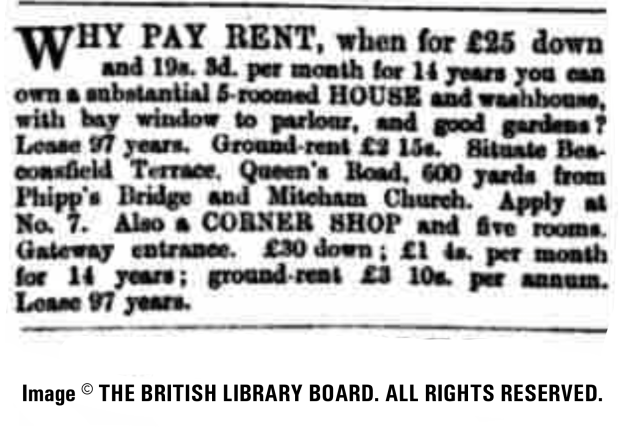
WHY PAY RENT, when for £25 down and 19s. 3d. per month for 14 years you can own a substantial 5-roomed HOUSE and washhouse, with bay window to parlour, and good gardens? Lease 97 years. Ground rent £2 15s. Situate Beaconsfield Terrace, Queen’s Road, 600 yards from Phipps Bridge and Mitcham Church. Apply at No. 7. Also CORNER SHOP and five rooms. Gateway entrance. £30 down; £1 4s. per month for 14 years; ground-rent £3 10s. per annum. Lease 97 years.

Streatham News – Friday 31 May 1918

A MITCHAM RAID FOR DESERTERS.

When the nine men taken in a Mitcham round-up were before the Croydon magistrates on Tuesday, Captain H. O. Carter, of the National Service Department, said he hoped the sanitary condition disclosed during the raid would receive the attention of the local authorities. The houses in Park-road and Queen’s-road, Mitcham, formed a warren which to him suggested a breeding-ground of death. A woman and seven children were living in one room, and all the premises were filthy. – The Chairman asked why some of the women were not brought before them for harbouring the men. Captain Carter replied that it took the police and military all their time to collar the men, as they scattered in all directions.

Streatham News – Friday 14 July 1922

MANNERS IN QUEEN’S ROAD, MITCHAM.

At the Croydon Coanty Bench, on Saturday, a Mitcham neighbours’ squabble was related to the justices, when Ellen Vine, of 33, Queen’s-road, was summoned by Elizabeth Hazell, of New Close Lodge, Phippsbridge-road, for assault, on June 27th.

Complainant stated that as she was going into her house defendant made a sneering remark, and jeered at the fact that witness and her husband had at one time lived apart. Witness took no notice of the insult, where upon defendant struck her and used most vile language. ‘I am innocent,’ was the declaration of defendant, when called upon to give evidence. ‘I have lived in my house for years and never had an angry word. It is all through her.’ (Indicating complainant). “The amenities of Queen’s-road are both special and peculiar,’’ remarked the chairman (Sir Arthur Spurgeon) Both parties were bound over for six months.

Streatham News – Friday 20 January 1928

A RIDDLE.

My first is in rain, but not in hail;
My second is in boat, but not in sail;
My third is in sweet, and not in sour ;
My fourth is in second, but not in hour.
My whole is the name of a favourite flower.
Solution: Rose.

From DAVID NEWSOM, 34 Queen’s-road, Mitcham.

Streatham News – Friday 28 November 1930

A MITCHAM DISPUTE.

Alleged Blows with Cup, Saucer and Plate.

A discussion over a funeral was given as the cause of a quarrel at Mitcham which led to a summons before Croydon County Bench on Wednescday. Frank Willoughby, Queen’s – road, Mitcham, was summoned for assaulting Violet Davis, Seaton-road, Mitcham. Miss – Davis alleged that defendant called at her house -and after calling her names, struck her on the face with a dinner-plate. Her mother supported her allegations, and denied that her daughter assaulted Mr. Willoughby first. Defendant said his father-in-law had asked him to call at the house to dlscuss funeral arrangements. Davis told him when he calied, however, that he had no right to call. During the argument Davis threw a cup and saucer at him, catching him on the arm. He did not touch her. “I have never insulted a woman in my life,” he declared. The matron said she found a bruise on Davis’ face. Both were bound over for six months.

Maps are reproduced with the permission of the National Library of Scotland.

Isolation Hospital

1938 OS map coutesy of National Library of Scotland usage CC-BY

From the 1913 Health Report, published in February 1914:

The Isolation Hospital, which is situated in Beddington Corner, Mitcham Junction, was opened at the beginning of March, 1899, and since that date 4,309 patients been admitted.

Accommodation.

At the time the Hospital was first opened, the population of the district being about 28,000, it was thought that 28 beds will be sufficient accommodation. Shortage of beds, however, became more pronounced in each succeeding year, and in 1905, the Hospital was very considerably enlarged by the addition of a Scarlet Fever pavilion of 22 beds. The hand laundry, and some additional dormitory accommodation is provided in the Administrative Block.

A further enlargement took place in 1910, which included a cubicle block 12 patients, and also quarters for Resident Medical Officer.

Staff

The Staff of the Hospital consists of

TitleNumber

Resident Medical Officer 1
Matron 1
Assistant matron 1
Nurses 13
Laundresses 3
Engineers 2
Servants 7
Wardmaids 6
Seamstress 1
Gardeners 2
Porter/Portress 1 each

Patients

During the year 292 patients have been admitted, of which number

ConditionNumber

Scarlet Fever 185
Diphtheria 94
Typhoid Fever 6
Puerperal Fever 1
Cerebro-spinal Meningitis 2
Erysipelas 4

Nineteen of these patients were admitted by arrangement with other authorities, and 17 were admitted from Merton.

Of the 292 patients admitted, 280 were discharged as cured, and 12 died, viz., 3 from Scarlet Fever, 5 from Diphtheria, 1 from Typhoid Fever, 1 from Erysipela, and 2 from Cerebro-spinal Meningitis (including one from Tuberculous Meningitis).

The case mortality is 4.1 per cent as compared with 4.4 in 1912.

In Scarlet Fever the case mortality is 1.5 per cent as compared with 0.85 in 1912, and in Diphtheria it is 5.3 per cent as compared with 7.9 per cent in 1912.

During the year 1,120 swabs were examined at the Hospital.

The sputum of 17 patients in the Hospital were examined during the year.

Note that the health report was for the Croydon Rural Sanitary Authority and the figures shown are for all parishes, which included

  1. Addington
  2. Beddington
  3. Coulsdon
  4. Mitcham
  5. Morden
  6. Sanderstead
  7. Wallington
  8. Woodmansterne
  9. Merton

1902 Nurse Appointment

From the minutes of the Croydon Rural District Council
Volume 8
1902 to 1903
15th May 1902
page 99

The Council considered applications for the appointment of a nurse at the Isolation Hospital, and had before them Nurse Owen, of Gravesend, Nurse Avery, of Islington, and Nurse Blaker of Portslade.

After interviewing the candidates, it was Resolved, That Nurse E. Blaker, of Portslade, be, and is hereby appointed nurse at the Isolation Hospital with a salary at the rate of £24 per annum, together with uniform, and the usual resident allowances, in accordance with the terms of the advertisement.


Demolished in the late 1980s, more information can be found at the Lost Hospitals website.


Extract from the 1912 Report on Isolation Hospitals, available on Archive.org

Croydon Rural and Merton Joint Hospital District.

Beddington Corner Hospital.

The hospital erected by the Croydon Rural District Council (now transferred to the Croydon Rural and Merton Joint Hospital Board) is situated in an outlying part of the Carshalton Urban District, but close to Beddington Corner in the Croydon Rural District, from which it is approached by a bridge over the River Wandle, which forms the boundary between the two districts. The site was purchased by means of a loan of £4,500 in 1895. The total extent of land purchased was 19 acres, but only 5 acres were at first enclosed for hospital purposes. The original hospital was erected by means of loans amounting to £17,500 in 1897-8 and contained accommodation, on the Board’s standard of space, for 28 beds. It comprised two pavilions (plan C), each with a six-bed and a four-bed ward, also on observation block (on plan B) with four two-bed wards. In addition, there were provided an entrance lodge, administration block, laundry block, with stabling, discharging block, and mortuary and post- morten room. In 1901 a loan of £700 was sanctioned for heating apparatus. The cost per bed of the hospital as thus constructed was high, viz., £650 without site and £810 including site. Subsequent additions, however, although adding to the total cost, have diminished the cost per bed.

In 1904 a further loan of £6,400 was sanctioned for extensions of the hospital, including a pavilion with two 10-bed and two single-bed wards and a day room over the centre, also an enlargement of the laundry block with provision of steam machinery and a destructor furnace.

These additions had the effect of reducing the cost per bed of the enlarged hospital to £492 without site and £582 with site.

In sanctioning the loan, the Board pointed out the need for additional observations wards, the existing observation block being in part reserved for cases of puerperal fever.

In February, 1910, a loan of £4,740 was sanctioned for further additions, including an isolation block of special design containing 12 single-bed wards. This extension again reduced the cost per bed, viz., to £473 without site or £546 with site.

The hospital was visited by me in May, 1911, in company with Dr. Fegen, medical officer of health; Dr. Cave, resident medical officer; and Mr. Chart, architect and surveyor. The object of the visit was especially to see the new isolation block which is on a novel plan designed by Mr. Chart which will be best understood on reference to the accompanying plate. It is of cruciform shape having a large central octagonal duty room and four wings, each of which contains three single-bed wards completely separated from one another by plate-glass partitions as in the Board’s plan D, which indeed it resembles, except in having four wings with three rooms in each, instead of two wings with two rooms in each. The wings point to N.W., S.W., S.E., and N.E. The wards are entered separately from open verandahs. The verandahs of the N.W. and S.W. wings, which are used for females, are continuous with each other, meeting on the W. side at an angle in which is placed the annexe containing the w.c. and slop sink. The verandahs of the S.E. and N.E. wings, which are used for males, are similarly arranged. The area of each ward is 144 square feet, and its height 10 feet, giving 1,440 cubic feet. There is one square foot of window area to each 70 cubic feet of space. The wards are warmed by fireplaces on the floor level, without grates. To each ward there is an external coal-bunker built of reinforced concrete, of hopper shape, opening by a door at the bottom into the ward at floor level close to the fireplace. This arrangement is said to effect a great saving of labour, as there is no need to carry coals into the wards; the bunkers are accessible to carts, and the carter, when delivering coals, has only to empty a sack into each bunker. There is a lavatory basin in each verandah, with two pedal-action taps (which, of course, cannot be used simultaneously by one person), for hot and cold water respectively; these are said to have given some trouble in frosty weather, the pipes being exposed.

The experience of the new block is said to have been quite satisfactory; the nursing has not presented any difficulty, and there have been no cases of cross-infection. It is found convenient to place young children in the rooms nearest to the duty room.

The cost of this block, including drainage (£120), was £2,195, or £183 per bed.

The other blocks follow more usual designs. They are solidly built: the floors are of terrazzo, and the walls lined with glazed brick, or with plaster distempered. Xo complaints were made of the terrazzo as being hard and cold, but it was cracked in places.
The warming, by central stoves, of the pavilion first erected was found insufficient, and a system of heating by warm water was subsequently adopted.

The observation block on plan B. is now little used, the new cubicle block being preferred for observation purposes. At my visit two of the wards had been used as a laboratory, while the other two were reserved for typhoid fever.

In all the pavilion wards at this hospital I found a considerably larger number of beds than the wards were designed to contain in accordance with the Board’s standard of space, though they were not overfull of patients at the time of my visit. These additional beds are placed in the wards in order to enable the Joint Hospital Board to take in patients on payment from the Caterham Urban district, and from the Guards’ barracks at Caterham.

Cruciform isolation block


Minutes of meetings held by the Croydon Rural District Council are available on request from the Merton Heritage and Local Studies Centre at Morden Library.

Maps are reproduced with the permission of the National Library of Scotland.