Tag Archives: 1915

Eveline Road

Road that connects Mortimer Road at its western end to its eastern end to London Road, where Streatham Road and Locks Lane meet.
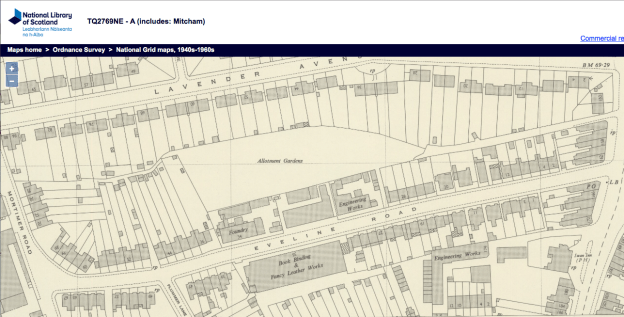
1953 OS map

Originally called Prospect Road according to a footnote in a 1957 article on a human skull being found in a coal shed.
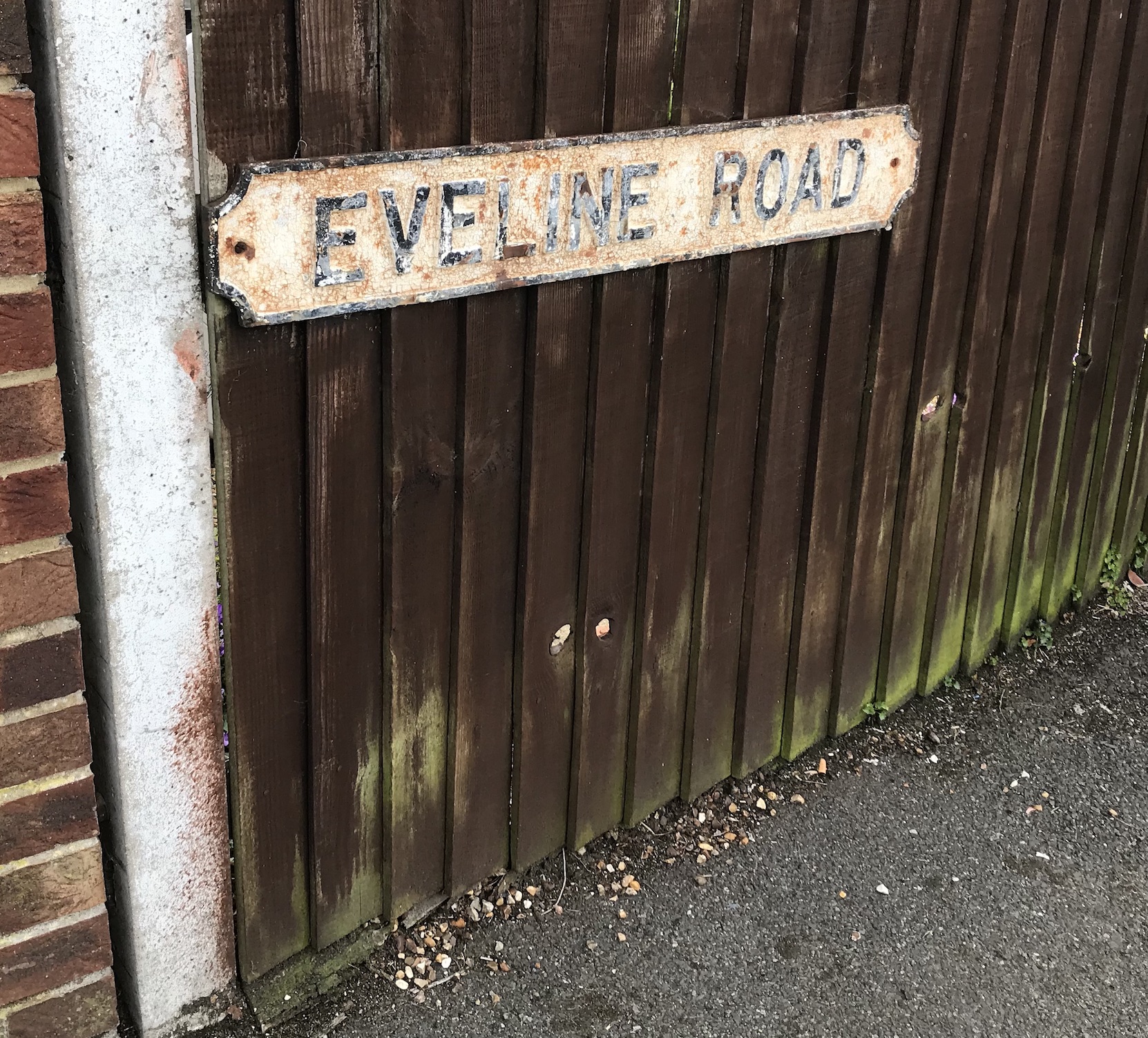
Older sign for Eveline Road, photo taken 3rd July 2020.

The houses are numbered odd on the south side, ascending from the eastern, London Road end, and even on the north side.

There is an allotment between the north side and Lavender Avenue, which is accessible from London Road. It is one of the 18 such allotment sites run by Merton Council.

On the south side, between numbers 47 and 49, is Plummer Lane, which leads to Bond Road.

Industries

W.E. Horsman, Son & Co., Iron Foundry
Light industrial unit at no. 32

Occupants from Street Directories

1910-1911

Eveline road, from 6 Eveline villas, London road.

NORTH SIDE

1, Mrs SIDDERS
2, Mrs McCAIG
6, Henry S. SAMME
8, Rev. Geo. ROBINSON

SOUTH SIDE

3, George HILLS
5, John Ernest EVERETT
9, Charles APLIN

1915

Eveline road, from 6 Eveline villas, London road.

NORTH SIDE

1, Noah BLAKE
2, W. GLOVER
4, George H. EARL
6, Mrs G. DALE
8, Carey KELHAM
10, Mrs BROWN

SOUTH SIDE

3, George HILLS
5, John Ernest EVERETT
7, Mrs SMITH
9, Henry HILLIER

1925

Eveline road, from 5 Eveline villas, London road.

SOUTH SIDE

3, George Horace BROOKMAN
5, Charles Robert William JORDAN
7, Miss ROGERS
9, Thomas HILLIER
11, Samuel H. SAUNDERS; Roland Charles DUNKLEY
13, Mrs ROGERSON
15, Victor A. SAUNDERS, insurance agent
17, Henry COLES
23, Frederick John BUSH
W.E. Horsman, Son & Co., sanitary engineers

NORTH SIDE

26, Charles MAYHEW
24, George William RUSE
22, Mrs BENNETT
20, John Edward BLUMIRE
18, Leonard Arthur COLES
16, Charles Henry J. SIVIOUR
14, Edward John HARVEY
12, Arnold L. BESEKE
10, Charles Frederick BROOKMAN
8, Carey KELHAM
6, Mrs Ellen DALE
4, George EARL
2, William GLOVER
1, Noah BLAKE


Maps are reproduced with the permission of the National Library of Scotland.

Anti-German Riots after sinking of the Lusitania

Anti-German riots broke out on the evening of Wednesday 12th May, 1915, in Tooting and the next day in Mitcham, in response to the sinking of the ship Lusitania.

ANTI-GERMAN RIOTS

Bakers’ Windows Broken

Several Arrests

The scenes of violence which have marked the public feeling against enemy aliens which has been aroused as a result of the Lusitania crime broke out in the neighbourhood on Wednesday evening. At Tooting Broadway a crowd commenced to assemble about 8 o’clock, but for some time it reached very large dimensions. Towards nine o’clock the gathering became more dense, and it was obvious that the baker’s shop owned by Mr P. Jung was in danger of assault. The police, who were reinforced, did their utmost to keep the crowd on the move, and prevented any congregating immediately outside the shop. Meanwhile Mr Jung closed his business as a precautionary measure, but this move was only greeted with jeers. Shortly before ten o’clock a loud crash of glass told that at least one missile had found the mark, a success which was boisterously cheered. The police continued to force the crowd to the opposite side of the road, but the passing of the trams enabled the mob to make some advances, which, however, were fortunately checked.

Every now and again more glass was smashed, and eventually there was very little left of the huge plate-glass windows which have helped to make Mr Jung’s shop such an attractive place of business. When the police did actually see a person throwing he was promptly arrested. Some ugly rushes were the result, and it is a matter for congratulation that no very serious conflicts occurred between the police and the public.

While the guardians of the law were straining every endeavour to cope with the crowd at the Broadway, now numbering some 2,000, a few persons commenced paying attention to the Hygienic Bakery, owned by a German, and situated further down the High-street, opposite the “Mercury” Offices. The roller shutters were lowered, but some spirits more determined than the rest wrenched them away from their fastenings, and with considerable noise they fell to the ground. Without loss of time a brick was hurled at the window with an accuracy of aim somewhat remarkable for a member of the fair sex, who made the claim of having drawn first blood. Other bricks and stones followed in quick succession with more or less precision, and one windows had hardly a particle of glass left in.

THE “SPECIALS” ARRIVE

At about 11 o’clock a strong contingent of special constables appeared on the scene, and were accorded a very mixed reception. The Tooting section was strengthened by a force from Mitcham, numbering about 70, under Inspector G.J. Poston. They were divided into sections, and did most useful work in helping the regular police to disperse the crowds.

Other shops were attacked in Garratt-lane, and all suffered in a like manner and to a similar extent. Police remained on guard all night and the next day, and as soons as carpenters could be procured the premises were boarded up, and in some cases the German traders packed up their goods and chattels and cleared off with all possible despatch.

ANTI-GERMAN DEMONSTRATIONS AT MITCHAM

Early last evening a crowd, which gradually swelled until about 8 o’clock, when it numbered several hundred persons, assembled at the Fair Green for the purpose of expressing indignation at the recent murders on the high seas.

Proceeding in the direction of the Parade, the crowd halted in front of the jeweller’s shop tenanted by Mr J. B. Rompel, a naturalised German.

Their attitude was distinctly menacing, and but for the prescence of a large force of Special Constabulary they would, no doubt, have vented their feelings in no unmistakeable manner. After some jeering and hooting the police dispersed the crowd.

With the exception of one man, whose head was cut with a stone, no damage or injury took place.

Source: Mitcham and Tooting Mercury, Friday, 14th May, 1915, page 4.

A photo of special constable recruited during the First World War is on Merton Memories.