Hygienic Wire Works Ltd. had its wire works factory at no. 79 Miles Road, Mitcham. The site today is occupied by housing and offices.
It made products of wire such as bird cages, hamster cages, fireguards, kitchen racks, as well as meat safes, saucepan stands.

This photo was kindly provided by the niece of the lady in the foreground, on the right, who is possibly working on a bird cage in the factory.
The products were sold under the brand names Genyk, Genykage and Blend.

1961 products. Image derived from ad on Grace’s Guide to British Industrial History.
This brief history of the company is from Grace’s Guide to British Industrial History:
Sheet metal and wire workers, producing Genykage cages, Blend occasional furniture, Genyk hardware products, fireguards, plastic coated wire work, bathroom cabinets, meat safes, saucepan stands.
1850 Company founded.
1925 Private company.
In 1961, it employed 250.
The company was bought by Spillers in around 1969.
Then bought by Chapman Seating, according to their website:
Chapman Seating purchased Genyk Products Limited and their factory at Mitcham in South London from the Spillers Group and all the pet type products including bird and hamster cages ceased production as they were no longer economical or viable in a diminishing pet market. Chapman Seating moved to this factory and traded under the Genyk Products name for a while, but the trading name reverted to the well known and respected Chapman Seating again after two years.

1947 Miles Road
From Britain From Above

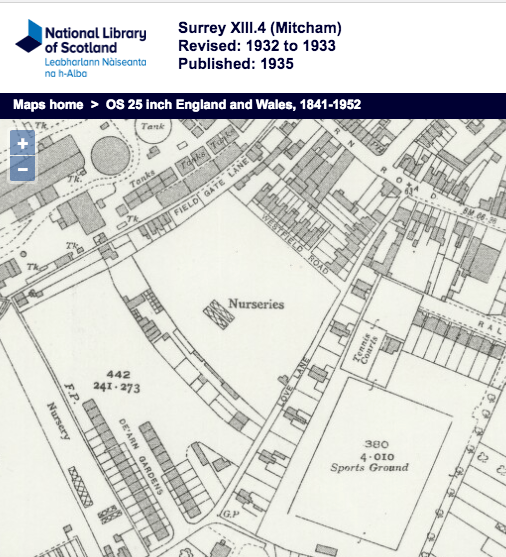
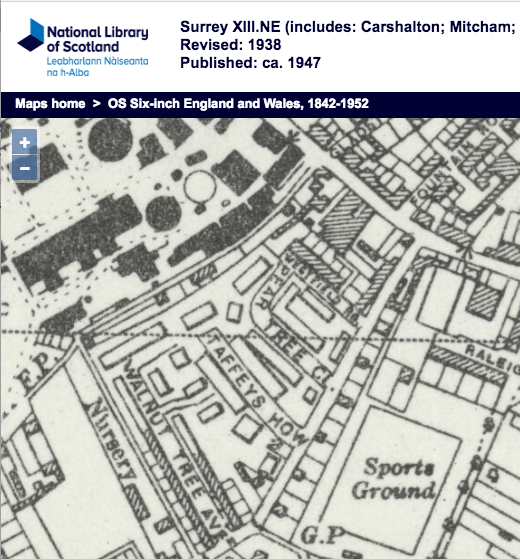
1954 OS map
These photos have been kindly provided by a woman via the Facebook Mitcham History Group, whose relatives are mentioned below.
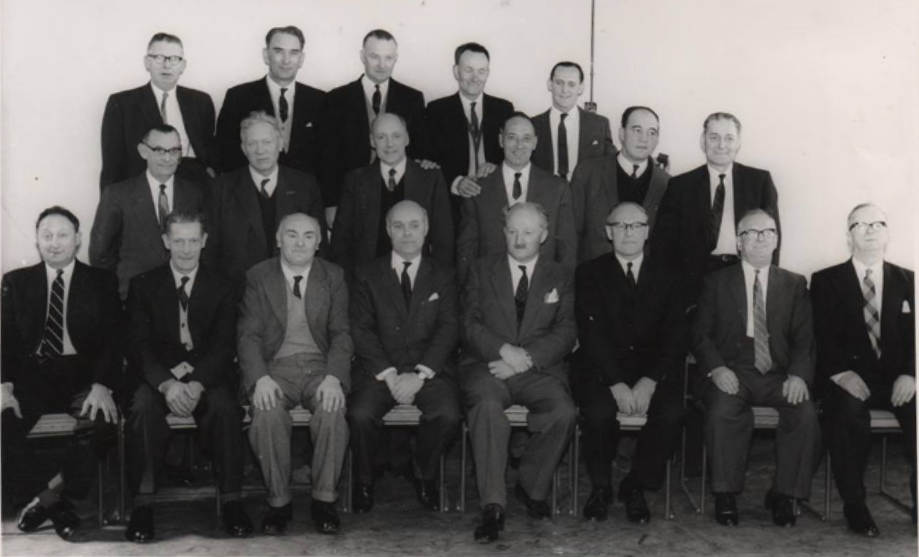
1969
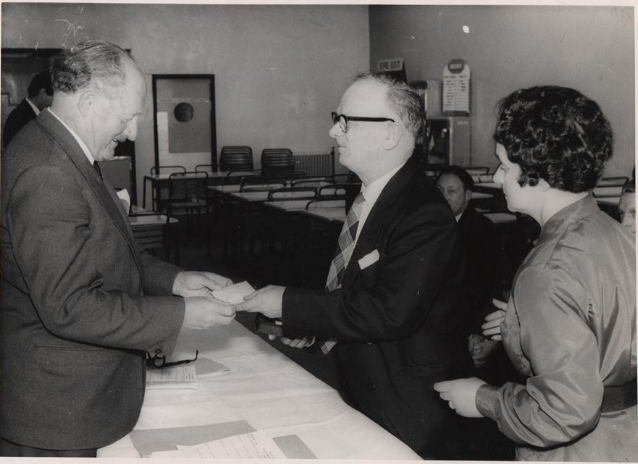
1969 Bill Stephens receives his long term service award

1969 George Stephens receives a watch for 55 years with the company
Bill Stephens (1900-1987) joined the company in 1914 at the age of 14, when the company started in Peckham, and he and his family moved to Mitcham when the factory was established there. He completed 55 years’ service in 1969.
His two brothers, George (1903-1970) and Charles (1902-1984), also worked for the company, and both lost their sight because of that work. One of the brothers worked with chromium plating and acid splashed into his face, damaging his eyes. He lived a 5 minute walk from the factory, and was able to continue working there.
A fellow on the Facebook Mitcham History Group said
I worked there around 1965, brazing fire guards……abysmal. There were two of us, one loaded while the other brazed them together, it was a bonus system so no let up for the 8 hrs you were there, couldn’t let your partner down. I remember spot welding machines that spat out white hot steel that sometimes went into your shoe – ouch !!!
Newspaper Articles
From the Mitcham News & Mercury, 17th November 1961:
Transformed
HYGIENIC WIRE WORKS LTD., Miles Road, Mitcham, have transformed their transport fleet by re-painting the vehicles to a design by Martin Rowlands, the well-known industrial designer.
The design embodies the company’s colours — light blue, white, and dove grey—and their symbol of three interlocking squares which signify the firm’s association with wire mesh and pressed steel.
Conforming with the modern trend of displaying a uniform “face of the firm,” the managing director, Mr. John Barnes, is applying the new design to firm’s notepaper, marketing operations and material.

Mitcham News and Mercury, 17th November, 1961
Adverts
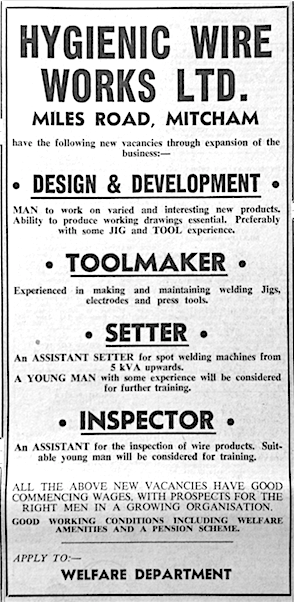
1962

1962
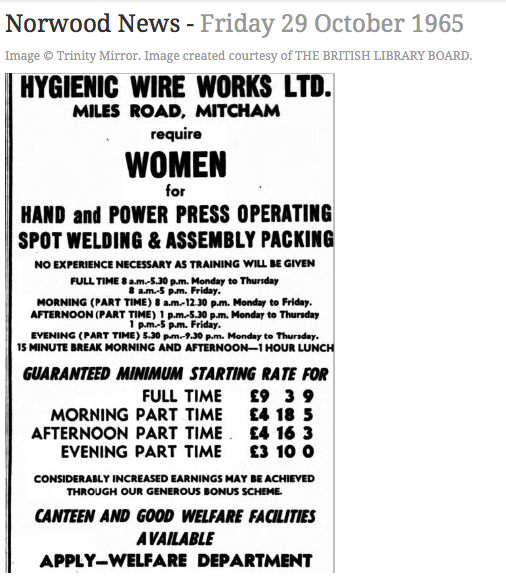
1965 ad from Norwood News
TOOLMAKERS
£1.60 per hour plus overtime.
We produce Presswork and Wirework, and require toolmakers to manufacture and maintain our presstools and welding fixtures. Apply to:Derek Bennett,
Genyk Products Ltd
Miles Road, Mitcham, Surrey
Telephone : 648 7071

11th Feb 1977
Maps are reproduced with the permission of the National Library of Scotland.
 Mitcham History Notes