The 1953 OS map shows “Anglo Saxon Burial Ground” in back garden of no. 67 Morden Road. Its location led to the road name of Runes Close, referring to the writing method of the Angles and Saxons.

1953 OS map reproduced by permission of the National Library of Scotland, reuse CC-BY
These houses were built in the 1930s, and the burial ground had been excavated over a period of 1888 to 1922. This earlier OS map from 1910 shows the openness of the land between Morden Road and the river Wandle. It was part of the estate of the owners of Mitcham Grove House, who during the period of excavation were George Parker BIDDER II, Q.C., and his son Harold BIDDER.

1910 OS map reproduced by permission of the National Library of Scotland, reuse CC-BY
Remains from Anglo Saxon burials, human bones and artefacts such as brooches, extended over a much larger area. This sketch shows the excavations by Harold Bidder and is from his report he co-authored with John Morris from 1959, The Anglo-Saxon Cemetery at Mitcham, which can be downloaded from the Surrey Archaeological Society website (pdf of 98 pages).
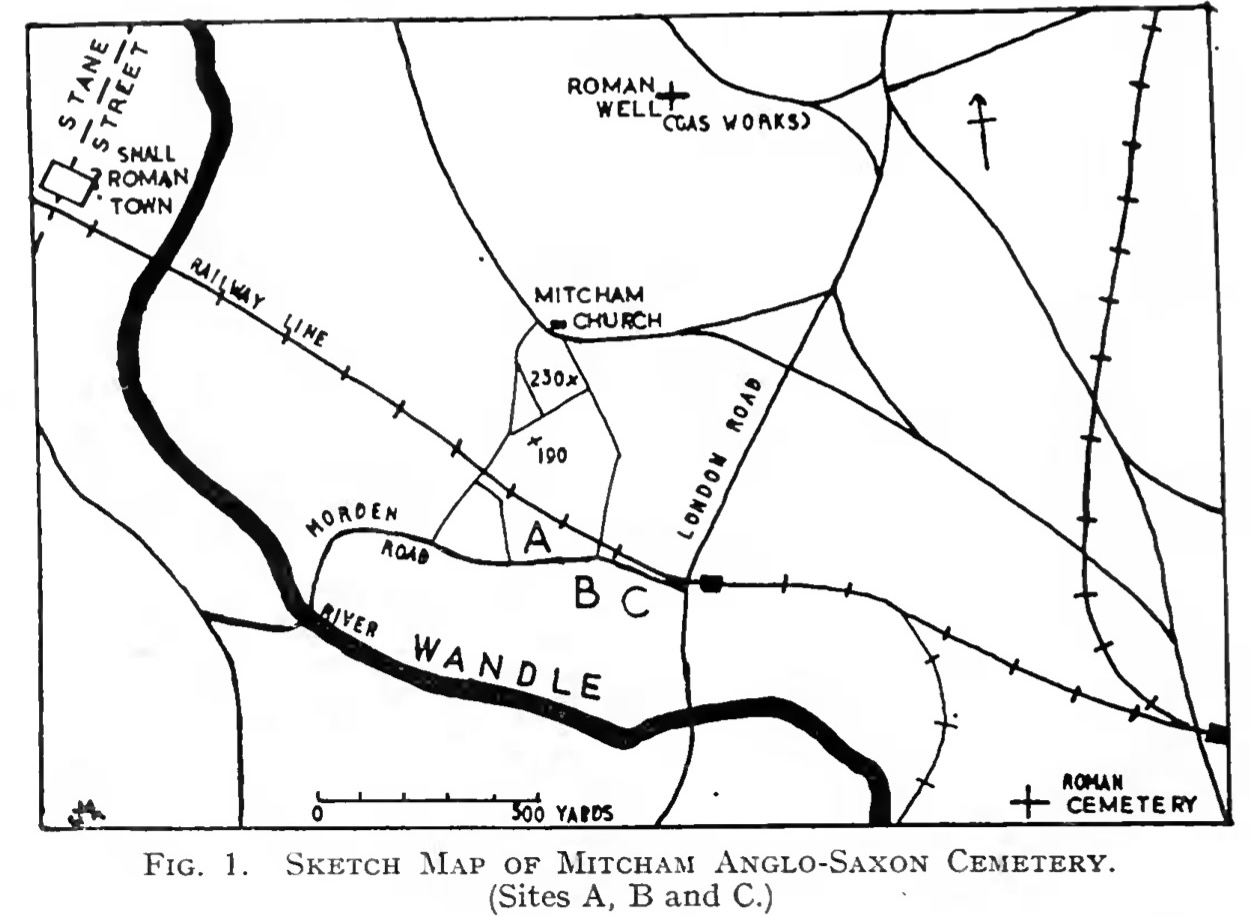
What led to these excavations included gravel digging. Gravel is common in the flood plain of the river Wandle and where that river used to run millions of years ago, such as over Mitcham Common. Gravel gained value during the Victorian building boom as it’s used in making concrete. Workmen who found bones while digging for gravel tended to keep it to themselves, and one of the fields became known as Dead Man’s Close.
In addition, the cultivation of liquorice, whose roots go down 4 or 5 feet deep, led to further discoveries over an even wider area. Ben Slater, recalling in 1911, said:
Liquorice, which is grown for its root, penetrates the earth to the depth of from 3 to 4 feet, and has to be trenched out of the ground. In the work of getting this crop out the men came across a large quantity of human bones – some of the skeletons were found in stone coffins – with them a long sword was found; a number of spears were also found, also silver and bronze coins; most of these the men kept – also some of the spears. There used to be a man come down each week and buy these of the men employed in the work – all the swords – and most of the spears were taken to Major Moore’s house at Figge’s Marsh, where he lived at Manor House by the Swan Hotel.
Here is a list of the artefacts found:
- 44 brooches
- 14 buckles
- 10 strings of beads
-  5 glass vessels
-  9 pottery vessels
- 39 knives
- 13 swords
- 15 shield-bosses
- 36 spears
Additionally, there were various miscellaneous objects made of bronze, iron, bone, and ivory. For drawings of some of the artefacts, see the Merton Historical Society webpage.
In 1914 Saxon relics were also found near Mitcham Station.
From the minutes of the Mitcham Parish Council
Volume 12 April 1914 to March 1915
Page 28
SAXON RELICS
The Clerk reported the receipt of the following letter from the General Manager of the London Brighton and South Coast Railway.
               LONDON, BRIGHTON & SOUTH COAST RAILWAY

                             General Manager's Office
                                     London Bridge Station, S.E.,
                                            26th May, 1914.
Dear Sir,
I enclose herewith two bronze tin-plated brooches, a bronze pin and iron knife supposed surrounded by a wooden sheath, which were recently discovered during excavations on this Company’s property near Mitcham Station, together with a photograph of same, and as the articles are no doubt of antiquarian interest, I am authorised by my Directors to forward them to you to be placed in the Vestry Hall at Mitcham, where I understand other similar relics found in the neighbourhood are on view.
I also enclose photographs of three skeletons which were unearthed at the same place recently.
I shall be obliged if you will kindly acknowledge receipt.
                         Yours faithfully,
                                 WILLIAM FORBES.
From the minutes of the Mitcham Parish Council
Volume 12 April 1914 to March 1915
Page 102
The following letter was read from the London, Brighton and South Coast Railway Co.
               LONDON, BRIGHTON & SOUTH COAST RAILWAY

                             General Manager's Office
                                     London Bridge Station, S.E.,
                                            23rd October, 1914.
Dear Sir,
With reference to my letter of the 26th May last, and your reply of the 27th idem, another ornament has been found in excavating gravel near Mitcham Station. Captain Bidder informs me that it is a gold-plated bronze brooch, a beautiful piece of work and important, as its design (purely geometrical without any trace of “animal” motive) points to a very early Saxon period, probably the sixth or seventh century.
I am authorised by my Directors to forward this brooch to you to be placed in the Vestry Hall at Mitcham with the other similar relics found in the neighbourhood.
I also have the pleasure of inclosing a photograph of the brooch.
     Kindly acknowledge receipt.
                         Yours faithfully,
                                 WILLIAM FORBES.
A find of 3 skeletons in 1920 was reported in the press:
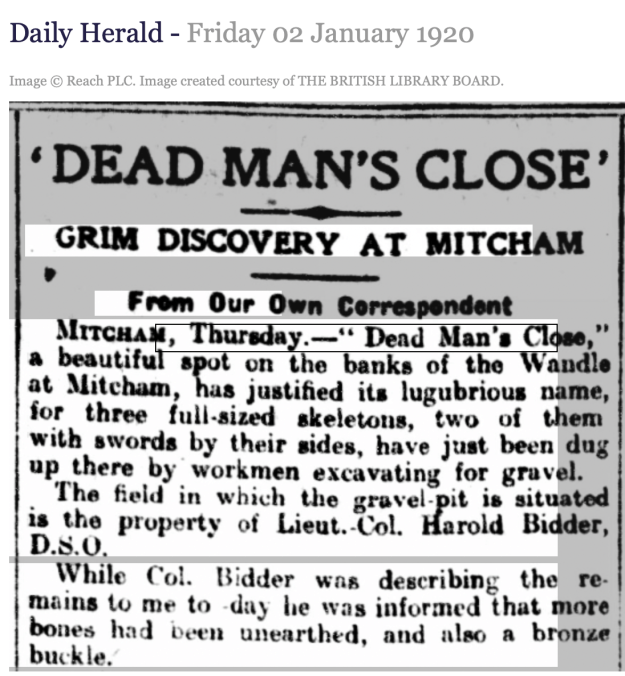
GRIM DISCOVERY AT MITCHAM
From Our Own Correspondent.
Mitcham, Thursday.
—”Dead Man’s Close,” a beautiful spot on the banks of the Wandle at Mitcham, has justified its lugubrious name, for three full-sized skeletons, two of them with swords by their sides, have just been dug up there by workmen excavating for gravel. The field in which the gravel-pit is situated is the property of Lieut.-Col. Harold Bidder, D.S.O.
While Col. Bidder was describing the remains to me to day he was informed that more bones had been unearthed, and also a bronze buckle. “As the work proceeds.” he said, “I expect and hope many more relics will come to light.” It appears that the present discoveries are not the first the kind made in Mitcham, or even in the same field. “They began in a very curious way,” explained the Colonel. “They were due, in fact, to a lucky accident.
A Chance Discovery
“About 35 years ago labourers employed by my father in this same part of the Ravensbury Manor estate came upon a of skeletons, but thinking that (in the words the bailiff) people did not like to hear such things, they said nothing about the matter, and it was only the chance discovery of a human bone by a member of the family two or three years later that led to investigation and scientific exploration. Since we began excavating in earnest we have dug up about 150 graves, not all containing remains. They are undoubtedly Anglo- Saxon of the fifth and early sixth centuries. Mitcham, it is known, was a Saxon settlement, and the carefully laid out remains, all properly orientated, though the majority are male, point to a cemetery rather than battlefield.”
In 1922 the south side of Morden Road was widened by 16 feet and some graves were encountered in digging post-holes for a new fence.
In the introduction to the book, The Place-Names of Surrey from the English Place-Name Society, published in 1934, the burial grounds of Mitcham and Croydon were described as the principal heathen burial-grounds of Surrey.
The Anglo-Saxon cemetery is recorded as Monument No. 400549 in Historic England’s Research Records.
 Mitcham History Notes