Road that is the start of the A237 and runs south from the junction with Commonside West, Cedars Avenue and Croydon Road, heading towards Carshalton.
On the west side there is a junction with Cranmer Road and Willow Lane, and on the right just after this is the entrance road to Mitcham Junction railway station and the Mitcham Golf Club. The road goes over the railway and tram lines on a bridge that was rebuilt and widened in the mid 1950s. On the west side of the road and part of the southern slope of the bridge is an access road leading to Aspen Gardens. Further south from here, and set back from the western side of the road is a line of houses that were originally called Rumbold Villas and Tramway Terrace. They are separated by two roads Drake Road and Arney’s Lane. At Beddington Corner is the Goat pub on the corner with Goat Road.
After Beddington Corner, the road is now called London Road and the A237 continues to the A23 at Coulsdon.
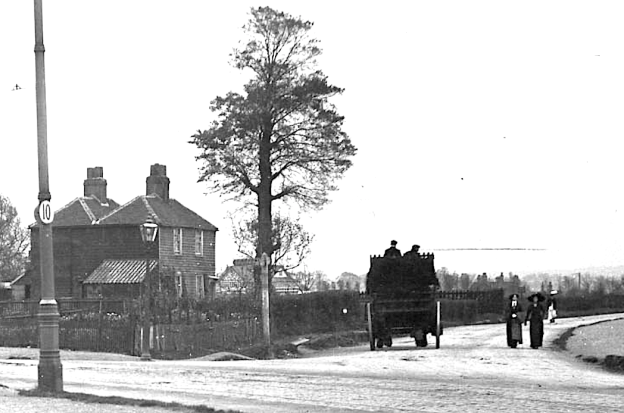
Carshalton Road at junction with Croydon Road. The house was one of the Blue Houses. From a Percy Mayhew postcard, from Merton Memories, photo reference Mit_19_1-19
The guide post (marked G.P.) that is on the south side of the tram line in this 1910 OS map is the one seen in the photo.
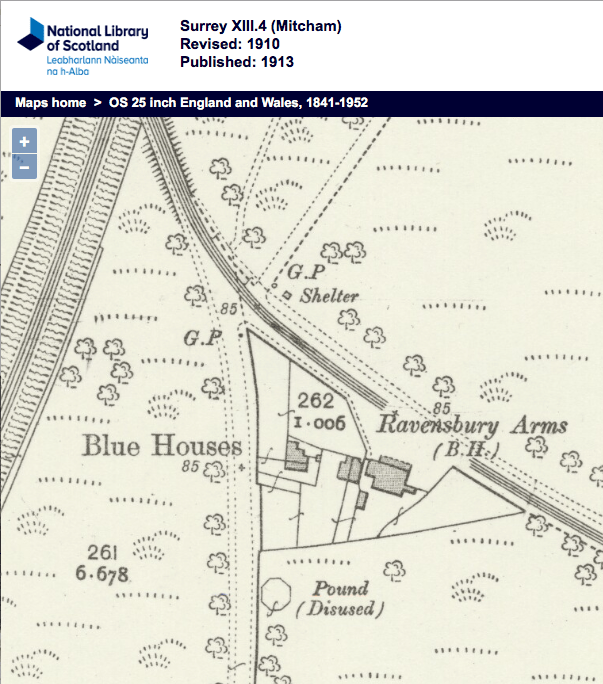
1910 OS map
The junction with Croydon Road was changed to a roundabout in 1955.
From the Mitcham News & Mercury, 24th February 1955
ROUNDABOUT
Work is to start soon on making a traffic roundabout at the busy junction of Croydon Road with Carshalton Road, on Mitcham Common.
The Transport Minister has approved a grant of up to £4,427 towards the cost of the roundabout. Coun. D.J. Hempstead, Highways Committee chairman, said last week that it was hoped that work would be speedily undertaken.
The bridge over the railway line was widened at the same time, the work having been started in 1939 but was interrupted by the war.
On the east side of Carshalton Road, south of the railway station, was a WW2 anti-aircraft gun site. It was cleared in the early 1960s.
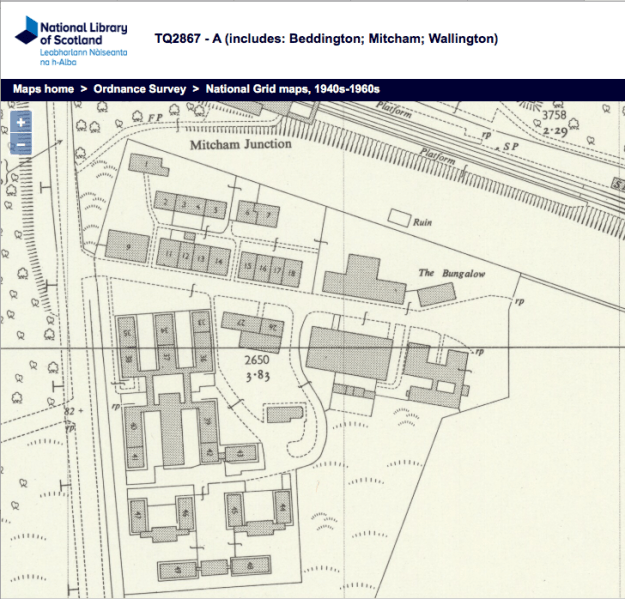
1955 OS map showing the Gun Site.
From the Mitcham News & Mercury, 13th July 1962:
At last – Gunsite is to go
One of Mitcham’s biggest eyesores, the Gun Site, Carshalton Road, Mitcham Common, is at last to be cleared at a cost of about £13,000.
Work on clearing the site is expected to start in about two months time.
The Ministry have approved a tender of £10,800 submitted to them from the Conservators and have further agreed to bear the cost of replacing trees on the site.
WELCOMED
A further cost of £2,000 fees will be included in the work.
This news is welcomed not only by the Conservators but by Mitcham Council and the public.
The Gun Site is one of the few remaining war relics in Mitcham and local people have been pressing for years to clear it.
The conservators hope to replace it with a grass landscape with trees.
WW2 Civilian Casualties
20th October 1940
16 Carshalton Road
Winifred Mabel LARBY, aged 35
Maps are reproduced with the permission of the National Library of Scotland.

