Makers of short silent films in the early 20th century. Their studios and workshops were at Ravensbury Lodge, in the grounds of Mitcham Grove, on the west side of the London Road near the bridge over the river Wandle. The sales office was in Film House, Gerard Street, in London’s West End.
At one point they were producing one film a week.
Location
Interviews
Adverts in trade press
Films available on youtube
Eric Montague, in his Mitcham Histories: 6 Mitcham Bridge, The Watermeads and the Wandle Mills, page 69, said that the firm of Cricks & Sharp had taken over parts of the outbuildings in the walled garden of Mitcham Grove in 1901.
According to the British Film Institute:
George Howard Cricks and John Howard Martin first met when they both worked for Robert Paul in the late nineteenth century. Martin was in charge of the darkroom, and Cricks of the sale of films and equipment through Paul’s Animatographe Depot in High Holborn.
Cricks left to form his own company, and Cricks and Martin was founded in 1908, when Martin replaced Cricks’ first partner, Henry Martin Sharp, at their studios in Mitcham in Surrey.
Location
Cricks & Martin was listed in the 1910-1911 street directory:
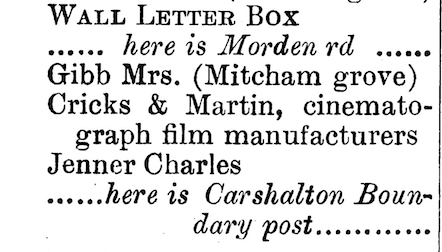
entry in the 1910-11 street directory
The building marked Lodge on this 1910 OS map was Ravensbury Lodge, where the entrance to Rawnsley Avenue is today. The Carshalton Boundary post referred to in the directory entry is shown as B.P. on the map on the south side of the bridge over the Wandle.
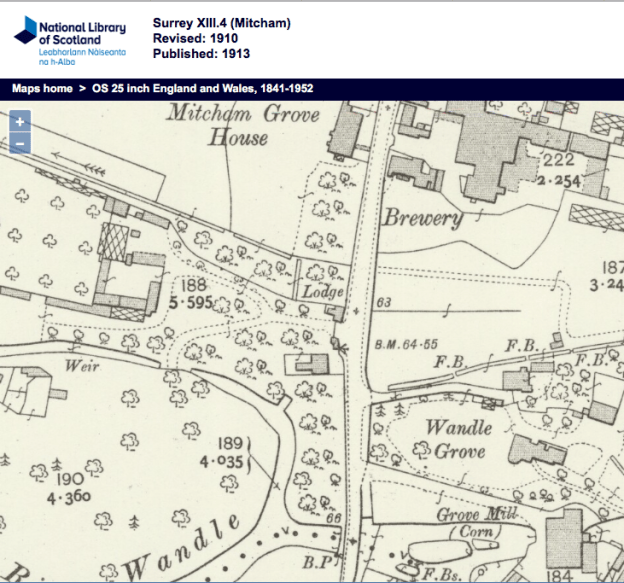
1910 OS map
Interviews
Mr Martin on joining in 1908
Mr Cricks in 1909
Mr Martin
From the Kinematograph Weekly – Thursday 20 February 1908
A Talk with Mr. J. Howard Martin.
MESSRS CRICKS & MARTIN AND THEIR PLANS.
As briefly announced in our last issue, the partnership between Mr. G. H. Cricks and Mr. H. M. Sharp has been dissolved. Mr. J. Howard Martin, who has had many years experience with Mr. R. W. Paul, takes the place of Mr. Sharp in the firm, which is now known as “Cricks and Martin.” In a conversation which we had with Mr. Martin, at the pleasantly-situated headquarters of the firm at Mitcham, he informed us that the change in the business would shortly be followed by a more energetic policy, one of the effects of which would be to still further increase the high photographic quality of the products of the firm. A step in this direction has already been taken by increasing the darkroom accommodation, and future plans include the erection of a studio in which the light will be under control, in addition to the out door stage on which the films are at present produced. Mr. Martin informed us that the present issue of one film subject per week would in the near future be considerably increased.
The bulk of the staging will in future fall upon Mr. Martin, assisted by a fully qualified staff, and during a walk through the grounds of “Ravensbury Lodge” he furnished us with particulars of his previous experience in this direction, which were sufficient assurance that a high level may be expected in future subjects. lt may be said in passing that Mr. Martin is exceptionally fortunate in the surroundings in which these fi!ms will be produced. Messrs. Cricks and Martin have 25 acres of ground at their disposal at Ravensbury Lodge,which was previously the country seat of Sir John Lubbock (Lord Avebury). Every kind of scenery lies ready at their hand. An old stable yard (which has already furnished a setting for several films) alone presents many possibilities to the expert, and within the radius of the grounds, there are garden scenes, meadow land and, last but by no means least, useful river scenery, the last furnished by the river Wandle. Many actors have plunged into the latter for film purposes already, and within easy reach of the office there are innumerable pretty spots suitable for photographic purposes. If horses or cows are required to impart an air of rusticity, they may be found already grazing in the grounds.
“I have been connected with photography practically all my life,” said Mr. Martin in reply to a question, “and my father before me followed the same occupation, which he has only recently relinquished. I started kinematograph work with Mr. R. W. Paul, in 1897, and continued with him until I joined Mr. Cricks only a few weeks ago.
“As you,know, Mr. Paul for some time furnished the pictures at the Alhambra, and the necessity for putting on pictures of current events led to my quickly making acquaintance with topical and rush work. I particularly remember the time of the Diamond Jubilee, which we filmed and put on at the Alhambra on the evening of the following day. At that day that was a big achievement, though it is frequently beaten now, and in order to fill orders it was necessary for the staff to work the rest of the day on which the picture was taken and right through the following night without rest. At Coronation time similar rush work was experienced, and I was at the works for 24 hours on end. We were putting out copies at the rate of 2,000 feet an hour.
“As the trade developed, plot subjects more particularly were in demand and, as you probably know, we were one of the first to put out trick films in England, that branch of the work having previously been entirely in the hands of the French makers. During the years I was in Mr. Paul’s studio, I had a hand in most of the trick subjects which were issued. It is my experience that a good trick film is certain to be a success, and as soon as the new studio is in working order we shall be turning out some here.”
“Will you issue ‘travel’ films in any number ? ”
“Certainly. As you know, the firm has already made something of a reputation for pictures of this class, and for subjects on the lines of ‘Carl Hagenbeck’s Zoo,’ ‘Cliff Climbing at Flamborough Head,’ and ‘Life on an English Reformatory Ship,’ and we shall certainly issue subjects of a higher level than the ordinary ‘comic’ wherever possible.”
” Do you not find yourself out of touch with buyers, making your headquarters out of London ?”
“Not at all; we may occasionally miss a casual caller, but most film buyers are reached through the post and telephone, and we can get at them just as easily as from London, while at the same time we can give personal attention to the manufacturing side. You might also point out to showmen that we are not so far off after all. We are just outside Mitcham station, which is reached in half-an-hour from Waterloo, and we shall be pleased to advise intending callers as to the train service.”
Mr Cricks
An interview with Mr Cricks, from the Kinematograph Weekly – Thursday 28 October 1909
A Leading English Producer and His History.
Mr. G. H. Cricks is one of the select band who joined the film business in its very earliest days in this country, and yet have been able to keep pace with the more stringent demands of latter day conditions. Several years as manager of a large photographic dealer’s business gave him an insight into matters photographic which proved of the utmost value when he joined the old Blair Company and obtained his first introduction to the trade of which he is now so prominent a member. The Blair Company was at that time in a position somewhat akin to that now occupied by Eastman, that is to say, they had a practical monopoly of the supply of film base. When Mr. Cricks speaks of these early days one is at once struck by the names of people at that time prominent in the film field, who have since entirely dropped out. In addition to Paul, Warwick, and Hepworth, still in the business, there were Chard, of Great Portland Street, and quite a number making their headquarters at Brighton, these including Esme Collings (now dead) and Mr. G. A. Smith, in addition to Mr. Williamson, the only one in the town now remaining in the business. Mr. Cricks supplied all of these with their raw material. At that time the price of raw film was 2d. per foot and finished prints were sold first at a shilling and later at eightpence. No wonder there is an element of regret in the manner in which some of these gentlemen allude to the good old times!
From the Blair Company, Mr. Cricks went all through the practical part of the business, from taking the negative, developing and printing, to selling the finished picture. Coming to the conclusion that “a rolling stone gathers no moss,’ he set himself to make a permanent niche in the business, a start being made in a small office in Great Queen Street, with a stage of equally modest proportions at the back of the Swan Brewery, Fulham. Things were very primitive in those days, and Mr. Cricks and his partner, Mr. H. M. Sharp, did practically all the work between them?the first being in charge of the operating and staging, the latter doing the office work, and the two sharing the dark room labours between them. Even in those early days the Lion’s Head films were noted for their acting, and subjects such as “Wife’s Revenge,” ” Nobbling the Derby Favourite,” “Drink and Repentance,” and other of their early issues are in no way behind modern productions in this particular, their dramatic films at the time being probably the finest acted on the market. During our conversation Mr. Cricks gave away the secret; it was due to the fact that they were able to draw upon the services of a company performing at one of the leading London theatres, and so procured talent far superior to the average used for films in those days.
Harking back a bit, we had some interesting illustrations of the difficulties of camera work in the early days. Mr. Cricks then worked with one of the old Gaumont cameras without light-tight boxes and lens calibrations, and recalled an instance where he had the filming of an event of great public interest with this instrument. On this occasion, by the way, he exposed 165 feet of film and produced a finished picture of 150 feet – a very small percentage of wastage.
“This is the way you had to go to work, said Mr. Cricks. First plank your camera down in the best position obtainable and focus up. Fix lens in position, then pencil-mark the position of the camera on the stand. Take the camera oil and put the film in it, in the dark sack which you always carried with you. Then carefully replace camera in the position marked, take your picture, and go home trusting in I rovidence as t o th e res ult. No one was more surprised than myself on this occasion when I obtained a film which Mr. Maskelyne thought the best result secured in London that day.”‘
Of recent developments in the business the most important has been the entry of Mr. J.H. Martin as partner, which occurred in February, 1908, and more recently the opening of an office for the sale of goods at the Film House, Gerrard Street, under Mr. Cricks’ management. The great increase in the firm’s business Mr. Cricks ascribed in a great measure to Mr. Martin’s ability as producer in turning out such a large percentage of winners, and we did not quarrel with his statement that at least half of the recent issues come under that head. But like all successful firms they are eager for further triumphs, and Mr. Cricks hinted at some big developments at the producing end which would enable them to keep pace with the demand for subjects, one of the few difficulties have to contend with since Lion’s Head subjects leaped into popularity, being due to the limited capacity of the factory. As regards this winter’s subjects, one interesting feature of tbe output will be a special series of travel subjects, which operators have been securing all the summer in various parts of the Continent, while an effort will be made to still further increase the technical merit of the film by a more liberal use of tinting and toning, for which a special plant has been recently laid down at the Mitcham factory. As an English maker, Mr. Cricks is naturally proud of the fact that his was the first English firm to regularly use this method of improving the effectiveness of their films. It may be added here that Mr. Cricks claimed a like credit for the English trade in the matter of titles as a part of the film itself, which his firm were the first In England to use on all their pictures, although other firms had at times put a title on some of their pictures.
A chance remark of ours led Mr. Cricks to air one of his few grievances.
“I am the first to admit,” he said, “the beautiful quality of so many of the foreign films, but some of the subjects! – really, they are quite foreign to British taste, and I am surprised that some of them are ever screened. You know the sort of thing I mean. There is always someone running off with someone else’s wife, and even more suggestive themes are handled.I do not think these subjects can do the business any good, and am particularly careful that nothing that can offend even an hyper-sensitive person should get into our films.
“While I am grumbling, may I point out another matter in which I think many manufacturers treat their customers rather hardly? I refer to the practice of hanging up all the good subjects until the ‘season’ – so called – so that the renter is swamped with film at one part of the year and almost denuded at another. During the last summer, we have consistently put out films, both in number and quality up to those which were released in the winter — this you know for yourself from such subjects as ‘Salome,’ ‘Boxing Fever,’ ‘Butcher Boy,’ and others.”
“Do you think any early alterations likely in the constitution of the business ? A revival of the Convention, for instance ? ”
I hope to Heaven not,” said Mr. Cricks, emphatically. “| think the scheme originated by the K.M.A. was worthy of more support than it received, particularly as regards limiting the life of the film, which would be to the advantage of every section of the business, but my experience at Paris convinced me that any effort to work with some of the Continental makers was a case of mixing oil and water. My method of business is to find out my requirements and fill them myself as far as possible.”
“Have you any alterations to suggest in present methods ?”
“As a manufacturer, I can regard a show somewhat as a member of the public, and after visiting a good many I have been particularly struck by the remissness of English exhibitors as compared with those of the Continent in the matter of effects. Anything which adds to the realism of the show should be cultivated. I think the day will come — and the sooner the better — when every film will be accompanied by a specially composed or adapted piece of music. This idea, by the way. was used lo conjunction with a film of ‘East Lynne, produced by me for Harrisons, of Berners Street in the early days; we recommending that slow music be used at one scene, and When Other Lips’ sung in another.”
“But before anything else is done,” concluded Mr Cricks, “it should be seen that a projector is only put into the hands pf a man capable of working it properly. A ‘handle turner’ is no good – you want a man who is capable of increasing or lessening the speed of projection as required by the picture, and so on. When you have got a good operator you have gone a fair way towards the perfect show.”
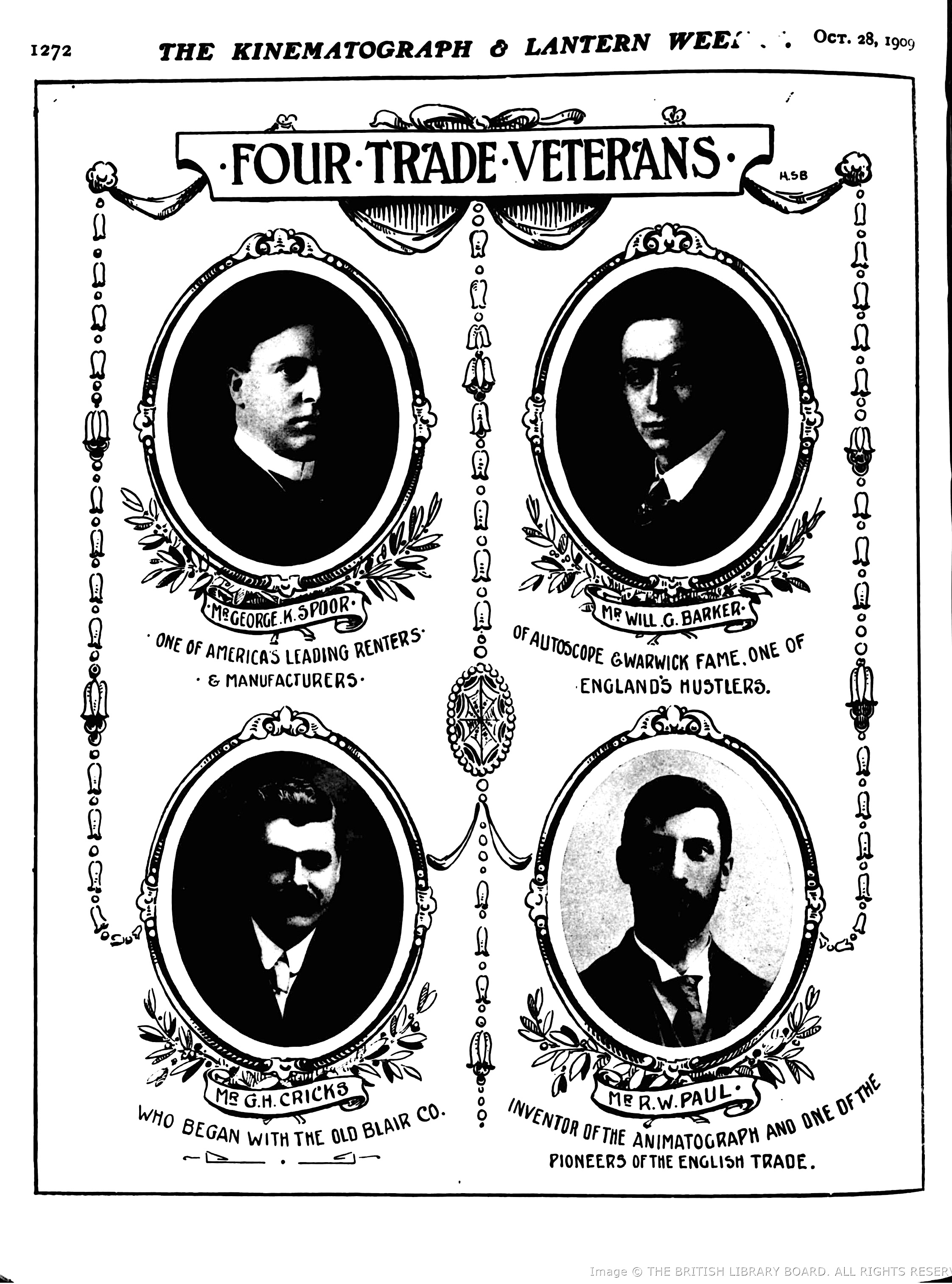
Photo of Mr Cricks, from the Kinematograph Weekly – Thursday 28 October 1909
Mr Martin left the firm in 1913, as reported in the Kinematograph Weekly – Thursday 09 January 1913
The year 1913 will see some curious changes in our industry. Already I hear rumours of pending amalgamations, re-arrangements and new floatations.
Perhaps one of the most interesting changes which has already taken place is the retirement of Mr. J. H. Martin from Messrs. Cricks and Martin, Ltd., one of the oldest English producing firms.
Mr. G. H. Cricks is well-known and respected in the Trade and he, perhaps, can claim to have been in the business from the start. It hardly seems five years ago since the firm changed its title from Cricks and Sharpe to Cricks and Martin. Mr. Cricks now takes entire charge of the business which will still retain the name of Cricks and Martin, Ltd., and in a chat with him last week I learned that he is retaining the old staff and is making very important additions to it by an infusion of new blood which should tell advantageously in their future productions. I also learned that we shall soon receive some sensational subjects from Mitcham. I know all the Trade will wish Mr. Cricks every success in the new arrangement.
Mr. H. J. Martin, who, at his own desire, severs his connection with the firm, leaves Mr. Cricks on the most friendly terms and will start another English producing company very shortly. By the by, Mr. Martin was with Mr. Paul sixteen years ago at the very start of the Trade in this country and produced films for him for eleven years and well remembers the time when 1s. 6d. per foot was the price of the finished film. He entered into partnership with Mr. Cricks five years ago and took charge of the production side of the business; he has a very optimistic view of the future of the English film and I wish him every in his new venture.
They marketed their films under the Lion’s Head brand, and between 1908 and 1911 they made over 150 films. See imdb.com for a full list, with descriptions of each film.
Adverts
These trade adverts appeared in the Kinematograph Weekly, British Newspaper Archive, and are copyright the British Library Board.
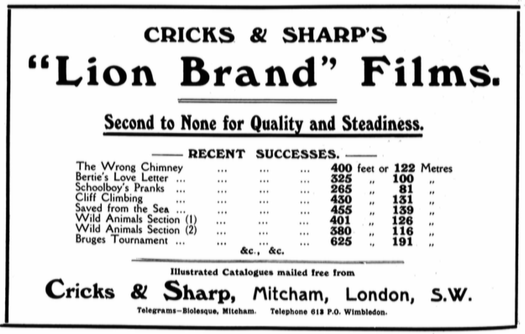
Kinematograph Weekly – Thursday 19 September 1907
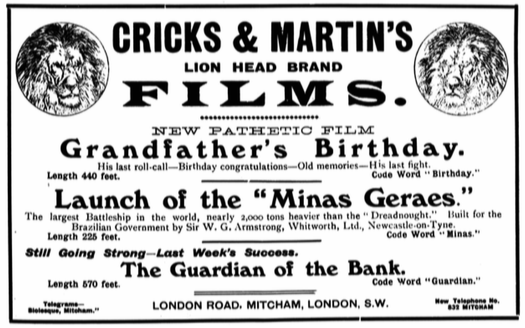
Kinematograph Weekly – Thursday 17 September 1908
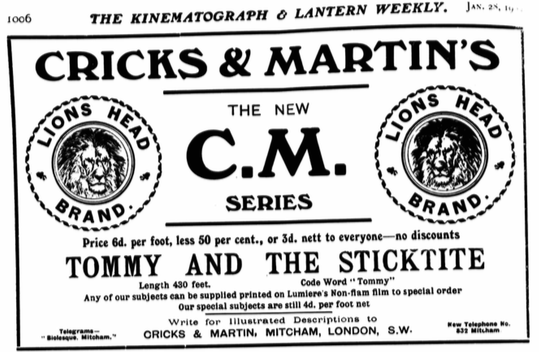
Kinematograph Weekly – Thursday 28 January 1909
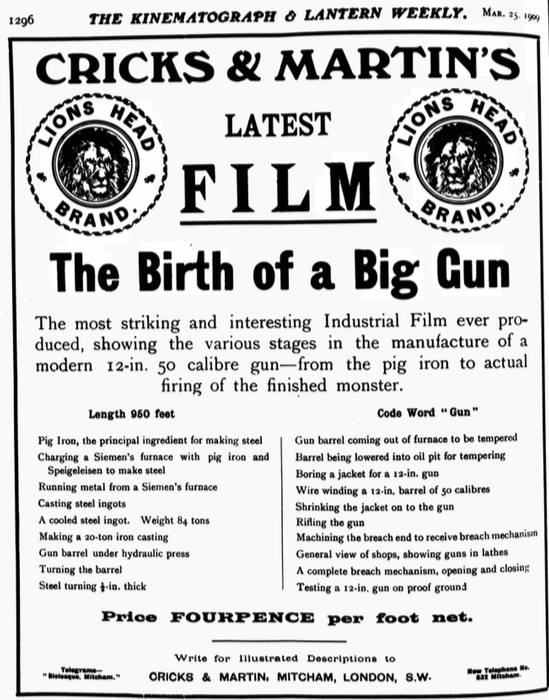
Kinematograph Weekly – Thursday 25 March 1909
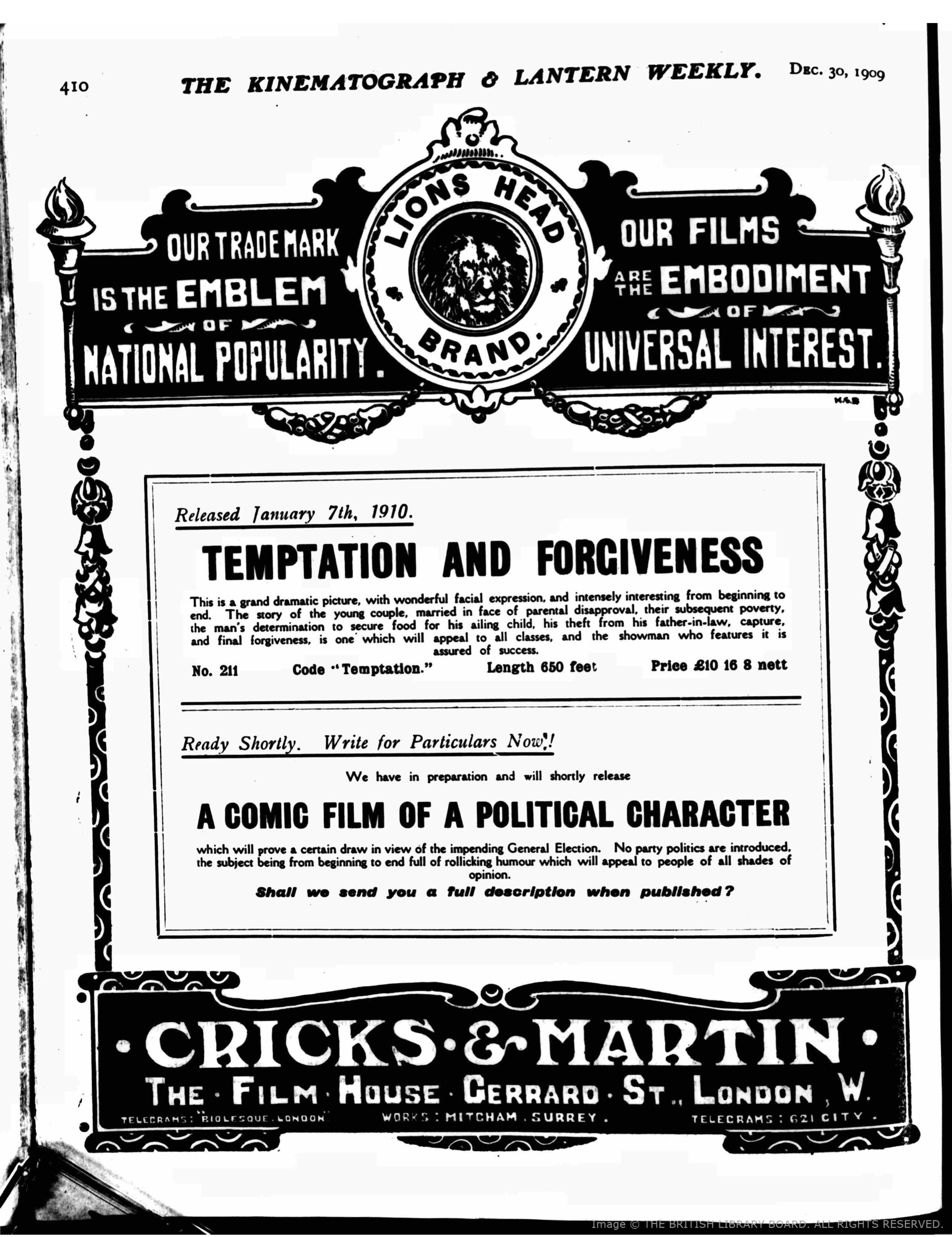
Kinematograph Weekly – Thursday 30 December 1909
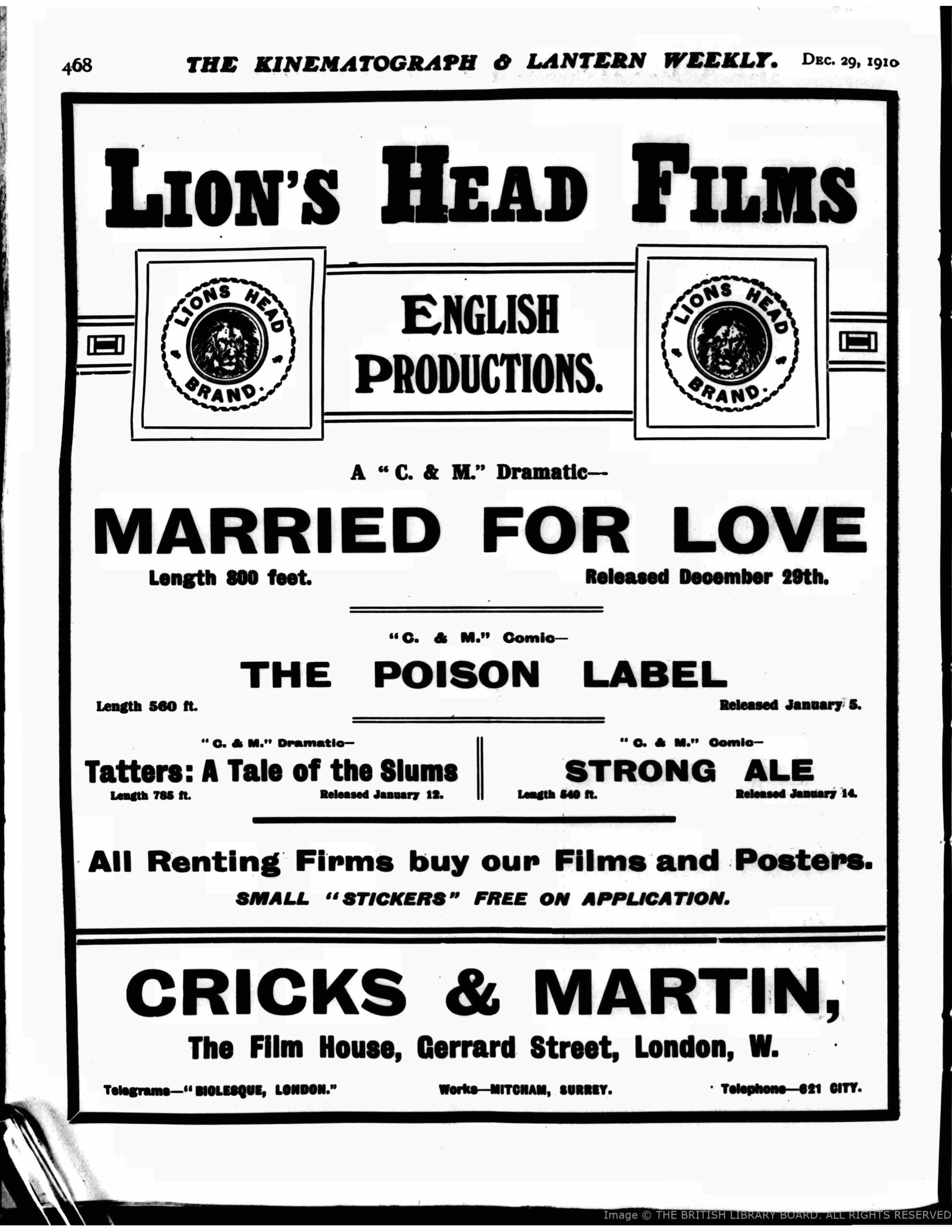
Kinematograph Weekly – Thursday 29 December 1910
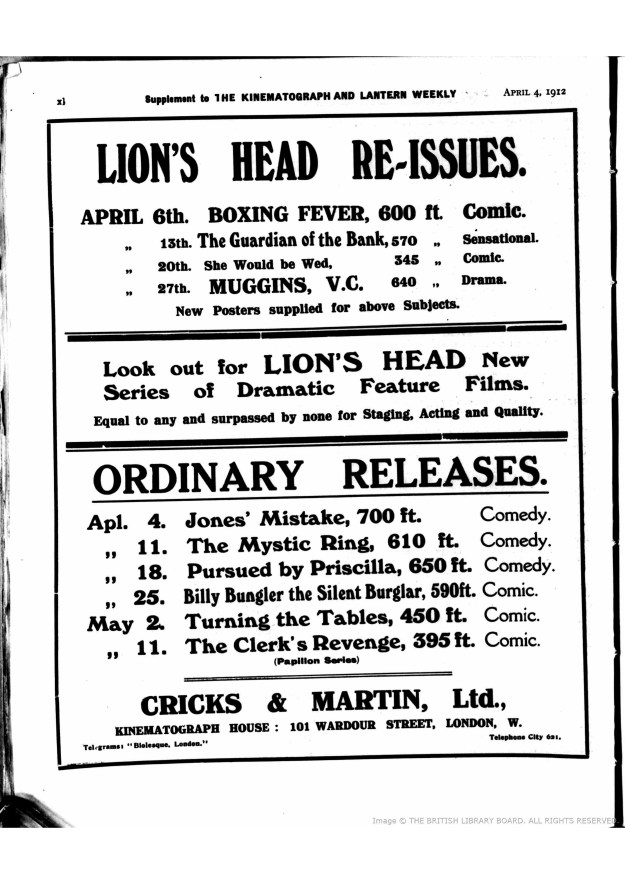
Kinematograph Weekly – Thursday 04 April 1912
Image © THE BRITISH LIBRARY BOARD. ALL RIGHTS RESERVED.
Films on youtube
Boxing Fever
A 9 minute 23 second film from 1909. The film is available on the British Pathe News website which has the description:
Full title reads: “Boxing Fever. London”. This is a Lion’s Head Brand film.
Fairground boxing booth where visitors try to knock out the champion and win five pounds, the first contestant is knocked out but the very eager (and possibly drunk) third man knocks out the champion and overcome with “boxing fever” rushes out punching at everybody and everything he meets. He is chased through the streets by an irate crowd and eventually goes into a pub where …
Intertitle reads: “Three Hours Later”.
he gets (even more) drunk and goes home where his wife knocks him about until he pleads for mercy.
From their youtube channel you can watch the whole film below.
The boxer takes to the Fair Green in Mitcham at 4 minutes in to the film:
Maps are reproduced with the permission of the National Library of Scotland.
 Mitcham History Notes